


High Salt Intake Augments Blood Pressure Responses During Submaximal Aerobic Exercise
- PMID: 32406312
- PMCID: PMC7660875
- DOI: 10.1161/JAHA.120.015633
High Salt Intake Augments Blood Pressure Responses During Submaximal Aerobic Exercise
Abstract
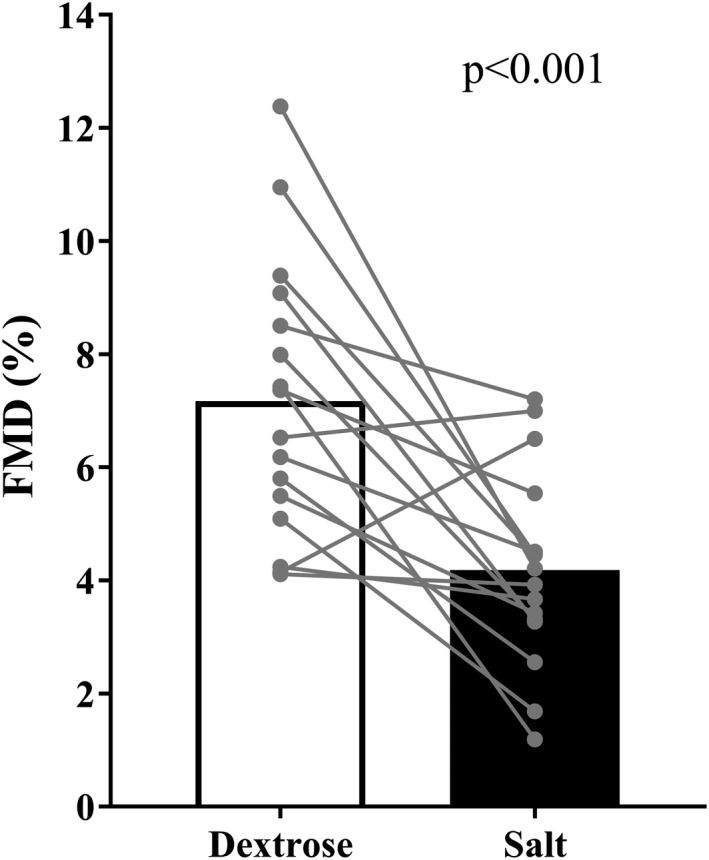
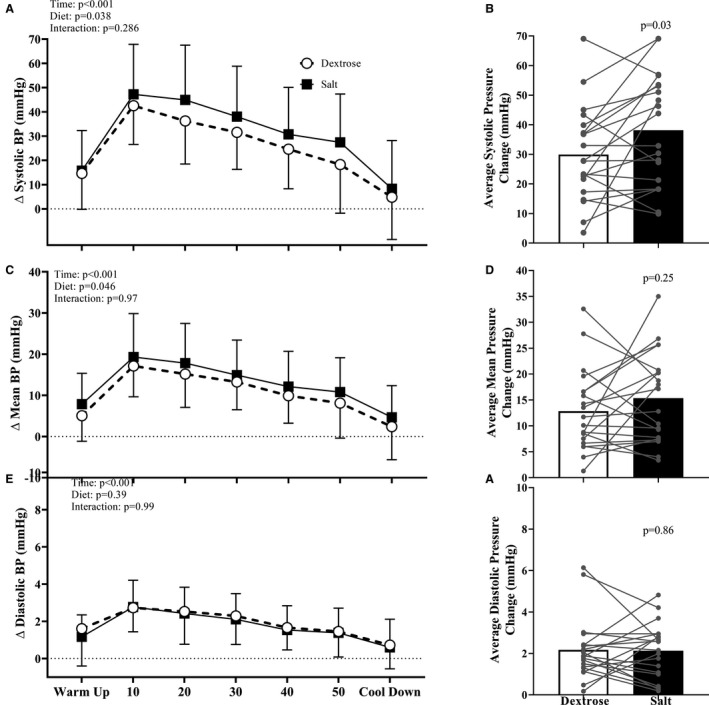
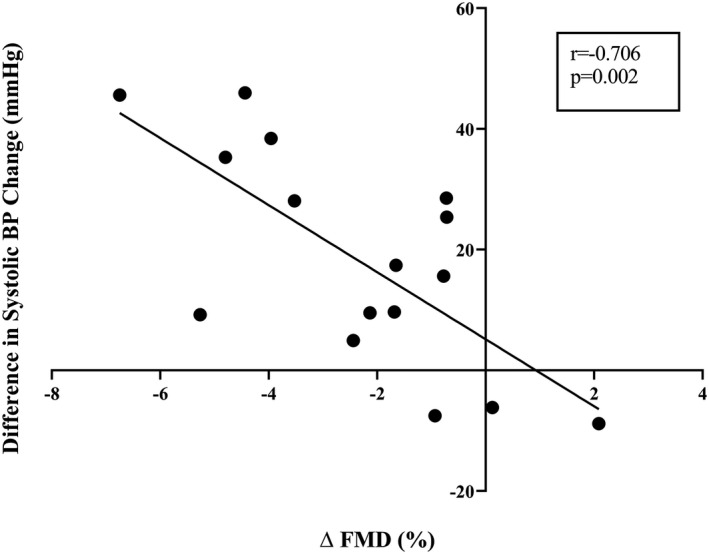
Background High sodium (Na+) intake is a widespread cardiovascular disease risk factor. High Na+ intake impairs endothelial function and exaggerates sympathetic reflexes, which may augment exercising blood pressure (BP) responses. Therefore, this study examined the influence of high dietary Na+ on BP responses during submaximal aerobic exercise. Methods and Results Twenty adults (8F/12M, age=24±4 years; body mass index 23.0±0.6 kg·m-2; VO2peak=39.7±9.8 mL·min-1·kg-1; systolic BP=111±10 mm Hg; diastolic BP=64±8 mm Hg) participated in this randomized, double-blind, placebo-controlled crossover study. Total Na+ intake was manipulated via ingestion of capsules containing either a placebo (dextrose) or table salt (3900 mg Na+/day) for 10 days each, separated by ≥2 weeks. On day 10 of each intervention, endothelial function was assessed via flow-mediated dilation followed by BP measurement at rest and during 50 minutes of cycling at 60% VO2peak. Throughout exercise, BP was assessed continuously via finger photoplethysmography and every 5 minutes via auscultation. Venous blood samples were collected at rest and during the final 10 minutes of exercise for assessment of norepinephrine. High Na+ intake increased urinary Na+ excretion (placebo=140±68 versus Na+=282±70 mmol·24H-1; P<0.001) and reduced flow-mediated dilation (placebo=7.2±2.4 versus Na+=4.2±1.7%; P<0.001). Average exercising systolic BP was augmented following high Na+ (placebo=Δ30.0±16.3 versus Na+=Δ38.3±16.2 mm Hg; P=0.03) and correlated to the reduction in flow-mediated dilation (R=-0.71, P=0.002). Resting norepinephrine concentration was not different between conditions (P=0.82). Norepinephrine increased during exercise (P=0.002), but there was no Na+ effect (P=0.26). Conclusions High dietary Na+ augments BP responses during submaximal aerobic exercise, which may be mediated, in part, by impaired endothelial function.
Keywords: acute exercise; blood pressure; dietary sodium; exercise pressor reflex; flow‐mediated dilation.
Figures
References
-
- Jackson SL, King SM, Zhao L, Cogswell ME. Prevalence of excess sodium intake in the United States—NHANES, 2009–2012. MMWR Morb Mortal Wkly Rep. 2016;64:1393–1397. - PubMed
-
- U S Department of Health and Human Services . Dietary guidelines for Americans 2015–2020. 2015.
-
- Frohlich ED, Chien Y, Sesoko S, Pegram BL. Relationship between dietary sodium intake, hemodynamics, and cardiac mass in SHR and WKY rats. Am J Physiol. 1993;264:R30–R34. - PubMed
-
- Matavelli LC, Zhou X, Varagic J, Susic D, Frohlich ED. Salt loading produces severe renal hemodynamic dysfunction independent of arterial pressure in spontaneously hypertensive rats. Am J Physiol Heart Circ Physiol. 2007;292:H814–H819. - PubMed
Publication types
MeSH terms
Substances
Grants and funding
LinkOut - more resources
Full Text Sources
Medical
Miscellaneous
