


COVID-19 and Laparoscopic Surgery: Scoping Review of Current Literature and Local Expertise
- PMID: 32406853
- PMCID: PMC7313384
- DOI: 10.2196/18928
COVID-19 and Laparoscopic Surgery: Scoping Review of Current Literature and Local Expertise
Abstract
Background: The current coronavirus disease (COVID-19) pandemic is holding the world in its grip. Epidemiologists have shown that the mortality risks are higher when the health care system is subjected to pressure from COVID-19. It is therefore of great importance to maintain the health of health care providers and prevent contamination. An important group who will be required to treat patients with COVID-19 are health care providers during semiacute surgery. There are concerns that laparoscopic surgery increases the risk of contamination more than open surgery; therefore, balancing the safety of health care providers with the benefit of laparoscopic surgery for the patient is vital.
Objective: We aimed to provide an overview of potential contamination routes and possible risks for health care providers; we also aimed to propose research questions based on current literature and expert opinions about performing laparoscopic surgery on patients with COVID-19.
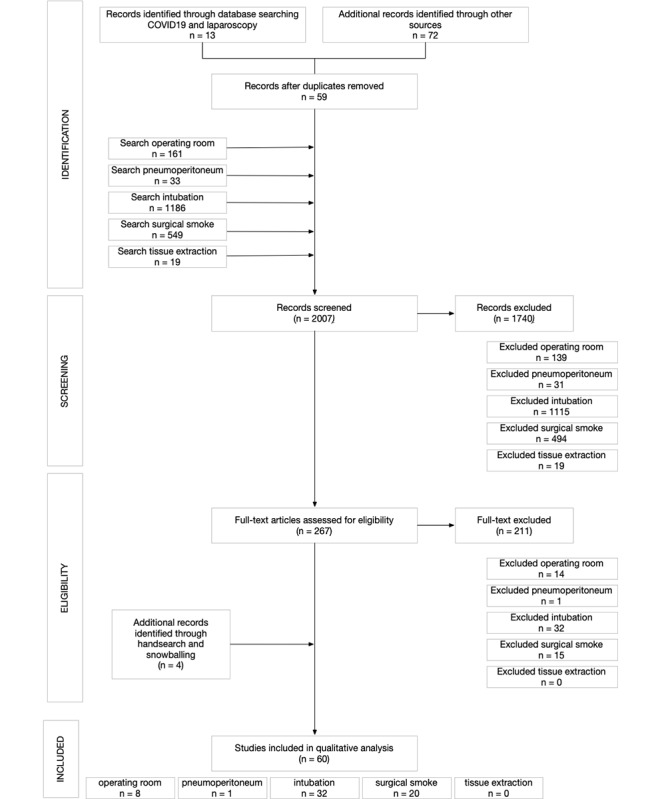
Methods: We performed a scoping review, adding five additional questions concerning possible contaminating routes. A systematic search was performed on the PubMed, CINAHL, and Embase databases, adding results from gray literature as well. The search not only included COVID-19 but was extended to virus contamination in general. We excluded society and professional association statements about COVID-19 if they did not add new insights to the available literature.
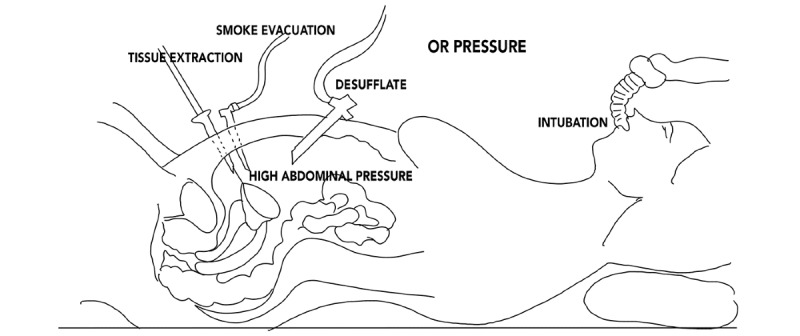
Results: The initial search provided 2007 records, after which 267 full-text papers were considered. Finally, we used 84 papers, of which 14 discussed severe acute respiratory syndrome coronavirus 2 (SARS-CoV-2). Eight papers discussed the added value of performing intubation in a low-pressure operating room, mainly based on the SARS outbreak experience in 2003. Thirteen papers elaborated on the risks of intubation for health care providers and SARS-CoV-2, and 19 papers discussed this situation with other viruses. They conclude that there is significant evidence that intubation and extubation is a high-risk aerosol-producing procedure. No papers were found on the risk of SARS-CoV-2 and surgical smoke, although 25 papers did provide conflicting evidence on the infection risk of human papillomavirus, hepatitis B, polio, and rabies. No papers were found discussing tissue extraction or the deflation risk of the pneumoperitoneum after laparoscopic surgery.
Conclusions: There seems to be consensus in the literature that intubation and extubation are high-risk procedures for health care providers and that maximum protective equipment is needed. On the other hand, minimal evidence is available of the actual risk of contamination of health care providers during laparoscopy itself, nor of operating room pressure, surgical smoke, tissue extraction, or CO2 deflation. However, new studies are being published daily from current experiences, and society statements are continuously updated. There seems to be no reason to abandon laparoscopic surgery in favor of open surgery. However, the risks should not be underestimated, surgery should be performed on patients with COVID-19 only when necessary, and health care providers should use logic and common sense to protect themselves and others by performing surgery in a safe and protected environment.
Keywords: COVID-19; corona 2019; health care provider; infectious disease; laparoscopy; outbreak; pandemic; physician; surgery; surgical procedures, operative.
©Robert Adrianus de Leeuw, Nicole Birgit Burger, Marcello Ceccaroni, Jian Zhang, Jurriaan Tuynman, Mohamed Mabrouk, Pere Barri Soldevila, Hendrik Jaap Bonjer, Pim Ankum, Judith Huirne. Originally published in JMIR Public Health and Surveillance (http://publichealth.jmir.org), 23.06.2020.
Conflict of interest statement
Conflicts of Interest: None declared.
Figures
References
-
- National Institutes of Health. 2020. May 14, [2020-05-15]. Coronavirus (COVID-19) https://www.nih.gov/health-information/coronavirus.
-
- World Health Organization. [2020-05-15]. WHO Coronavirus Disease (COVID-19) Dashboard https://covid19.who.int.
-
- Médecins Sans Frontières. 2020. Mar 16, [2020-05-15]. Help and solidarity needed in Europe to protect medical staff from COVID-19 https://www.msf.org/covid-19-urgent-help-needed-across-european-borders-....
Publication types
MeSH terms
LinkOut - more resources
Full Text Sources
Miscellaneous
