


Gratitude at Work: Prospective Cohort Study of a Web-Based, Single-Exposure Well-Being Intervention for Health Care Workers
- PMID: 32406864
- PMCID: PMC7256751
- DOI: 10.2196/15562
Gratitude at Work: Prospective Cohort Study of a Web-Based, Single-Exposure Well-Being Intervention for Health Care Workers
Abstract
Background: Emotional exhaustion (EE) in health care workers is common and consequentially linked to lower quality of care. Effective interventions to address EE are urgently needed.
Objective: This randomized single-exposure trial examined the efficacy of a gratitude letter-writing intervention for improving health care workers' well-being.
Methods: A total of 1575 health care workers were randomly assigned to one of two gratitude letter-writing prompts (self- vs other focused) to assess differential efficacy. Assessments of EE, subjective happiness, work-life balance, and tool engagement were collected at baseline and 1-week post intervention. Participants received their EE score at baseline and quartile benchmarking scores. Paired-samples t tests, independent t tests, and correlations explored the efficacy of the intervention. Linguistic Inquiry and Word Count software assessed the linguistic content of the gratitude letters and associations with well-being.
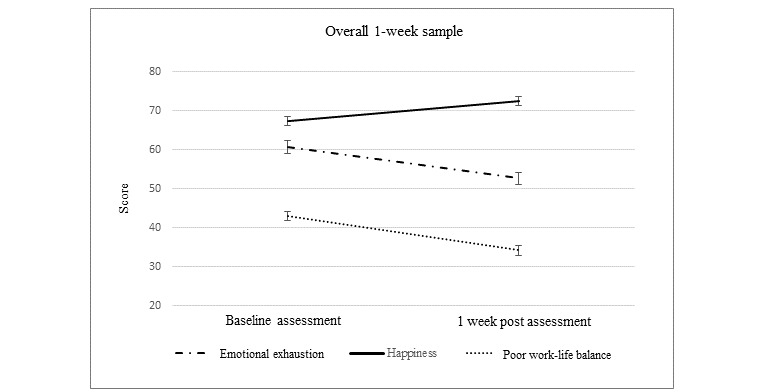
Results: Participants in both conditions showed significant improvements in EE, happiness, and work-life balance between the intervention and 1-week follow-up (P<.001). The self-focused (vs other) instruction conditions did not differentially predict improvement in any of the measures (P=.91). Tool engagement was high, and participants reporting higher motivation to improve their EE had higher EE at baseline (P<.001) and were more likely to improve EE a week later (P=.03). Linguistic analyses revealed that participants high on EE at baseline used more negative emotion words in their letters (P=.005). Reduction in EE at the 1-week follow-up was predicted at the level of a trend by using fewer first-person (P=.06) and positive emotion words (P=.09). No baseline differences were found between those who completed the follow-up assessment and those who did not (Ps>.05).
Conclusions: This single-exposure gratitude letter-writing intervention appears to be a promising low-cost, brief, and meaningful tool to improve the well-being of health care workers.
Keywords: burnout; emotions; health care; mental health; positive psychology.
©Kathryn C Adair, Larissa G Rodriguez-Homs, Sabran Masoud, Paul J Mosca, J Bryan Sexton. Originally published in the Journal of Medical Internet Research (http://www.jmir.org), 14.05.2020.
Conflict of interest statement
Conflicts of Interest: None declared.
Figures
References
-
- Aiken LH, Sermeus W, van den Heede K, Sloane DM, Busse R, McKee M, Bruyneel L, Rafferty AM, Griffiths P, Moreno-Casbas MT, Tishelman C, Scott A, Brzostek T, Kinnunen J, Schwendimann R, Heinen M, Zikos D, Sjetne IS, Smith HL, Kutney-Lee A. Patient safety, satisfaction, and quality of hospital care: cross sectional surveys of nurses and patients in 12 countries in Europe and the United States. Br Med J. 2012 Mar 20;344:e1717. doi: 10.1136/bmj.e1717. http://europepmc.org/abstract/MED/22434089 - DOI - PMC - PubMed
-
- McCray LW, Cronholm PF, Bogner HR, Gallo JJ, Neill RA. Resident physician burnout: is there hope? Fam Med. 2008 Oct;40(9):626–32. http://www.stfm.org/fmhub/fm2008/October/Laura626.pdf - PMC - PubMed
-
- Wheeler DL, Vassar M, Worley JA, Barnes LL. A reliability generalization meta-analysis of coefficient alpha for the Maslach Burnout Inventory. Educ Psychol Meas. 2011;71(1):231–44. doi: 10.1177/0013164410391579. - DOI
Publication types
MeSH terms
Grants and funding
LinkOut - more resources
Full Text Sources
