


Regional variation of hysterectomy for benign uterine diseases in Switzerland
- PMID: 32407404
- PMCID: PMC7224542
- DOI: 10.1371/journal.pone.0233082
Regional variation of hysterectomy for benign uterine diseases in Switzerland
Abstract
Background: Hysterectomy is the last treatment option for benign uterine diseases, and vaginal hysterectomy is preferred over more invasive techniques. We assessed the regional variation in hysterectomy rates for benign uterine diseases across Switzerland and explored potential determinants of variation.
Methods: We conducted a population-based analysis using patient discharge data from all Swiss hospitals between 2013 and 2016. Hospital service areas (HSAs) for hysterectomies were derived by analyzing patient flows. We calculated age-standardized mean procedure rates and measures of regional variation (extremal quotient [EQ], highest divided by lowest rate) and systematic component of variation [SCV]). We estimated the reduction in the variance of crude hysterectomy rates across HSAs in multilevel regression models, with incremental adjustment for procedure year, age, cultural/socioeconomic factors, burden of disease, and density of gynecologists.
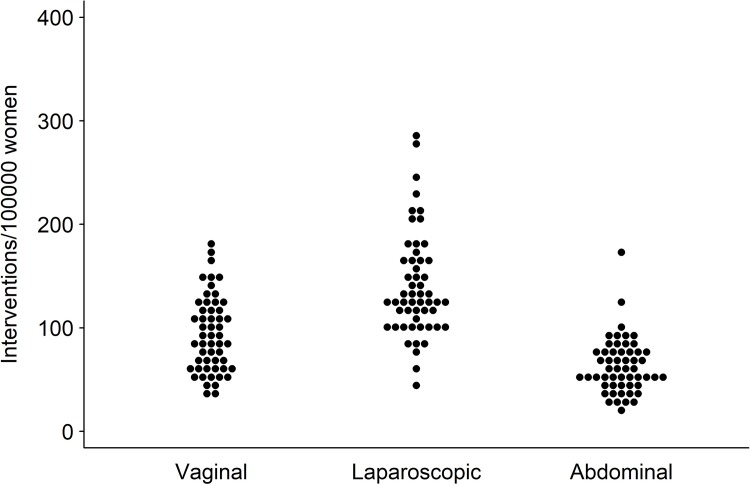
Results: Overall, 40,211 hysterectomies from 54 HSAs were analyzed. The mean age-standardized hysterectomy rate was 298/100,000 women (range 186-456). While the variation in overall procedure rate was moderate (EQ 2.5, SCV 3.7), we found a very high procedure-specific variation (EQ vaginal 5.0, laparoscopic 6.3, abdominal 8.0; SCV vaginal 17.5, laparoscopic 11.2, abdominal 16.9). Adjusted for procedure year, demographic, cultural, and sociodemographic factors, a large share (64%) of the variance remained unexplained (vaginal 63%, laparoscopic 85%, abdominal 70%). The main determinants of variation were socioeconomic/cultural factors. Burden of disease and the density of gynecologists was not associated with procedure rates.
Conclusions: Switzerland has a very high regional variation in vaginal, laparoscopic, and abdominal hysterectomy for benign uterine disease. After adjustment for potential determinants of variation including demographic factors, socioeconomic and cultural factors, burden of disease, and the density of gynecologists, two thirds of the variation remain unexplained.
Conflict of interest statement
The authors declare no additional funding or competing interests such as consultancies, stock ownership or other payments other than the reported funding sources. Dr. Haynes is affiliated with CTU Bern, University of Bern, which has a staff policy of not accepting honoraria or consultancy fees. However, CTU Bern is involved in design, conduct, or analysis of clinical studies funded by not-for-profit and for-profit organizations. In particular, pharmaceutical and medical device companies provide direct funding to some of these studies. For an up-to-date list of CTU Bern’s conflicts of interest see http://www.ctu.unibe.ch/research/declaration_of_interest/index_eng.html. This does not alter our adherence to PLOS ONE policies on sharing data and materials.
Figures
References
-
- Organisation for Economic Co-operation and Development (OECD). Health Care Utilisation—Surgical procedures [Internet]. 2018 [cited 16/12/2018]. Available from: https://stats.oecd.org/.
-
- Thurston J, Murji A, Scattolon S, Wolfman W, Kives S, Sanders A, et al. No. 377-Hysterectomy for Benign Gynaecologic Indications. Journal of obstetrics and gynaecology Canada: JOGC = Journal d'obstetrique et gynecologie du Canada: JOGC. 2019;41(4):543–57. Epub 2019/03/19. 10.1016/j.jogc.2018.12.006 . - DOI - PubMed
-
- Neis KJ, Zubke W, Romer T, Schwerdtfeger K, Schollmeyer T, Rimbach S, et al. Indications and Route of Hysterectomy for Benign Diseases. Guideline of the DGGG, OEGGG and SGGG (S3 Level, AWMF Registry No. 015/070, April 2015). Geburtshilfe Frauenheilkunde. 2016;76(4):350–64. Epub 2016/09/27. 10.1055/s-0042-104288 - DOI - PMC - PubMed
-
- Deffieux X, Rochambeau B, Chene G, Gauthier T, Huet S, Lamblin G, et al. Hysterectomy for benign disease: clinical practice guidelines from the French College of Obstetrics and Gynecology. European journal of obstetrics, gynecology, and reproductive biology. 2016;202(3):83–91. Epub 2016/05/20. 10.1016/j.ejogrb.2016.04.006 . - DOI - PubMed
