. 2021 Feb 1;113(2):171-181.
doi: 10.1093/jnci/djaa063.

Quality of Life With Pembrolizumab for Recurrent and/or Metastatic Head and Neck Squamous Cell Carcinoma: KEYNOTE-040

Affiliations

Quality of Life With Pembrolizumab for Recurrent and/or Metastatic Head and Neck Squamous Cell Carcinoma: KEYNOTE-040

Kevin J Harrington et al. J Natl Cancer Inst. .

Abstract

Background: Head and neck squamous cell carcinoma (HNSCC) affects health-related quality of life (HRQoL); few treatments have demonstrated clinically meaningful HRQoL benefit. KEYNOTE-040 evaluated pembrolizumab vs standard of care (SOC) in patients with recurrent and/or metastatic HNSCC whose disease recurred or progressed after platinum-containing regimen.

Methods: Patients received pembrolizumab 200 mg or SOC (methotrexate, docetaxel, or cetuximab). Exploratory HRQoL analyses used European Organisation for Research and Treatment of Cancer (EORTC) 30 quality-of-life, EORTC 35-question quality-of-life head and neck cancer-specific module, and EuroQoL 5-dimensions questionnaires.

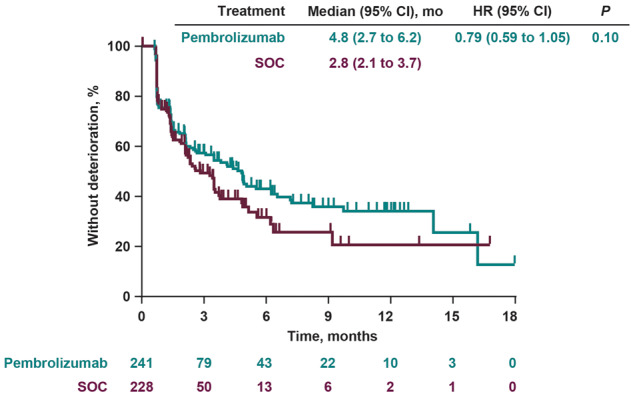
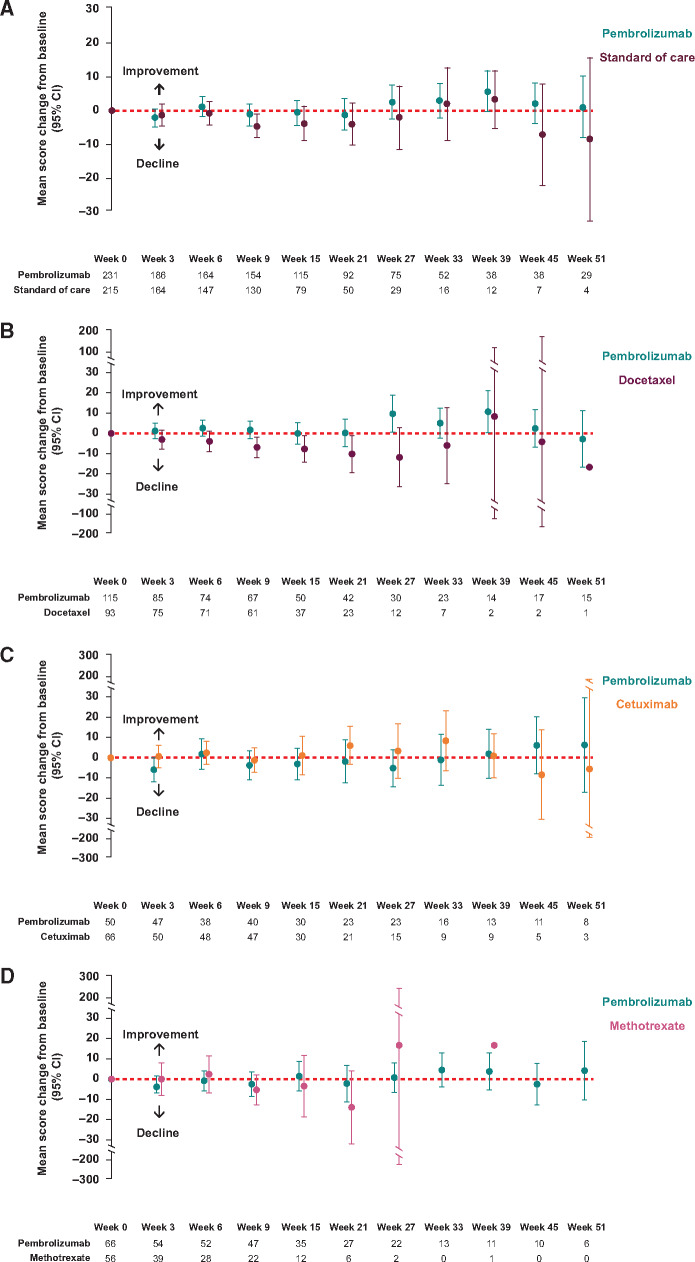
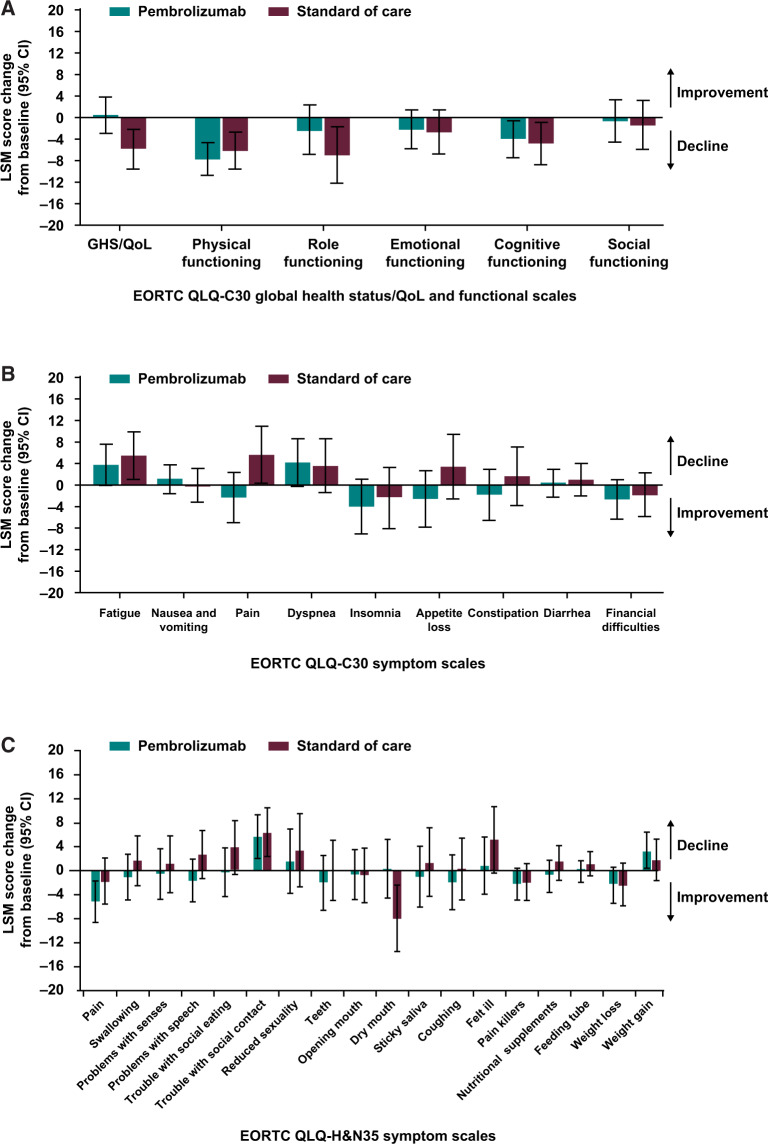
Results: The HRQoL population comprised 469 patients (pembrolizumab = 241, SOC = 228). HRQoL compliance for patients in the study at week 15 was 75.3% (116 of 154) for pembrolizumab and 74.6% (85 of 114) for SOC. The median time to deterioration in global health status (GHS) and QoL scores were 4.8 months with pembrolizumab and 2.8 months with SOC (hazard ratio = 0.79, 95% confidence interval [CI] = 0.59 to 1.05). At week 15, GHS / QoL scores were stable for pembrolizumab (least squares mean [LSM] = 0.39, 95% CI = -3.00 to 3.78) but worsened for SOC (LSM = -5.86, 95% CI = -9.68 to -2.04); the LSM between-group difference was 6.25 points (95% CI = 1.32 to 11.18; nominal 2-sided P = .01). A greater difference in the LSM for GHS / QoL score occurred with pembrolizumab vs docetaxel (10.23, 95% CI = 3.15 to 17.30) compared with pembrolizumab vs methotrexate (6.21, 95% CI = -4.57 to 16.99) or pembrolizumab vs cetuximab (-1.44, 95% CI = -11.43 to 8.56). Pembrolizumab-treated patients had stable functioning and symptoms at week 15, with no notable differences from SOC.

Conclusions: GHS / QoL scores were stable with pembrolizumab but declined with SOC in patients at week 15, supporting the clinically meaningful benefit of pembrolizumab in recurrent and/or metastatic HNSCC.


Figures

Figure 1.
Figure 1.
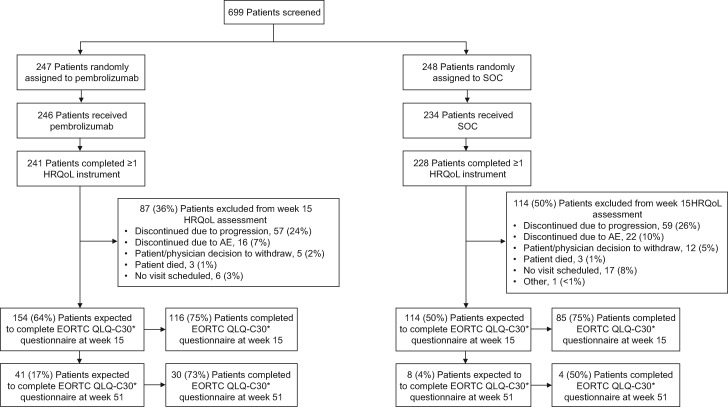
CONSORT diagram. *European Organisation for Research and Treatment of Cancer 35-question quality of life head and neck cancer-specific module and EuroQoL 5-dimensions compliance rates were nearly identical to those observed for European Organisation for Research and Treatment of Cancer scale 30 quality-of-life questionnaire (EORTC QLQ-C30). AE = adverse event; HRQoL = health-related quality of life; SOC = standard of care.
Figure 2.
Figure 2.
Time to deterioration in the European Organisation for Research and Treatment of Cancer scale 30 quality-of-life questionnaire global health status and quality of life scores. The nominal 2-sided P value was calculated using a log-rank test. CI = confidence interval; HR = hazard ratio; SOC = standard of care.
Figure 3.
Figure 3.
Change from baseline in the European Organisation for Research and Treatment of Cancer scale 30 quality-of-life questionnaire global health status and quality of life scores over time by investigator’s choice of standard of care (SOC) in patients who were in the study at each time point. A) Pembrolizumab vs SOC. Week 51: pembrolizumab, 95% confidence interval (CI) = –7.85 to 10.14; SOC, 95% CI = –32.54 to 15.88. B) Pembrolizumab vs docetaxel. Week 39: pembrolizumab 95% CI = –6.86 to 11.76; docetaxel 95% CI = –97.55 to 114.22. Week 45: pembrolizumab 95% CI = –0.30 to 21.12; docetaxel 95% CI = –162.99 to 154.66. C) Pembrolizumab vs cetuximab. Week 45: pembrolizumab 95% CI = –7.90 to 20.02; cetuximab 95% CI = –30.28 to 13.62. Week 51: pembrolizumab 95% CI = –16.93 to 29.43; cetuximab 95% CI = –48.65 to 37.54. D) Pembrolizumab vs methotrexate. Week 21: pembrolizumab 95% CI = –11.19 to 6.87; methotrexate 95% CI = –31.95 to 4.18. Week 27: pembrolizumab 95% CI = –6.54 to 8.05; methotrexate 95% CI = –195.10 to 228.44. One patient receiving methotrexate did not complete a questionnaire at week 33 but did so at week 39. For B, C, and D, analyses were conducted in the subgroup of patients for whom investigators chose SOC of methotrexate, docetaxel, or cetuximab before patients were randomly assigned to receive pembrolizumab or SOC. The division of pembrolizumab-treated patients in panels B, C, and D was based on the corresponding SOC treatment chosen by the investigator before randomization.
Figure 4.
Figure 4.
Difference in least squares mean (LSM) from baseline in European Organisation for Research and Treatment of Cancer core 30 quality-of-life questionnaire (EORTC QLQ-C30) and European Organisation for Research and Treatment of Cancer 35-question quality of life head and neck cancer-specific module (EORTC QLQ-H&N35) global health status (GHS) and quality of life (QoL) functional and symptom scales for patients who remained in the study at week 15. A) EORTC QLQ-C30 GHS and QoL and functional scales. A positive GHS and QoL or functioning score indicates improvement in health-related quality of life or function, whereas a negative score indicates decline. B) EORTC QLQ-C30 symptom scales. A positive symptom score indicates decline or more severe symptoms, whereas a negative score indicates symptom improvement. C) EORTC QLQ-H&N35 multi-item and single-item symptom scales. A positive symptom score indicates decline or more severe symptoms, whereas a negative score indicates symptom improvement. CI = confidence interval.

References

    1. Velikova G, Coens C, Efficace F, et al. Health-related quality of life in EORTC clinical trials - 30 years of progress from methodological developments to making a real impact on oncology practice. EJC Supplements. 2012;10(1):141–149.
    1. Rhoten BA, Murphy B, Ridner SH.. Body image in patients with head and neck cancer: a review of the literature. Oral Oncol. 2013;49(8):753–760. - PubMed
    1. Melo Filho MR, Rocha BA, Pires MB, et al. Quality of life of patients with head and neck cancer. Braz J Otorhinolaryngol. 2013;79(1):82–88. - PMC - PubMed
    1. National Comprehensive Cancer Network I. NCCN Clinical Practice Guidelines in Oncology - Head and Neck Cancers, v1.2020. National Comprehensive Cancer Network. https://www.nccn.org/professionals/physician_gls/pdf/head-and-neck.pdf. Accessed on May 18, 2020. - PubMed
    1. Vermorken JB, Herbst RS, Leon X, Amellal N, Baselga J.. Overview of the efficacy of cetuximab in recurrent and/or metastatic squamous cell carcinoma of the head and neck in patients who previously failed platinum-based therapies. Cancer. 2008;112(12):2710–2719. - PubMed

Publication types

MeSH terms