


Association between ambient temperature and COVID-19 infection in 122 cities from China
- PMID: 32408450
- PMCID: PMC7142675
- DOI: 10.1016/j.scitotenv.2020.138201
Association between ambient temperature and COVID-19 infection in 122 cities from China
Abstract
Background: Coronavirus disease 2019 (COVID-19) has become a severe public health problem globally. Both epidemiological and laboratory studies have shown that ambient temperature could affect the transmission and survival of coronaviruses. This study aimed to determine whether the temperature is an essential factor in the infection caused by this novel coronavirus.
Methods: Daily confirmed cases and meteorological factors in 122 cities were collected between January 23, 2020, to February 29, 2020. A generalized additive model (GAM) was applied to explore the nonlinear relationship between mean temperature and COVID-19 confirmed cases. We also used a piecewise linear regression to determine the relationship in detail.
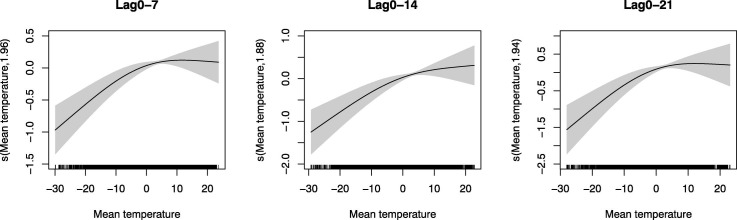
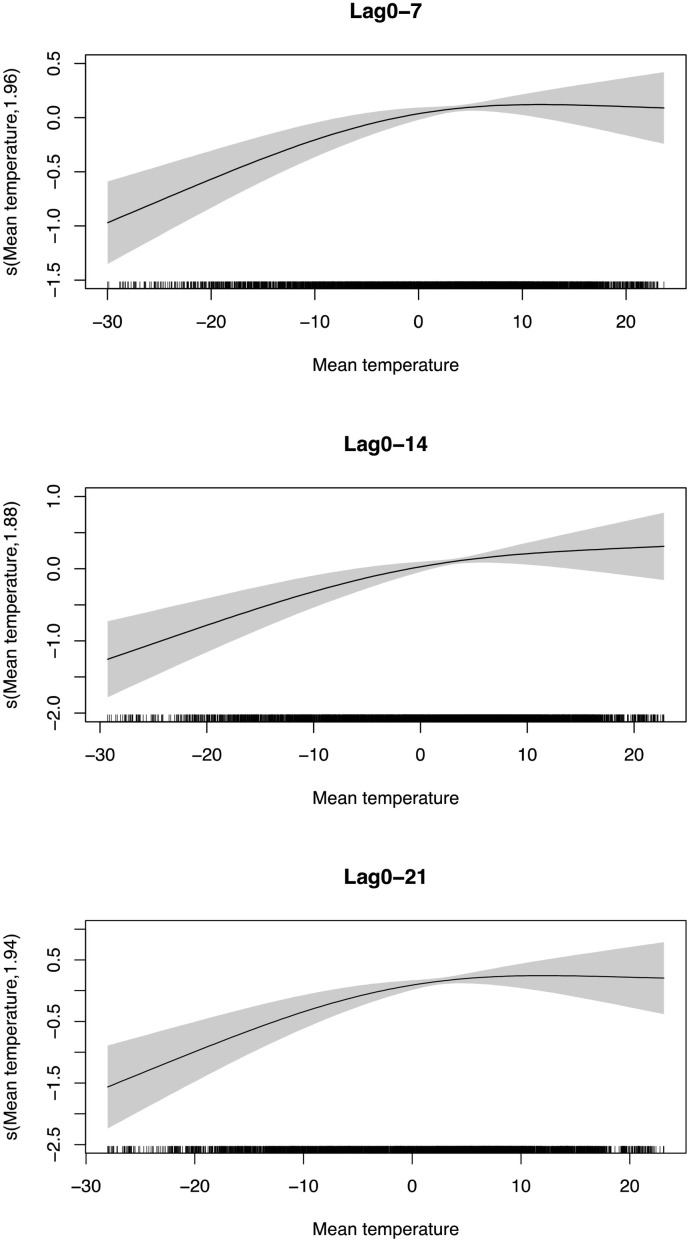
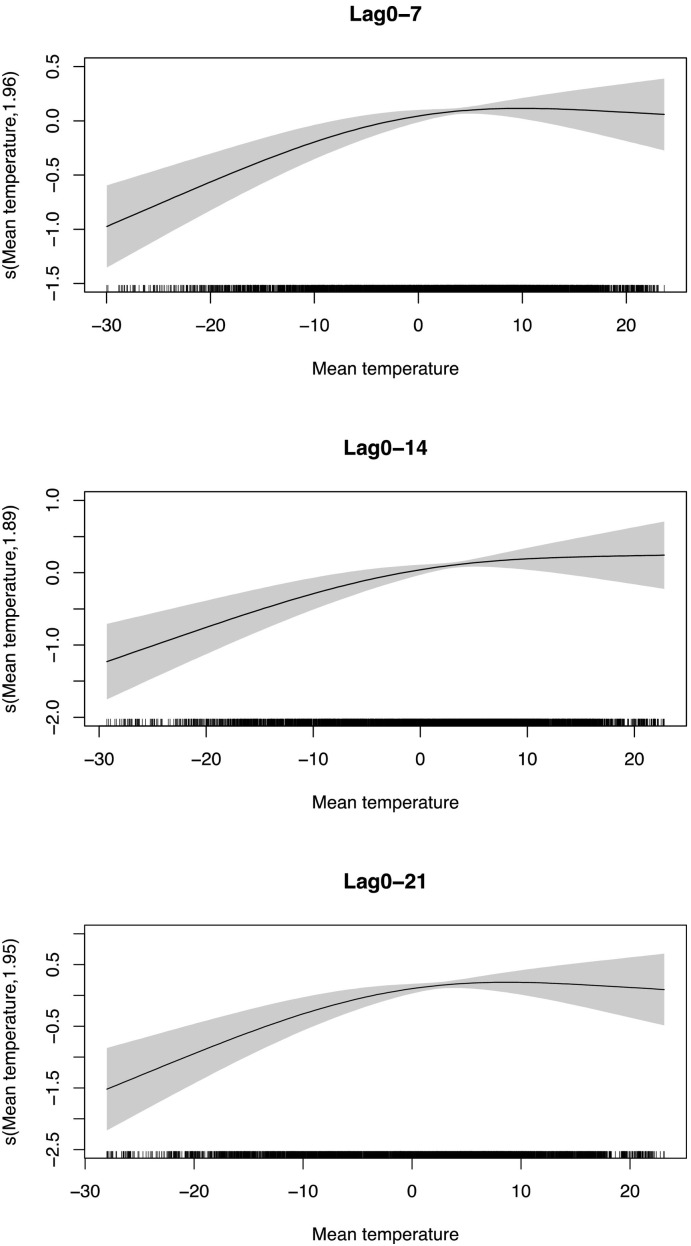
Results: The exposure-response curves suggested that the relationship between mean temperature and COVID-19 confirmed cases was approximately linear in the range of <3 °C and became flat above 3 °C. When mean temperature (lag0-14) was below 3 °C, each 1 °C rise was associated with a 4.861% (95% CI: 3.209-6.513) increase in the daily number of COVID-19 confirmed cases. These findings were robust in our sensitivity analyses.
Conclusions: Our results indicate that mean temperature has a positive linear relationship with the number of COVID-19 cases with a threshold of 3 °C. There is no evidence supporting that case counts of COVID-19 could decline when the weather becomes warmer, which provides useful implications for policymakers and the public.
Keywords: COVID-19; China; Generalized additive model; Novel coronavirus pneumonia; Temperature.
Copyright © 2020 Elsevier B.V. All rights reserved.
Conflict of interest statement
Declaration of competing interest The authors declare that they have no known competing financial interests or personal relationships that could have appeared to influence the work reported in this paper.
Figures
Comment in
-
Can PM2.5 pollution worsen the death rate due to COVID-19 in India and Pakistan?Sci Total Environ. 2020 Nov 10;742:140557. doi: 10.1016/j.scitotenv.2020.140557. Epub 2020 Jun 27. Sci Total Environ. 2020. PMID: 32615374 Free PMC article. No abstract available.
References
-
- Chan J.F.-W., Yuan S., Kok K.-H., To K.K.-W., Chu H., Yang J., Xing F., Liu J., Yip C.C.-Y., Poon R.W.-S. A familial cluster of pneumonia associated with the 2019 novel coronavirus indicating person-to-person transmission: a study of a family cluster. Lancet. 2020;395:514–523. doi: 10.1016/S0140-6736(20)30154-9. - DOI - PMC - PubMed
MeSH terms
LinkOut - more resources
Full Text Sources
