


Risk Factors for Mortality in Patients with Elizabethkingia Infection and the Clinical Impact of the Antimicrobial Susceptibility Patterns of Elizabethkingia Species
- PMID: 32408478
- PMCID: PMC7290601
- DOI: 10.3390/jcm9051431
Risk Factors for Mortality in Patients with Elizabethkingia Infection and the Clinical Impact of the Antimicrobial Susceptibility Patterns of Elizabethkingia Species
Abstract
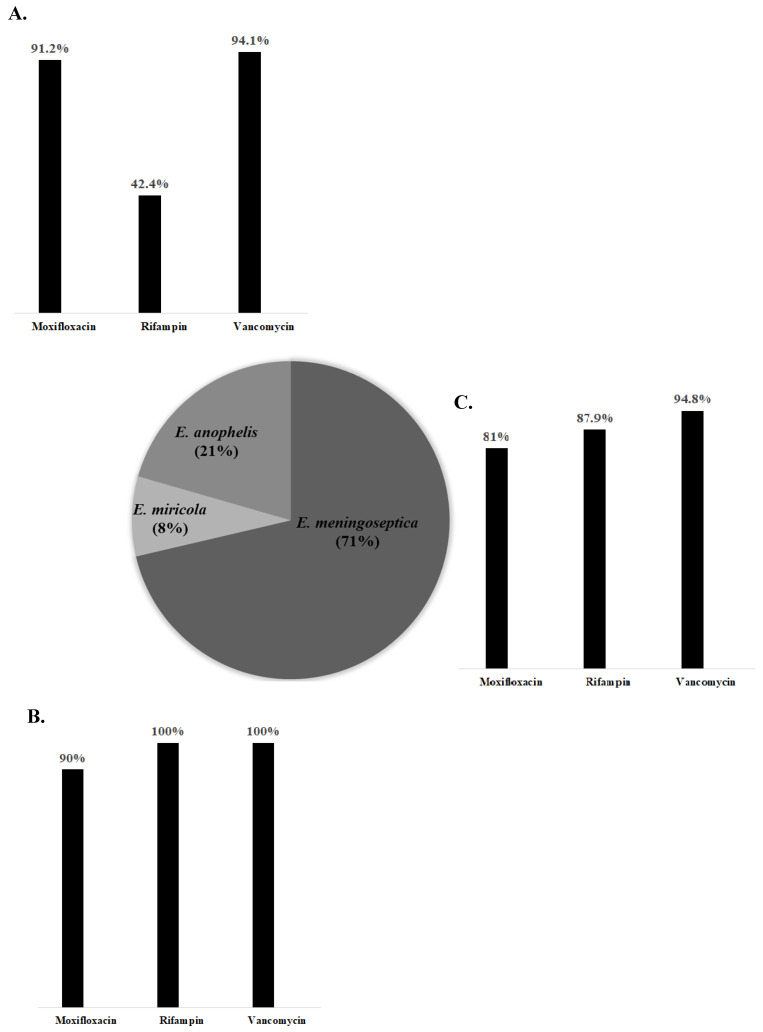
Elizabethkingia species (spp.), which can colonize hospital environments, are emerging nosocomial pathogens presenting high mortality. Due to their intrinsic resistance to a broad range of antibiotics, optimal antibiotic dosage has yet to be determined against infections caused by Elizabethkingia spp. This study aimed to investigate the risk factors for the mortality of infections caused by Elizabethkingia spp. and assess the clinical implications of their antimicrobial susceptibility patterns. Data from 210 patients affected by Elizabethkingia-induced pneumonia and bacteremia between 1 November 2005 and 31 May 2016, were analyzed. Further antimicrobial susceptibility tests for moxifloxacin, rifampin, and vancomycin using Elizabethkingia isolates were performed to compensate for the Elizabethkingia spp. susceptibility panel in patients affected after 2013. The mean age of the patients was 66.5 ± 18 years and the 28-day mortality rate was 25.2% (53/210). In the univariate analysis, history of prior stay in an intensive care unit, central venous catheter use, presented thrombocytopenia, immunocompetent status, a high simplified acute physiology score II (SAPS II score), a high C-reactive protein (CRP)/albumin ratio on the day of isolation and seven days later, and a high minimum inhibitory concentration (MIC) value of rifampin were significantly associated with a higher mortality rate. In the multivariate logistic regression analysis, the MIC values of rifampin (odds ratio (OR): 1.045; 95% confidence interval (CI): 1.006-1.085; p = 0.023), SAPS II score (OR: 1.053; 95% CI: 1.022-1.084; p = 0.001), and initial CRP/albumin ratio (OR: 1.030; 95% CI: 1.009-1.051; p = 0.004) were significantly associated with 28-day mortality. To reduce the mortality associated with Elizabethkingia infections, prediction of the clinical course using initial CRP/albumin ratio and SAPS II and early intervention are essential. Rifampin is a promising candidate as the drug of choice in treating Elizabethkingia infections.
Keywords: Elizabethkingia; anti-bacterial agent; microbial sensitivity tests; mortality; risk factors.
Conflict of interest statement
The authors declare no conflict of interest.
Figures
References
-
- Kim K.K., Kim M.K., Lim J.H., Park H.Y., Lee S.T. Transfer of chryseobacterium meningosepticum and chryseobacterium miricola to elizabethkingia gen. Nov. As elizabethkingia meningoseptica comb. Nov. And elizabethkingia miricola comb. Nov. Int. J. Syst. Evol. Microbiol. 2005;55:1287–1293. doi: 10.1099/ijs.0.63541-0. - DOI - PubMed
-
- Lin P.Y., Chen H.L., Huang C.T., Su L.H., Chiu C.H. Biofilm production, use of intravascular indwelling catheters and inappropriate antimicrobial therapy as predictors of fatality in chryseobacterium meningosepticum bacteraemia. Int. J. Antimicrob. Agents. 2010;36:436–440. doi: 10.1016/j.ijantimicag.2010.06.033. - DOI - PubMed
LinkOut - more resources
Full Text Sources
Research Materials
Miscellaneous
