. 2020 May 15;368(6492):731-736.
doi: 10.1126/science.aba5216.

Natural hybridization reveals incompatible alleles that cause melanoma in swordtail fish

Affiliations

Natural hybridization reveals incompatible alleles that cause melanoma in swordtail fish

Daniel L Powell et al. Science. .

Abstract

The establishment of reproductive barriers between populations can fuel the evolution of new species. A genetic framework for this process posits that "incompatible" interactions between genes can evolve that result in reduced survival or reproduction in hybrids. However, progress has been slow in identifying individual genes that underlie hybrid incompatibilities. We used a combination of approaches to map the genes that drive the development of an incompatibility that causes melanoma in swordtail fish hybrids. One of the genes involved in this incompatibility also causes melanoma in hybrids between distantly related species. Moreover, this melanoma reduces survival in the wild, likely because of progressive degradation of the fin. This work identifies genes underlying a vertebrate hybrid incompatibility and provides a glimpse into the action of these genes in natural hybrid populations.


Conflict of interest statement

Competing interests: The authors declare no competing interests.

Figures

Fig. 1.
Fig. 1.. Hybridization generates a high incidence of melanoma.
(A) Naturally hybridizing species X. malinche (top) and X. birchmanni (middle) differ in morphological traits, including the presence of a melanin pigment spot that is polymorphic in X. birchmanni. In hybrids, this spotting phenotype can transform into a melanoma (bottom). (B) Whereas X. birchmanni populations segregate for the presence of this spot, the trait is absent in X. malinche populations; hybrid populations have high frequencies of this trait. (C) The trait is at higher frequencies in hybrid populations and covers more of the body. Shown here is invasion area, or the melanized body surface area outside of the caudal fin (normalized for body size). Hybrid phenotypes are shown from three populations on the Río Calnali (fig. S3). AGCZ, Aguazarca; CALL, Calnali low; CHAF, Chahuaco falls. (D) Spots expand more over a 6-month period in hybrids than in X. birchmanni individuals. (E) A cross section of the caudal peduncle from a Chahuaco falls hybrid (10× magnification). Melanoma cells invading the body and muscle bundles are visually evident (indicated with blue stars). (F) Gene ontology categories enriched in melanoma tissue compared with normal caudal tissue (24, 45). The size of the dots reflects the number of genes identified, and the color corresponds to the P value. Categories with undefined odds ratios (not plotted) are listed in table S1. In (B) and (D), the plot shows the mean, and whiskers indicate two standard errors of the mean. Individual points show the raw data.
Fig. 2.
Fig. 2.. Combined genome-wide association and admixture mapping approaches identify the genetic basis of the melanoma hybrid incompatibility.
(A) Results of genome-wide association scan for allele frequency differences between spotted cases and unspotted controls. (Top) Results can be seen for all chromosomes, and the red line indicates the genome-wide significance threshold, determined by permutation (24). (Bottom) Results from chromosome 21, where two distinct regions are strongly associated with spotting. (B) Admixture mapping in hybrids identifies associations between X. birchmanni ancestry on chromosome 21 and spot presence. Plotted here are log likelihood differences between models with and without ancestry at the focal site included as a covariate. The red line indicates the genome-wide significance threshold, determined by permutation (24). (C) When we treated melanocyte invasion as the focal trait and mapped associations with ancestry, we again identified associations with X. birchmanni ancestry on chromosome 21 but also identified a second region on chromosome 5 associated with X. malinche ancestry.
Fig. 3.
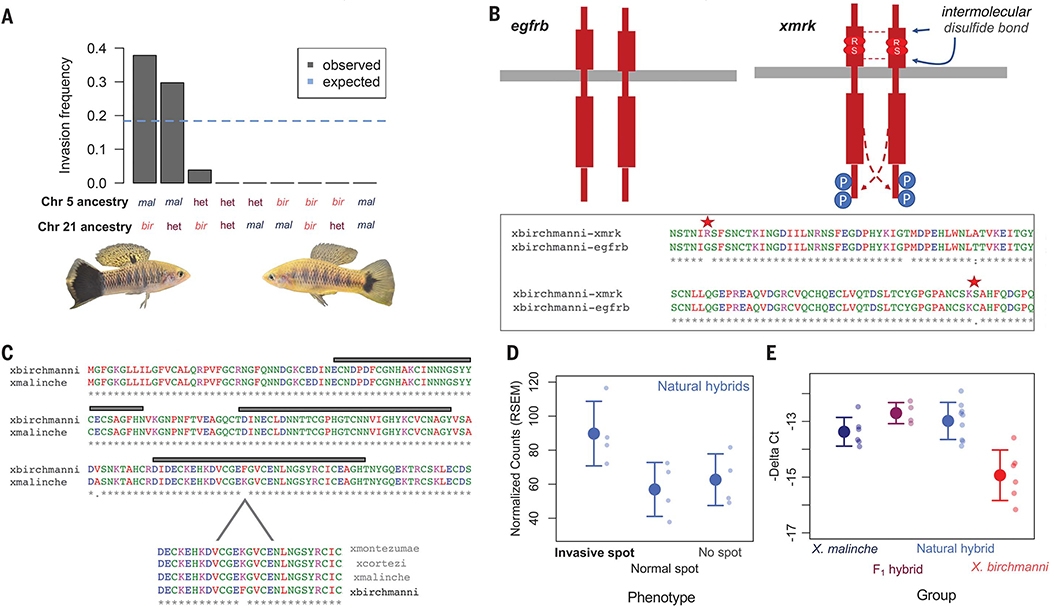
Fig. 3.. Interactions between chromosomes 5 and 21 are associated with melanoma in hybrids.
(A) Proportion of individuals with melanoma as a function of ancestry at the associated regions on chromosome 5 and chromosome 21. The blue dashed line indicates the expected proportion of cases if melanoma risk were equally distributed among individuals with at least one birchmanni allele at chromosome 21. We only had one observation for the bir-bir and bir-het genotypes. (B) The xmrk sequence in X. birchmanni harbors two mutations (G364R and C582S) that transform xmrk to a constitutively active state (33, 46). The schematic compares the ancestral form of the protein (egfrb) to the predicted structure of xmrk in X. birchmanni. Proteins are shown in red, and the cell membrane is shown in gray. In xmrk, residues R364 and S582 promote intramolecular disulfide bonds that cause protein dimerization and phosphorylation (blue circles) (33, 46). (Single-letter abbreviations for the amino acid residues are as follows: C, Cys; G, Gly; R, Arg; and S, Ser. In xmrk, amino acids were substituted at certain locations; for example, G364R indicates that glycine at position 364 was replaced by arginine.) (Inset) A partial clustal alignment of X. birchmanni egfrb and xmrk with these substitutions highlighted. Colors indicate properties of the amino acid, and asterisks indicate locations where the amino acid sequences are identical. (C) Clustal alignment showing the N terminus of cd97 in X. birchmanni and X. malinche. We observed a substitution in a conserved epidermal growth factor–binding domain (gray rectangles). (Inset) The substitution found in X. birchmanni is not present in closely related species. (D) Expression of cd97 based on RNA-seq data in melanoma, spotted, and unspotted tissue from Chahuaco falls hybrids (four biological replicates per group). (E) Real-time quantitative PCR of cd97 from caudal fin tissue from X. malinche, X. birchmanni, and natural and F1 hybrids (four to nine biological replicates per group). In (D) and (E), large solid dots indicate the mean, and whiskers indicate two standard errors of the mean. Individual points show the raw data.
Fig. 4.
Fig. 4.. Impact of the spotted caudal melanoma in natural hybrid populations.
(A) Frequency of spotting in juvenile and adult males across populations with high (circles, Calnali low and Chahuaco falls) or low (squares, Aguazarca and X. birchmanni) melanoma incidence. Asterisks indicate significant differences by age class (*P < 0.05, **P < 0.01; ns indicates nonsignificant differences in a two-sample z test). Gray points indicate the raw data, black points indicate the mean, and error bars indicate one standard error of the mean. (B) Results of approximate Bayesian computation simulations indicate that the change in frequency of the spotting phenotype between juvenile and adult males is consistent with strong viability selection (24). Shown here are posterior distributions of viability selection coefficients consistent with the observed frequency change data in (left) Chahuaco falls and (right) Calnali low. (C) Because of where the melanoma develops, it can cause (top) the degradation of a fin essential in swimming or (bottom) the growth of tumors on the fin (overhead and side view of the same individual). (D) Visualization of the difference in fast-start response between individuals with low and high melanoma invasion (upper and lower 25% quantiles shown here). This representation is for visualization only; the statistical analysis comes from a linear model.

Comment in

References

    1. Dobzhansky T, Zellforsch. 21, 169–223 (1934).
    1. Johnson NA, Genetics 161, 939–944 (2002). - PMC - PubMed
    1. Dobzhansky T, Biol. Rev. Camb. Philos. Soc 11, 364–384 (1936).
    1. Coyne JA, Orr HA, Speciation (Sinaeur Associates, 2004).
    1. Presgraves DC, Nat. Rev. Genet 11, 175–180 (2010). - PubMed

Publication types

Substances