


Distinguishing the Neural Correlates of Perceptual Awareness and Postperceptual Processing
- PMID: 32409620
- PMCID: PMC7326348
- DOI: 10.1523/JNEUROSCI.0120-20.2020
Distinguishing the Neural Correlates of Perceptual Awareness and Postperceptual Processing
Abstract
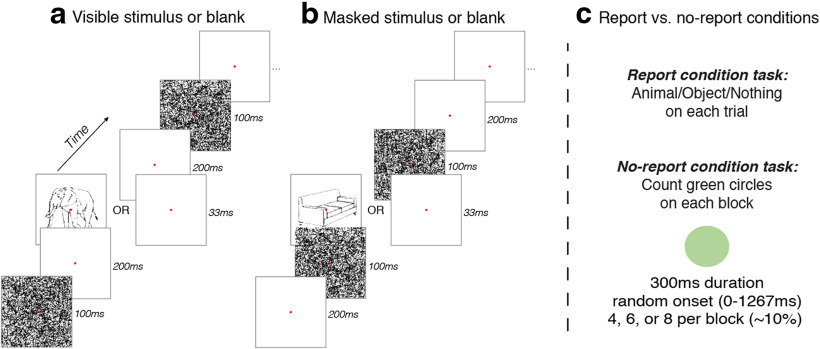
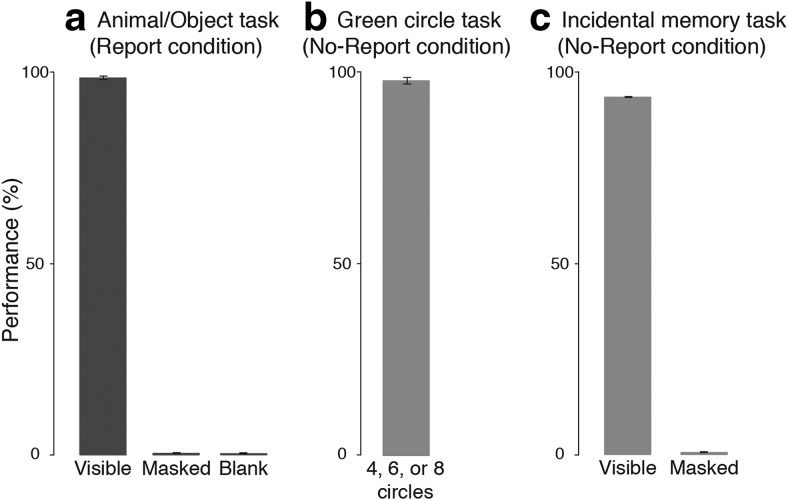
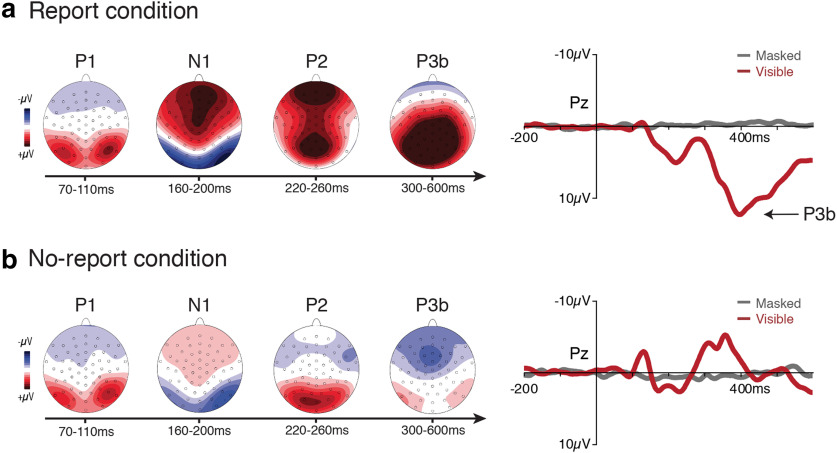
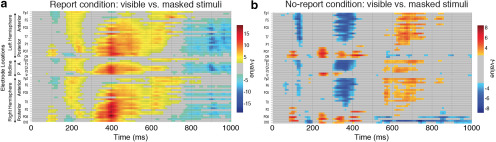
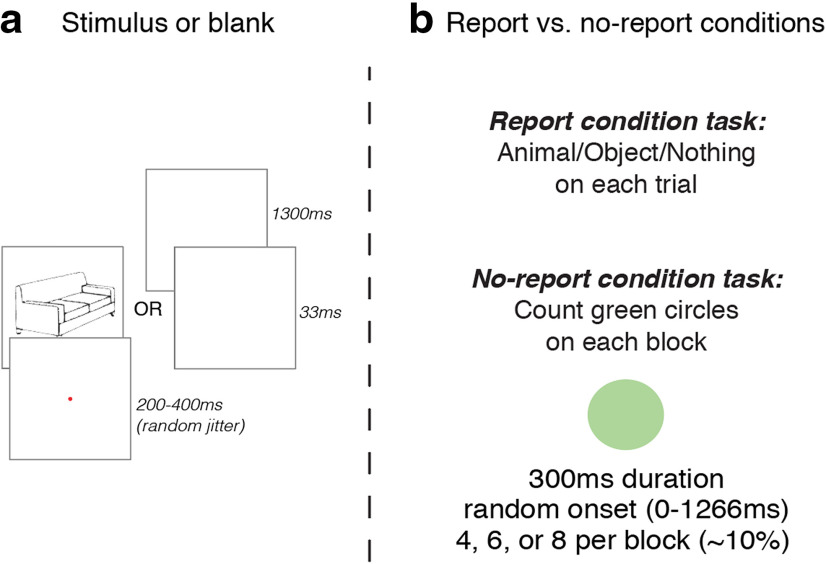
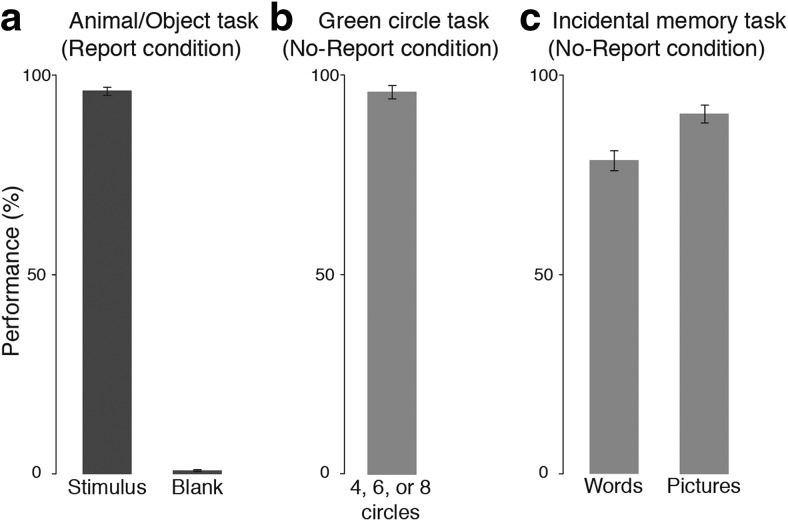
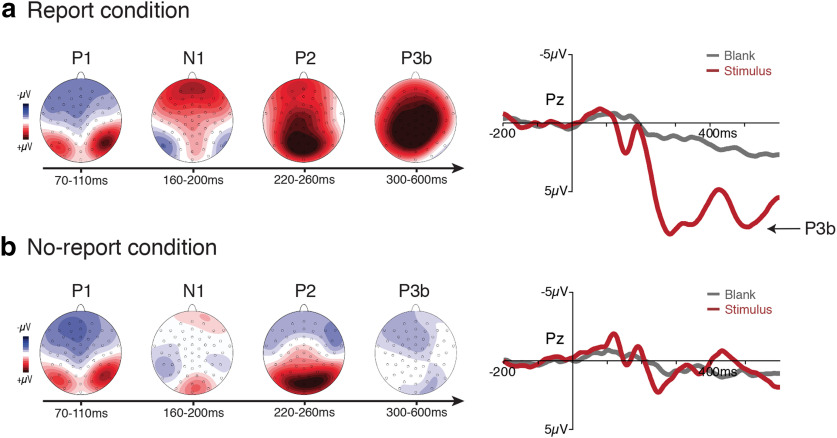
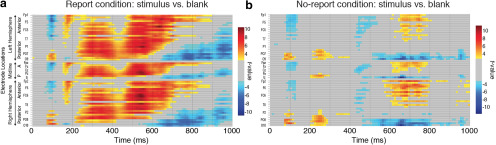
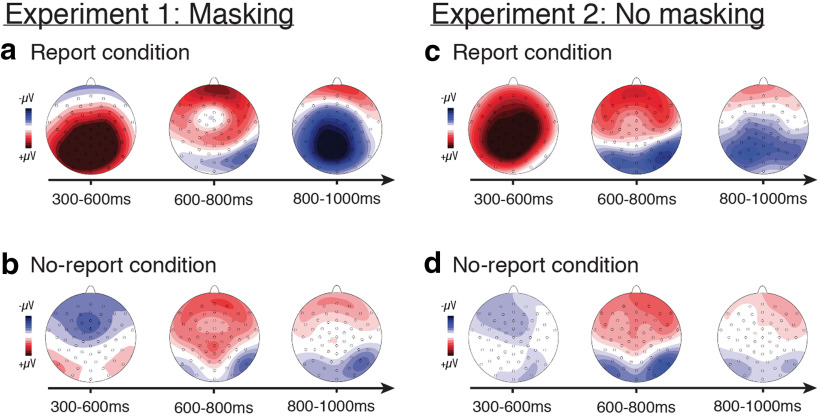
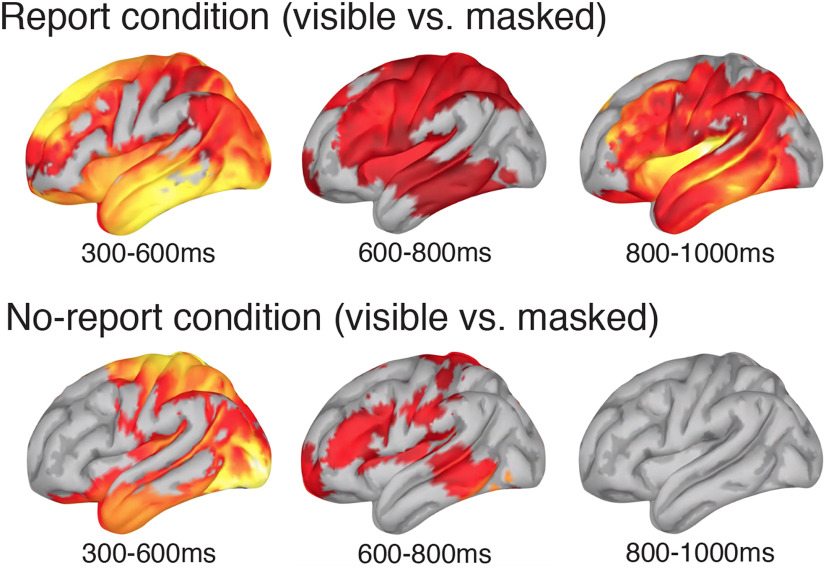
To identify the neural correlates of perceptual awareness, researchers often compare the differences in neural activation between conditions in which an observer is or is not aware of a stimulus. While intuitive, this approach often contains a critical limitation: to link brain activity with perceptual awareness, observers traditionally report the contents of their perceptual experience. However, relying on observers' reports is problematic because it is difficult to know whether the neural responses being measured are associated with conscious perception or with postperceptual processes involved in the reporting task (e.g., working memory, decision-making). To address this issue, we combined a standard visual masking paradigm with a recently developed "no-report" paradigm in male/female human participants. In the visual masking paradigm, observers saw images of animals and objects that were visible or invisible, depending on their proximity to masks. Meanwhile, on half of the trials, observers reported the contents of their perceptual experience (i.e., report condition), while on the other half of trials they refrained from reporting about their experiences (i.e., no-report condition). We used electroencephalography to examine how visibility interacts with reporting by measuring the P3b event-related potential, one of the proposed canonical "signatures" of conscious processing. Overall, we found a robust P3b in the report condition, but no P3b whatsoever in the no-report condition. This finding suggests that the P3b itself is not a neural signature of conscious processing and highlights the importance of carefully distinguishing the neural correlates of perceptual awareness from postperceptual processing.SIGNIFICANCE STATEMENT What are the neural signatures that differentiate conscious and unconscious processing in the brain? Perhaps the most well established candidate signature is the P3b event-related potential, a late slow wave that appears when observers are aware of a stimulus, but disappears when a stimulus fails to reach awareness. Here, however, we found that the P3b does not track what observers are perceiving, but instead tracks what observers are reporting. When observers are aware of simple visual stimuli, the P3b is nowhere to be found unless observers are reporting the contents of their experience. These results challenge the well established notion of the P3b as a neural marker of awareness and highlight the need for new approaches to the neuroscience of consciousness.
Keywords: EEG; attention; awareness; consciousness; perception; vision.
Copyright © 2020 the authors.
Figures
Comment in
-
Don't tell anyone: the importance of no-report paradigms in neuroscience of consciousness.J Neurophysiol. 2021 May 1;125(5):1577-1579. doi: 10.1152/jn.00569.2020. Epub 2021 Mar 31. J Neurophysiol. 2021. PMID: 33788637
References
-
- Benjamini Y, Yekutieli D (2001) The control of the false discovery rate in multiple testing under dependency. Ann Stat 29:1165–1188. 10.1214/aos/1013699998 - DOI
Publication types
MeSH terms
LinkOut - more resources
Full Text Sources
