


Shared and Independent Genetic Basis of Resistance to Bt Toxin Cry2Ab in Two Strains of Pink Bollworm
- PMID: 32409635
- PMCID: PMC7224296
- DOI: 10.1038/s41598-020-64811-w
Shared and Independent Genetic Basis of Resistance to Bt Toxin Cry2Ab in Two Strains of Pink Bollworm
Abstract
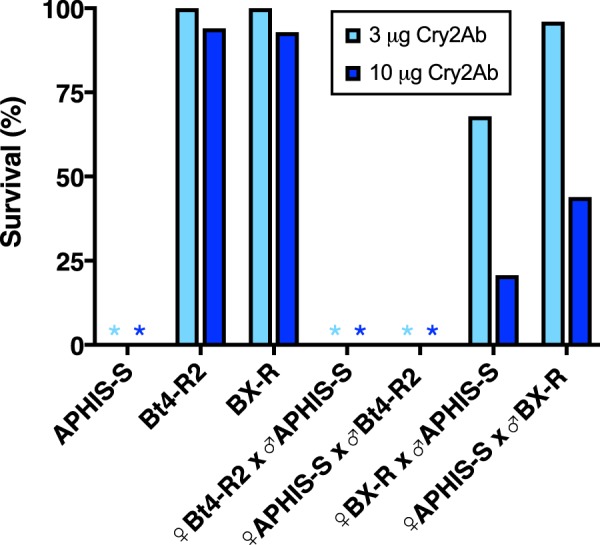
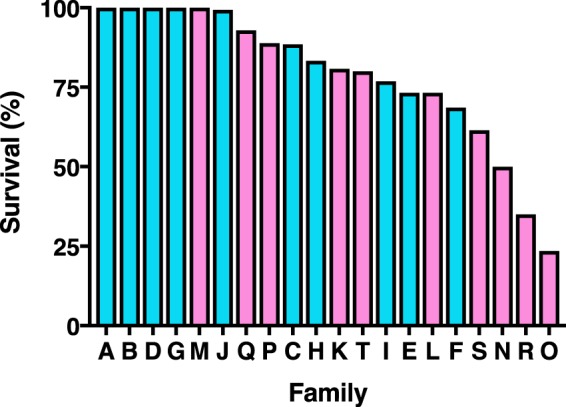
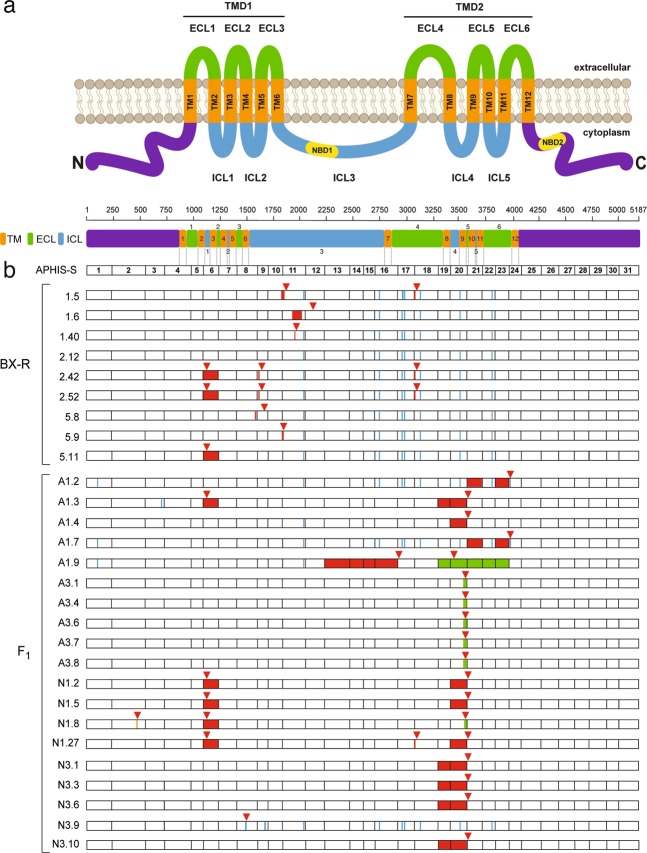
Evolution of pest resistance threatens the benefits of crops genetically engineered to produce insecticidal proteins from Bacillus thuringiensis (Bt). Field populations of the pink bollworm (Pectinophora gossypiella), a global pest of cotton, have evolved practical resistance to transgenic cotton producing Bt toxin Cry2Ab in India, but not in the United States. Previous results show that recessive mutations disrupting an autosomal ATP-binding cassette gene (PgABCA2) are associated with pink bollworm resistance to Cry2Ab in field-selected populations from India and in one lab-selected strain from the United States (Bt4-R2). Here we discovered that an independently derived, lab-selected Cry2Ab-resistant pink bollworm strain from the United States (BX-R) also harbors mutations that disrupt PgABCA2. Premature stop codons introduced by mis-splicing of PgABCA2 pre-mRNA were prevalent in field-selected larvae from India and in both lab-selected strains. The most common mutation in field-selected larvae from India was also detected in both lab-selected strains. Results from interstrain crosses indicate BX-R has at least one additional mechanism of resistance to Cry2Ab that does not involve PgABCA2 and is not completely recessive or autosomal. We conclude that recessive mutations disrupting PgABCA2 are the primary, but not the only, mechanism of resistance to Cry2Ab in pink bollworm.
Conflict of interest statement
This is a cooperative investigation between USDA ARS and the University of Arizona, with J.A.F., Y.C., and B.E.T. receiving funding from USDA National Institute of Food and Agriculture (Agriculture and Food Research Initiative Program Grant #2018-67013-27821) and Corteva Agriscience (agreement #58-3K95-4-1666) to support this work. D.L., G.C.U, and A.J.Y declare no potential conflict of interest. J.A.F. is coauthor of a patent “Cadherin Receptor Peptide for Potentiating Bt Biopesticides” (patent numbers: US20090175974A1, US8354371, WO2009067487A2, WO2009067487A3). B.E.T. is a coauthor of a patent on modified Bt toxins, “Suppression of Resistance in Insects to
Figures
References
-
- ISAAA. Global Status of Commercialized Biotech/GM Crops in 2018: Biotech Crops Continue to Help Meet the Challenges of Increased Population and Climate Change. ISAAA Brief No. 54 (ISAAA: Ithaca, NY, 2018).
-
- Hutchison, W. D. et al. Areawide suppression of European corn borer with Bt maize reaps savings to non-Bt maize growers. Science330, 222–225, 10.1126/science.1190242 (2010). - PubMed
Publication types
MeSH terms
Substances
LinkOut - more resources
Full Text Sources
Miscellaneous
