


Marine natural compounds as potents inhibitors against the main protease of SARS-CoV-2-a molecular dynamic study
- PMID: 32410504
- PMCID: PMC7284144
- DOI: 10.1080/07391102.2020.1769733
Marine natural compounds as potents inhibitors against the main protease of SARS-CoV-2-a molecular dynamic study
Abstract
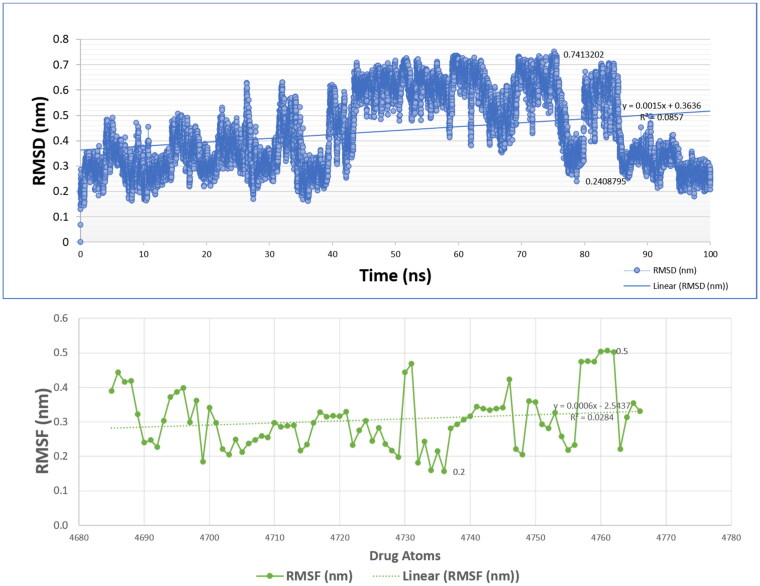
Sever acute respiratory syndrome coronavirus 2 (SARS-CoV-2) is a single-stranded RNA (ssRNA) virus, responsible for severe acute respiratory disease (COVID-19). A large number of natural compounds are under trial for screening compounds, possessing potential inhibitory effect against the viral infection. Keeping in view the importance of marine compounds in antiviral activity, we investigated the potency of some marine natural products to target SARS-CoV-2 main protease (Mpro) (PDB ID 6MO3). The crystallographic structure of Mpro in an apo form was retrieved from Protein Data Bank and marine compounds from PubChem. These structures were prepared for docking and the complex with good docking score was subjected to molecular dynamic (MD) simulations for a period of 100 ns. To measure the stability, flexibility, and average distance between the target and compounds, root mean square deviations (RMSD), root mean square fluctuation (RMSF), and the distance matrix were calculated. Among five marine compounds, C-1 (PubChem CID 11170714) exhibited good activity, interacting with the active site and surrounding residues, forming many hydrogen and hydrophobic interactions. The C-1 also attained a stable dynamic behavior, and the average distance between compound and target remains constant. In conclusion, marine natural compounds may be used as a potential inhibitor against SARS-CoV-2 for better management of COVID-19.
Keywords: COVID-19; Marine drugs; dock; interactions; molecular dynamics.
Figures




References
-
- Abdelli I., Hassani F., Brikci S. B., & Ghalem S. (2020). In silico study the inhibition of Angiotensin converting enzyme 2 receptor of COVID-19 by Ammoides verticillata components harvested from western Algeria. Journal of Biomolecular Structure and Dynamics, 0(ja), 1–17. 10.1080/07391102.2020.1763199 - DOI - PMC - PubMed
-
- Anand K., Yang H., Bartlam M., Rao Z., & Hilgenfeld R. (2005). Coronavirus main proteinase: Target for antiviral drug therapy In Coronaviruses with special emphasis on first insights concerning SARS (pp. 173–199). Birkhäuser Basel; 10.1007/3-7643-7339-3_9 - DOI
Publication types
MeSH terms
Substances
LinkOut - more resources
Full Text Sources
Other Literature Sources
Miscellaneous