Review
. 2020 May 14;17(1):8.
doi: 10.1186/s12976-020-00126-7.

Computational models of melanoma

Affiliations
Review

Computational models of melanoma

Marco Albrecht et al. Theor Biol Med Model. .

Abstract

Genes, proteins, or cells influence each other and consequently create patterns, which can be increasingly better observed by experimental biology and medicine. Thereby, descriptive methods of statistics and bioinformatics sharpen and structure our perception. However, additionally considering the interconnectivity between biological elements promises a deeper and more coherent understanding of melanoma. For instance, integrative network-based tools and well-grounded inductive in silico research reveal disease mechanisms, stratify patients, and support treatment individualization. This review gives an overview of different modeling techniques beyond statistics, shows how different strategies align with the respective medical biology, and identifies possible areas of new computational melanoma research.

Keywords: Melanoma; Physical oncology; Systems biology; Tumor growth.


Conflict of interest statement

The authors declare that they have no competing interests.

Figures
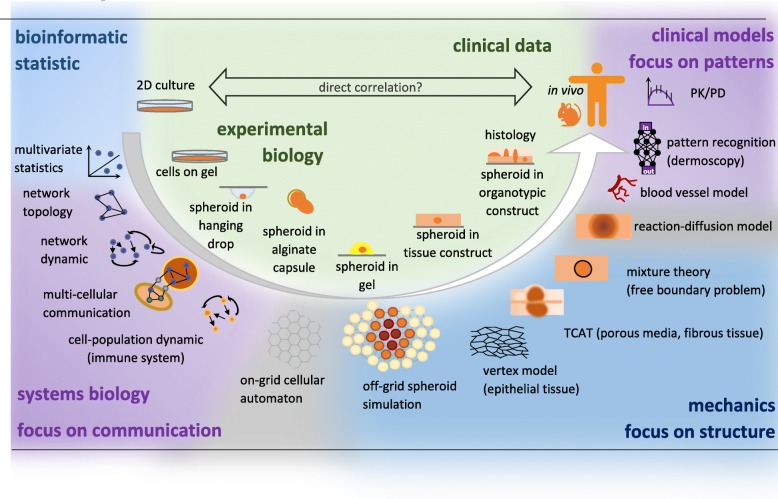
Fig. 1
Fig. 1
Computational and experimental approaches to understand cancer. Experimental approaches span from 2D cell culture to clinical data and are often correlated directly. Possible intermediate steps can delineate the response of cells to certain characteristics of the environment. Cells on gel sense the rigidity of the substratum, spheroids in hanging drops can develop a necrotic core, spheroid growing in alginate capsules reveal the growth pressure at which the capsule burst, spheroids in gel reveal the cellular response to a confined environment, spheroids in a tissue construct shows interactions with fibroblasts and host cells in a confined environment, and organotypic constructs and histological sections emphasize the behavior in a realistic anatomical structure. Computational models change accordingly in scale and approach. Methods are classified counter-clockwise, beginning at the top left corner. Descriptive methods of statistics and bioinformatics focus on the identification of single features. Often groups are compared, or the explanatory power of certain factors is investigated. Systems biologists increasingly connect different elements, focus on network information, and study dynamic effects. The network topology in steady-state is the first step but can also be extended to time dynamic and directed interactions. The networks might be compartmentalized to study communication across different cells, but the cells themselves can also represent network nodes, which is common in immunological studies. If interconnections between cells, with or without ECM, are studied and spatially distributed, on-grid and off-grid cellular automatons, vertex models, and reaction-diffusion models become relevant. Deformed tissue structures and anatomical obstacles require the integration of mechanical information. The more the approaches move from cell data to clinical images, the more pattern recognition becomes relevant. The functioning of the blood vessel system often depends on the pattern of the vessel network. Clinical images, such as from dermoscopy, might be linked via artificial intelligence to various pathologies. At the top right, computational methods of pharmacokinetics and pharmacodynamics relate drug dose to the concentration in blood plasma and then to the mode of action. The upper half of the figure pronounce the statistical significance; the bottom half of the figure shows models, which pronounce the importance of physical and mechanistic dependencies. In conclusion, a direct correlation between in vitro and in vivo data might be straight-forward, but might be also too simplistic. The laborious indirect way with step-wise experimental and computational extension of knowledge might be harder and more expensive, but more insightful in the long term and can enrich meaningful model development

References

    1. Karimkhani C, Green AC, Nijsten T, Weinstock M, Dellavalle RP, Naghavi M, et al. The global burden of melanoma: results from the global burden of disease study 2015. Br J Dermatol. 2017;177(1):134–40. doi: 10.1111/bjd.15510. - DOI - PMC - PubMed
    1. Kunz M. Oncogenes in melanoma: an update. Eur J Cell Biol. 2014;93(1-2):1–10. doi: 10.1016/j.ejcb.2013.12.002. - DOI - PubMed
    1. Omholt K, Platz A, Kanter L, Ringborg U, Hansson J. NRAS and BRAF mutations arise early during melanoma pathogenesis and are preserved throughout tumor progression. Clin Cancer Res. 2003;9(17):6483–8. - PubMed
    1. Aris M, Barrio MM. Combining immunotherapy with oncogene-targeted therapy: a new road for melanoma treatment. Front Immunol. 2015;6:46. - PMC - PubMed
    1. Amaral T, Sinnberg T, Meier F, Krepler C, Levesque M, Niessner H, et al. MAPK pathway in melanoma part II—secondary and adaptive resistance mechanisms to BRAF inhibition. Eur J Cancer. 2017;73:93–101. doi: 10.1016/j.ejca.2016.12.012. - DOI - PubMed

Publication types
