


Comparison of the clinical and cost effectiveness of two management strategies (rehabilitation versus surgical reconstruction) for non-acute anterior cruciate ligament (ACL) injury: study protocol for the ACL SNNAP randomised controlled trial
- PMID: 32410697
- PMCID: PMC7222454
- DOI: 10.1186/s13063-020-04298-y
Comparison of the clinical and cost effectiveness of two management strategies (rehabilitation versus surgical reconstruction) for non-acute anterior cruciate ligament (ACL) injury: study protocol for the ACL SNNAP randomised controlled trial
Abstract
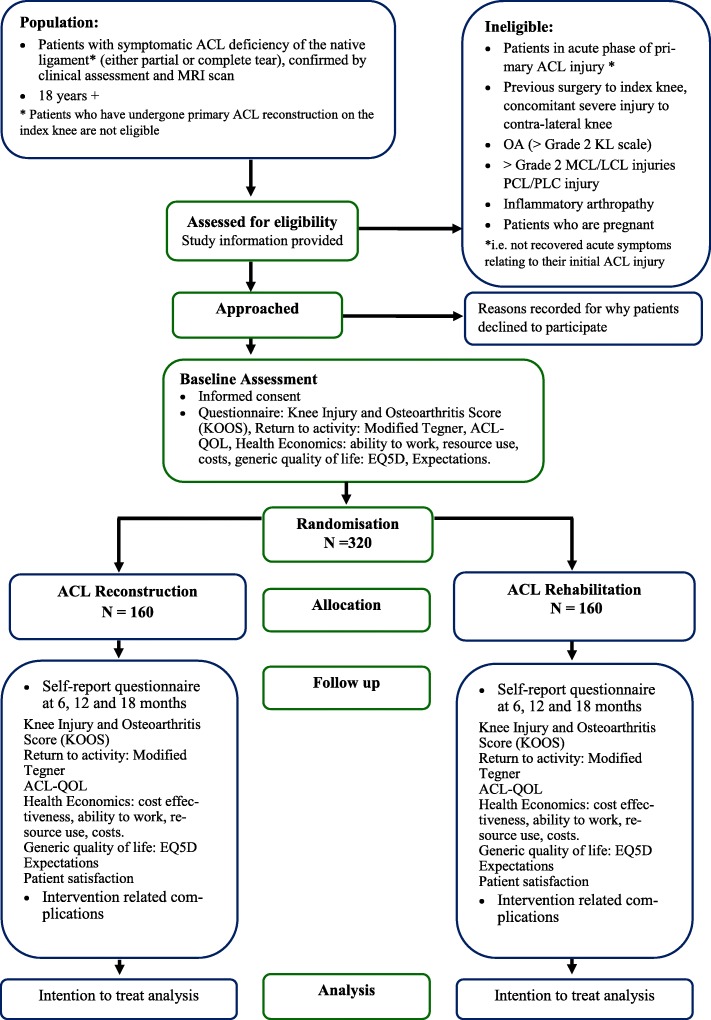
Background: Anterior cruciate ligament (ACL) rupture is a common knee injury that can lead to poor quality of life, decreased activity and increased risk of secondary osteoarthritis of the knee. Management of patients with a non-acute ACL injury can include a non-surgical (rehabilitation) or surgical (reconstruction) approach. However, insufficient evidence to guide treatment selection has led to high variation in treatment choice for patients with non-acute presentation of ACL injury. The objective of the ACL SNNAP trial is to determine in patients with non-acute anterior cruciate ligament deficiency (ACLD) whether a strategy of non-surgical management (rehabilitation) (with option for later ACL reconstruction only if required) is more clinically effective and cost effective than a strategy of surgical management (reconstruction) without prior rehabilitation with all patients followed up at 18 months.
Methods: The study is a pragmatic, multi-centre, superiority, randomised controlled trial with two-arm parallel groups and 1:1 allocation. Patients with a symptomatic non-acute ACL deficient knee will be randomised to either non-surgical management (rehabilitation) or surgical management (reconstruction). We aim to recruit 320 patients from approximately 30 secondary care orthopaedic units from across the United Kingdom. Randomisation will occur using a web-based randomisation system. Blinding of patients and clinicians to treatment allocation will not be possible because of the nature of the interventions. Participants will be followed up via self-reported questionnaires at 6, 12 and 18 months. The primary outcome is the Knee injury and Osteoarthritis Outcome Score (KOOS) at 18 months post randomisation. Secondary outcomes will include a return to sport/activity, intervention-related complications, patient satisfaction, expectations of activity, generic health quality of life, knee specific quality of life and resource usage.
Discussion: At present, no evidence-based treatment of non-acute ACL deficiency exists, particularly in the NHS. Moreover, little consensus exists on the management approach for these patients. The proposed trial will address this gap in knowledge regarding the clinical and cost effectiveness of ACL treatment and inform future standards of care for this condition.
Trial registration: ISRCTN: 10110685. Registered on 16 November 2016. ClinicalTrials.gov: NCT02980367. Registered in December 2016.
Keywords: Anterior cruciate ligament deficiency, Randomised controlled trial, Reconstruction, Rehabilitation.
Conflict of interest statement
The authors declare that they have no competing interests.
Figures
References
-
- Hernandez LM, Micheo WF, Amy E. Rehabilitation update for the anterior cruciate ligament injured patient: current concepts. Bol Asoc Med Puerto Rico. 2006;98(1):62–72. - PubMed
-
- Grindem H, Eitzen I, Engebretsen L, Snyder-Mackler L, Risberg MA. nonsurgical or surgical treatment of acl injuries: knee function, sports participation, and knee reinjury: the Delaware-Oslo ACL Cohort Study. J Bone Joint Surg Am. 2014;96(15):1233–1241. doi: 10.2106/JBJS.M.01054. - DOI - PMC - PubMed
Publication types
MeSH terms
Associated data
Grants and funding
LinkOut - more resources
Full Text Sources
Medical
Miscellaneous
