Review
. 2020 Jan 29:2020:8405370.
doi: 10.1155/2020/8405370. eCollection 2020.

Ischemia/Reperfusion Injury: Pathophysiology, Current Clinical Management, and Potential Preventive Approaches

Affiliations
Review

Ischemia/Reperfusion Injury: Pathophysiology, Current Clinical Management, and Potential Preventive Approaches

César Daniel Sánchez-Hernández et al. Mediators Inflamm. .

Abstract

Myocardial ischemia reperfusion syndrome is a complex entity where many inflammatory mediators play different roles, both to enhance myocardial infarction-derived damage and to heal injury. In such a setting, the establishment of an effective therapy to treat this condition has been elusive, perhaps because the experimental treatments have been conceived to block just one of the many pathogenic pathways of the disease, or because they thwart the tissue-repairing phase of the syndrome. Either way, we think that a discussion about the pathophysiology of the disease and the mechanisms of action of some drugs may shed some clarity on the topic.


Conflict of interest statement

The authors declare that no potential conflicts of interest exist both in the writing and in the publication of this paper.

Figures
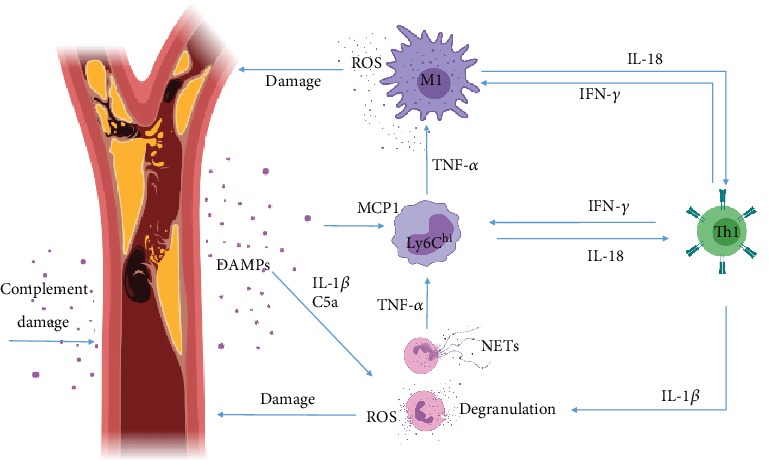
Figure 1
Figure 1
Inflammation during the Th1 tissue-damaging immune response of MIRS. Blood clots generate ischemia, which causes necrosis. Released DAMPs induce neutrophil and monocyte activation trough TLR and inflammasome activation, which in turn potentiate Th1 polarization. Inflammatory monocytes mature and become M1 macrophages. Tissue damage amplification comes in the form of NETs, granule components, and ROS produced by innate cells and direct complement attack.
Figure 2
Figure 2
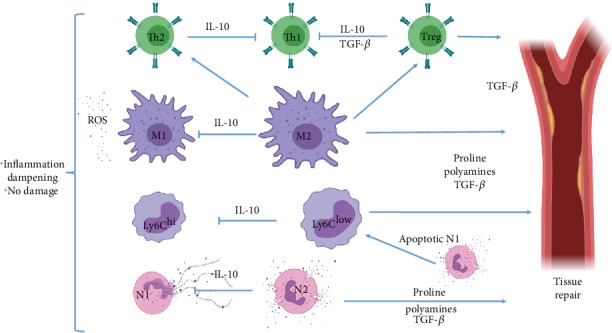
The Th2-mediated reparative phase of MIRS. N2 neutrophils and M2 macrophages both produce high levels of IL-10 to dampen N1, Ly6Chi, and M1-mediated degradation of tissue integrity. Also, M2 macrophages induce Th2 and Treg differentiation, while both suppress Th1 development, and Tregs thwart Th2 cells. M2 differentiation is possible by phagocytosis of the neutrophil apoptotic bodies. M2 and Treg cells mediate tissue repair.
Figure 3
Figure 3
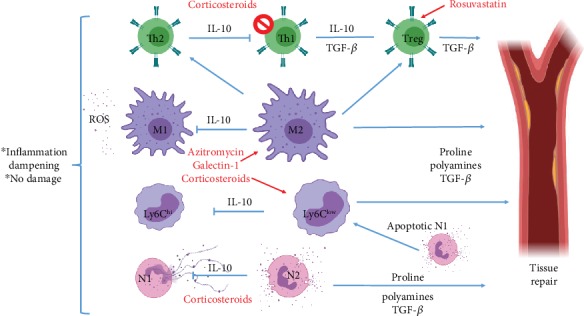
Immune-regulatory drugs could thwart destructive inflammation and promote tissue repair. Corticosteroids could enhance M2 differentiation while blocking NET, ROS, and granule-component deposition, thus blocking inflammatory damage. Also, azithromycin and rosuvastatin may induce cardioprotective leukocytes.

References

    1. Kosuge M., Kimura K., Ishikawa T., et al. Differences between men and women in terms of clinical features of ST-segment elevation acute myocardial infarction. Circulation Journal. 2006;70(3):222–226. doi: 10.1253/circj.70.222. - DOI - PubMed
    1. Antman E. M., Anbe D. T., Armstrong P. W., et al. ACC/AHA Guidelines for the Management of Patients With ST-Elevation Myocardial Infarction: A Report of the American College of Cardiology/American Heart Association Task Force on Practice Guidelines (Committee to Revise the 1999 Guidelines for the Management of Patients With Acute Myocardial Infarction) Journal of the American College of Cardiology. 2004;44(3):E1–E211. doi: 10.1016/j.jacc.2004.07.014. - DOI - PubMed
    1. Valensi P., Lorgis L., Cottin Y. Prevalence, incidence, predictive factors and prognosis of silent myocardial infarction: A review of the literature. Archives of Cardiovascular Diseases. 2011;104(3):178–188. doi: 10.1016/j.acvd.2010.11.013. - DOI - PubMed
    1. Graham I., Atar D., Borch-Johnsen K., et al. European guidelines on cardiovascular disease prevention in clinical practice: executive summary. Atherosclerosis. 2007;194(1):1–45. doi: 10.1016/j.atherosclerosis.2007.08.024. - DOI - PubMed
    1. Harrington D. H., Stueben F., Lenahan C. M. ST-elevation myocardial infarction and non-ST-elevation myocardial infarction: medical and surgical interventions. Critical Care Nursing Clinics of North America. 2019;31(1):49–64. doi: 10.1016/j.cnc.2018.10.002. - DOI - PubMed

Substances

LinkOut - more resources