Review
. 2020 Apr 28:14:376.
doi: 10.3389/fnins.2020.00376. eCollection 2020.

Multiple-Hit Hypothesis in Parkinson's Disease: LRRK2 and Inflammation

Affiliations
Review

Multiple-Hit Hypothesis in Parkinson's Disease: LRRK2 and Inflammation

Diego Cabezudo et al. Front Neurosci. .

Abstract

The multiple hit hypothesis for Parkinson's disease (PD) suggests that an interaction between multiple (genetic and/or environmental) risk factors is needed to trigger the pathology. Leucine-Rich Repeat Kinase 2 (LRRK2) is an interesting protein to study in this context and is the focus of this review. More than 15 years of intensive research have identified several cellular pathways in which LRRK2 is involved, yet its exact physiological role or contribution to PD is not completely understood. Pathogenic mutations in LRRK2 are the most common genetic cause of PD but most likely require additional triggers to develop PD, as suggested by the reduced penetrance of the LRRK2 G2019S mutation. LRRK2 expression is high in immune cells such as monocytes, neutrophils, or dendritic cells, compared to neurons or glial cells and evidence for a role of LRRK2 in the immune system is emerging. This has led to the hypothesis that an inflammatory trigger is needed for pathogenic LRRK2 mutations to induce a PD phenotype. In this review, we will discuss the link between LRRK2 and inflammation and how this could play an active role in PD etiology.

Keywords: IBD; LRRK2; Parkinson’s disease; inflammation; neuroinflammation.


Figures

FIGURE 1
FIGURE 1
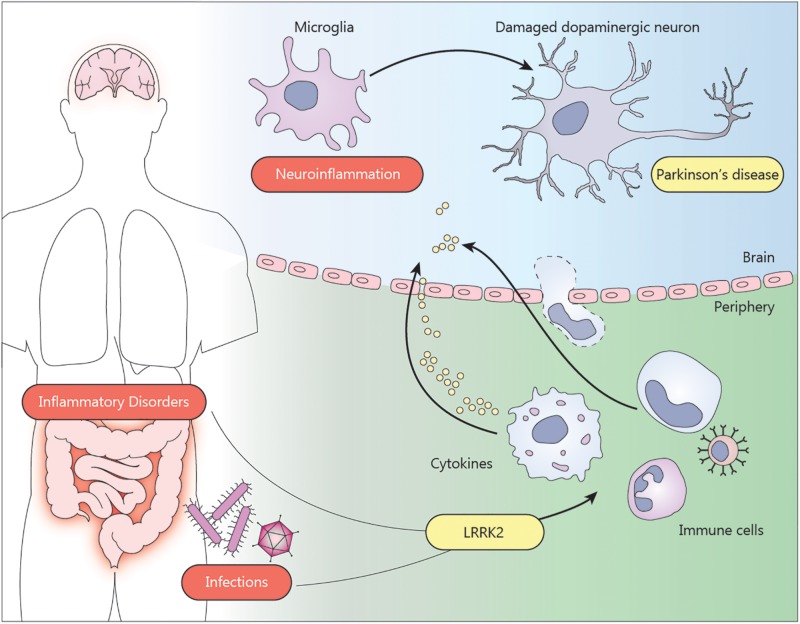
Environmental factors such as inflammatory bowel disease or infections can trigger neuroinflammation and contribute to the pathogenesis of Parkinson’s disease. The presence of LRRK2 mutations exacerbate the pro-inflammatory state of the immune cells from the periphery. Infiltration of monocytes, T cells or cytokines through the blood brain barrier can induce the activation of microglia in the brain. The neuroinflammatory environment affects the dopaminergic neurons in the substantia nigra, contributing to the neurodegeneration.

References

    1. Albanese F., Novello S., Morari M. (2019). Autophagy and LRRK2 in the aging brain. Front. Neurosci. 13:1352. 10.3389/fnins.2019.01352 - DOI - PMC - PubMed
    1. Berwick D. C., Heaton G. R., Azeggagh S., Harvey K. (2019). LRRK2 Biology from structure to dysfunction: research progresses, but the themes remain the same. Mol. Neurodegener. 14:49. 10.1186/s13024-019-0344-2 - DOI - PMC - PubMed
    1. Bieri G., Brahic M., Bousset L., Couthouis J., Kramer N. J., Ma R., et al. (2019). LRRK2 modifies α-syn pathology and spread in mouse models and human neurons. Acta Neuropathol. 137 961–980. 10.1007/s00401-019-01995-0 - DOI - PMC - PubMed
    1. Biskup S., Moore D. J., Celsi F., Higashi S., West A. B., Andrabi S. A., et al. (2006). Localization of LRRK2 to membranous and vesicular structures in mammalian brain. Ann. Neurol. 60 557–569. 10.1002/ana.21019 - DOI - PubMed
    1. Bliederhaeuser C., Zondler L., Grozdanov V., Ruf W. P., Brenner D., Melrose H. L., et al. (2016). LRRK2 contributes to monocyte dysregulation in Parkinson’s disease. Acta Neuropathol. Commun. 4:123 10.1186/s40478-016-0396-2 - DOI - PMC - PubMed

LinkOut - more resources