


A protective nesting association with native species counteracts biotic resistance for the spread of an invasive parakeet from urban into rural habitats
- PMID: 32411270
- PMCID: PMC7206781
- DOI: 10.1186/s12983-020-00360-2
A protective nesting association with native species counteracts biotic resistance for the spread of an invasive parakeet from urban into rural habitats
Erratum in
-
Correction: A protective nesting association with native species counteracts biotic resistance for the spread of an invasive parakeet from urban into rural habitats.Front Zool. 2023 Apr 6;20(1):11. doi: 10.1186/s12983-023-00490-3. Front Zool. 2023. PMID: 37024908 Free PMC article. No abstract available.
Abstract
Background: Non-native species are often introduced in cities, where they take advantage of microclimatic conditions, resources provided by humans, and competitor/predator release to establish and proliferate. However, native communities in the surrounding rural or natural areas usually halt their spread through biotic resistance, mainly via top-down regulative processes (predation pressure). Here, we show an unusual commensal interaction between exotic and native bird species that favours the spread of the former from urban to rural habitats.
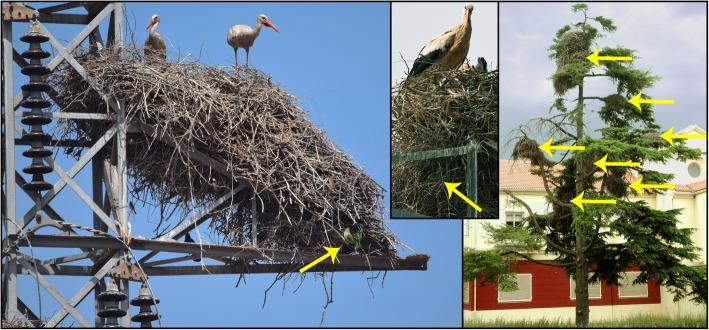
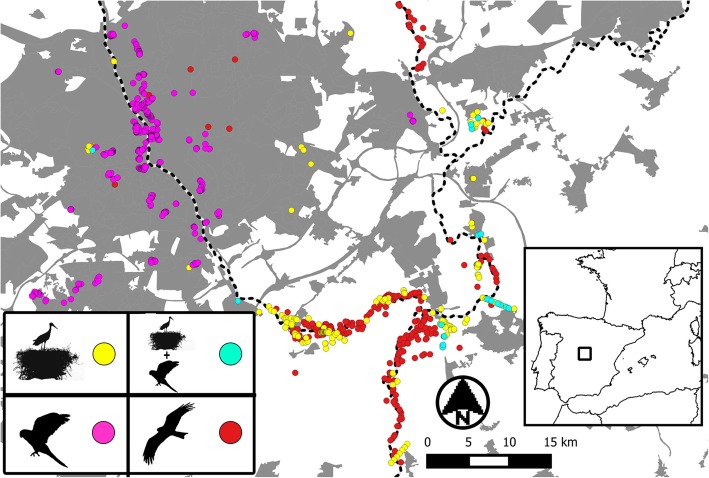
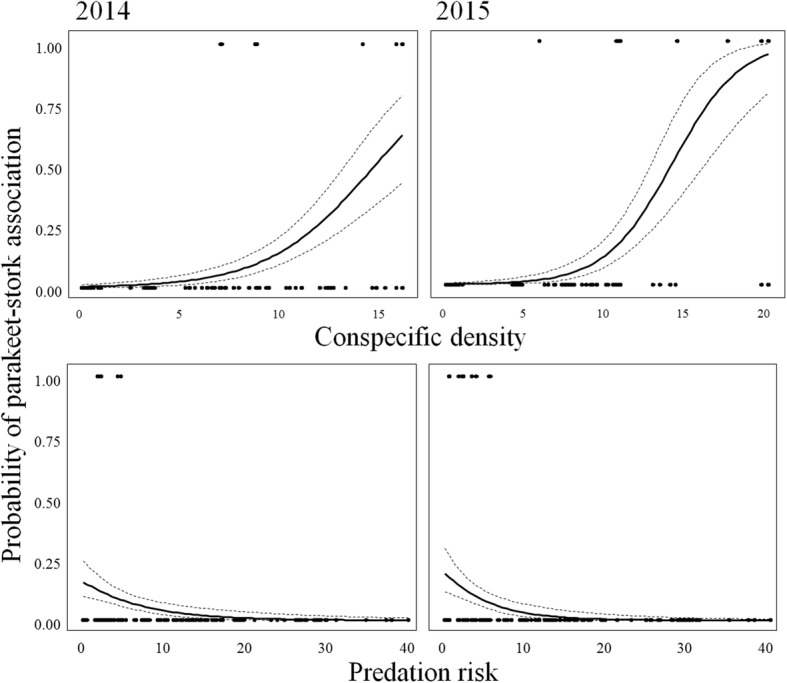
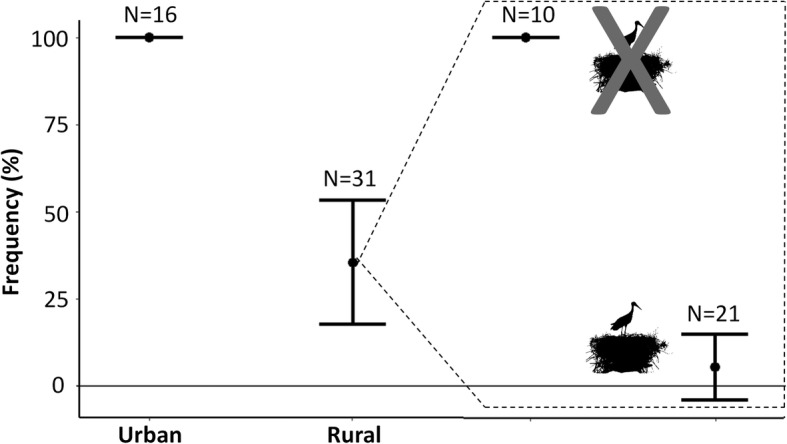
Results: We show how Monk parakeets Myiopsitta monachus, an invasive species often introduced in cities worldwide, associated for breeding with a much larger, native species (the white stork Ciconia ciconia) to reduce predation risk in central Spain, thus allowing their colonization of rural areas. Parakeets selected stork nests close to conspecifics and where breeding raptors were less abundant. Parakeets always flushed when raptors approached their nests when breeding alone, but stayed at their nests when breeding in association with storks. Moreover, when storks abandoned a nest, parakeets abandoned it in the following year, suggesting that storks actually confer protection against predators.
Conclusions: Our results show how a protective-nesting association between invasive and native species can counteract biotic resistance to allow the spread of an invasive species across non-urban habitats, where they may become crop pests. Monk parakeet populations are now growing exponentially in several cities in several Mediterranean countries, where they coexist with white storks. Therefore, management plans should consider this risk of spread into rural areas and favour native predators as potential biological controllers.
Keywords: Biological invasions; Biotic resistance; Commensalism; Facilitation; Monk parakeet; Predation pressure; White stork.
© The Author(s) 2020.
Conflict of interest statement
Competing interestsThe authors declare that they have no competing interests.
Figures
References
-
- Aagaard K, Lockwood J. Exotic birds show lags in population growth. Divers Distrib 2014;20(5):547–554. https://doi.org/10.1111/ddi.12175.
-
- Abellán P, Carrete M, Anadón J D, Cardador L, Tella, JL. Non-random patterns and temporal trends (1912–2012) in the transport, introduction and establishment of exotic birds in Spain and Portugal. Divers Distrib 2016;22(3):263–273. https://doi.org/10.1111/ddi.12403.
-
- Abellán P, Tella JL, Carrete M, Cardador L, Anadón JD. Climate matching drives spread rate but not establishment success in recent unintentional bird introductions. P Natl Acad Sci Usa 2017;114(35):9385–9390. https://doi.org/10.1073/pnas.1704815114. - PMC - PubMed
-
- Alberti M. Eco-evolutionary dynamics in an urbanizing planet. Trends Ecol Evol 2015;30(2):114–126. https://doi.org/10.1016/j.tree.2014.11.007. - PubMed
-
- Alston KP, Richardson DM. The roles of habitat features, disturbance, and distance from putative source populations in structuring alien plant invasions at the urban/wildland interface on the cape peninsula, South Africa Biol Conserv 2006;132(2):183–198. https://doi.org/10.1016/j.biocon.2006.03.023.
LinkOut - more resources
Full Text Sources
