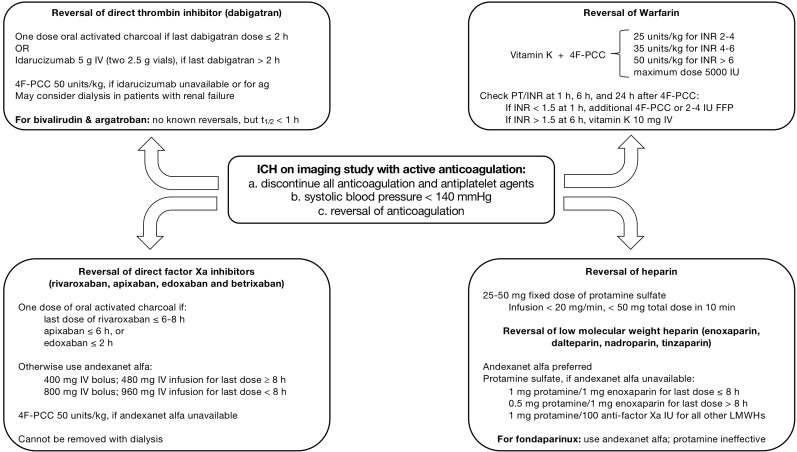
Coagulopathy reversal in intracerebral haemorrhage
- PMID: 32411405
- PMCID: PMC7213499
- DOI: 10.1136/svn-2019-000274
Coagulopathy reversal in intracerebral haemorrhage
Abstract
As intracerebral hemorrahge becomes more frequent as a result of an aging population with greater comorbidities, rapid identification and reversal of precipitators becomes increasingly paramount. The aformentioned population will ever more likely be on some form of anticoagulant therapy. Understanding the mechanisms of these agents and means by which to reverse them early on is critical in managing the acute intracerebral hemorrhage.
Keywords: anticoagulation; cerebral hemorrhage; coagulopathy reversal; hemorrhagic stroke.
© Author(s) (or their employer(s)) 2020. Re-use permitted under CC BY-NC. No commercial re-use. See rights and permissions. Published by BMJ.
Conflict of interest statement
Competing interests: None declared.
Figures
References
-
- Huttner HB, Schellinger PD, Hartmann M, et al. . Hematoma growth and outcome in treated neurocritical care patients with intracerebral hemorrhage related to oral anticoagulant therapy: comparison of acute treatment strategies using vitamin K, fresh frozen plasma, and prothrombin complex concentrates. Stroke 2006;37:1465–70. 10.1161/01.STR.0000221786.81354.d6 - DOI - PubMed
Publication types
MeSH terms
Substances
LinkOut - more resources
Full Text Sources
Medical
Research Materials