Review
. 2020 Jan 17:2020:1924379.
doi: 10.1155/2020/1924379. eCollection 2020.

CAR-T Cell Therapy in Cancer: Tribulations and Road Ahead

Affiliations
Review

CAR-T Cell Therapy in Cancer: Tribulations and Road Ahead

Qingyang Zhang et al. J Immunol Res. .

Abstract

Chimeric antigen receptor- (CAR-) T cell therapy is one of the most recent innovative immunotherapies and is rapidly evolving. Like other technologies, CAR-T cell therapy has undergone a long development process, and persistent explorations of the actions of the intracellular signaling domain and make several improvements have led to the superior efficacy when anti-CD19 CAR-T cell treatments in B cell cancers. At present, CAR-T cell therapy is developing rapidly, and many clinical trials have been established on a global scale, which has great commercial potential. This review mainly describes the toxicity of CAR-T cell therapy and the challenges of CAR-T cells in the treatment of solid tumors, and looks forward to future development and opportunities for immunotherapy and reviews major breakthroughs in CAR-T cell therapy.


Conflict of interest statement

The authors declare no conflict of interest.

Figures
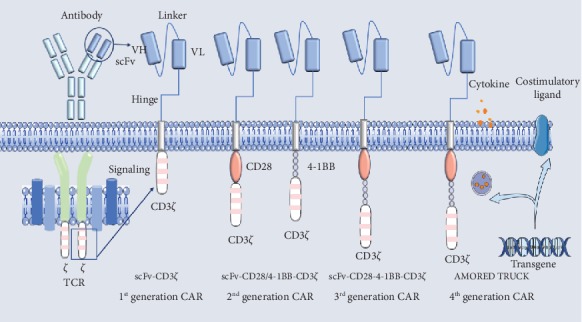
Figure 1
Figure 1
The development and design principle of CAR-T three generations. The first generation of CAR-T cells was composed of immunoglobulin scFv and CD3 complexes. Most of the experiments did not respond well in cell expansion, in vivo survival time, cytokine secretion, etc., and the therapeutic effect was not as expected. The second- and third-generation CARs add costimulatory molecules such as CD28, CD134, and CD137 (4-1BB) to the chimeric receptor, which enables the cells to obtain long-lasting in vitro proliferation ability and strong cytokine secretion ability. The fourth generation of CAR-T can solve the problem that traditional CAR-T cannot identify and remove some antigens that are not explicitly recognized by T cells.
Figure 2
Figure 2
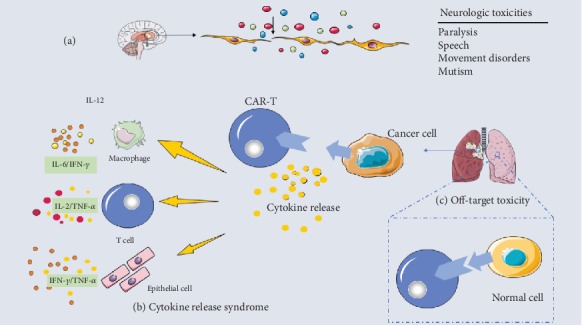
Common side effects of CAR-T cell therapy. (a) CAR-T cells can be examined in routine examinations of cerebrospinal fluid, which allows increased transport of CAR-T cells and other lymphocytes to the central nervous system and increases permeability to soluble mediators. (b) Cytokine storms are the most common form of CAR-T toxicity. The affinity and conduction function of CAR-T cells cause rapid release of a large number of cytokines such as TNF-α, IL-1, IL-2, IL-6, IFN-α, and IFN-γ to cause acute respiratory distress syndrome after binding to relevant antigens and multiple organ failure. (c) Off-target effects are the effect of cells on additional targets outside of the design, leading to autoimmune disease responses to normal tissues.

References

    1. Ruhlmann C. H., Iversen T. Z., Okera M., et al. Multinational study exploring patients’ perceptions of side-effects induced by chemo-radiotherapy. Radiotherapy and Oncology. 2015;117(2):333–337. doi: 10.1016/j.radonc.2015.09.014. - DOI - PubMed
    1. Emens L. A., Ascierto P. A., Darcy P. K., et al. Cancer immunotherapy: opportunities and challenges in the rapidly evolving clinical landscape. European Journal of Cancer. 2017;81:116–129. doi: 10.1016/j.ejca.2017.01.035. - DOI - PubMed
    1. June C. H., O'Connor R. S., Kawalekar O. U., Ghassemi S., Milone M. C. CAR T cell immunotherapy for human cancer. Science. 2018;359(6382):1361–1365. doi: 10.1126/science.aar6711. - DOI - PubMed
    1. Gowrishankar K., Birtwistle L., Micklethwaite K. Manipulating the tumor microenvironment by adoptive cell transfer of CAR T-cells. Mammalian Genome. 2018;29(11-12):739–756. doi: 10.1007/s00335-018-9756-5. - DOI - PubMed
    1. Lu Y. C., Yao X., Crystal J. S., et al. Efficient identification of mutated cancer antigens recognized by T cells associated with durable tumor regressions. Clinical Cancer Research. 2014;20(13):3401–3410. doi: 10.1158/1078-0432.CCR-14-0433. - DOI - PMC - PubMed

MeSH terms