


Vitamin D concentrations and COVID-19 infection in UK Biobank
- PMID: 32413819
- PMCID: PMC7204679
- DOI: 10.1016/j.dsx.2020.04.050
Vitamin D concentrations and COVID-19 infection in UK Biobank
Erratum in
-
Corrigendum to "Vitamin D concentrations and COVID-19 infection in UK Biobank" [Diabetes Metabol Syndr: Clin Res Rev 2020 14 (4) 561-5].Diabetes Metab Syndr. 2020 Sep-Oct;14(5):1315-1316. doi: 10.1016/j.dsx.2020.07.021. Epub 2020 Jul 23. Diabetes Metab Syndr. 2020. PMID: 32755828 Free PMC article. No abstract available.
Abstract
Background and aims: COVID-19 and low levels of vitamin D appear to disproportionately affect black and minority ethnic individuals. We aimed to establish whether blood 25-hydroxyvitamin D (25(OH)D) concentration was associated with COVID-19 risk, and whether it explained the higher incidence of COVID-19 in black and South Asian people.
Methods: UK Biobank recruited 502,624 participants aged 37-73 years between 2006 and 2010. Baseline exposure data, including 25(OH)D concentration and ethnicity, were linked to COVID-19 test results. Univariable and multivariable logistic regression analyses were performed for the association between 25(OH)D and confirmed COVID-19, and the association between ethnicity and both 25(OH)D and COVID-19.
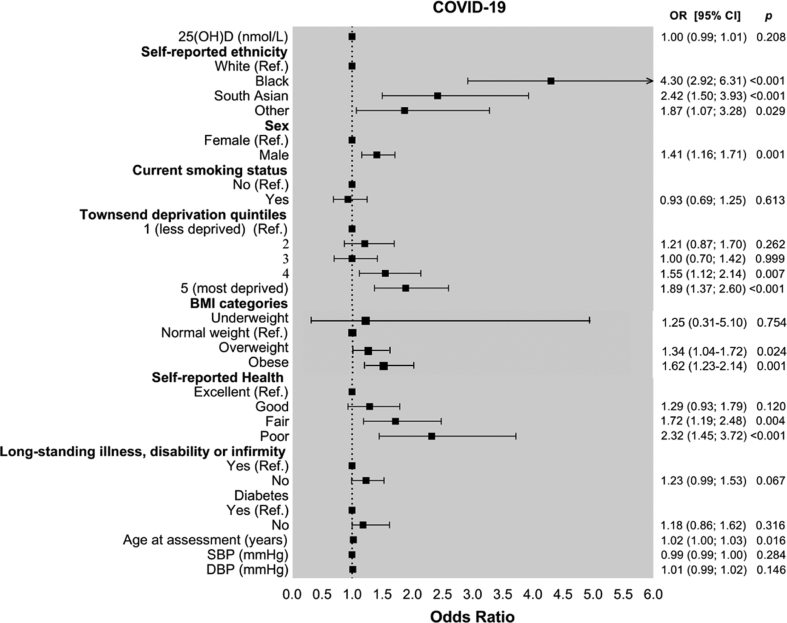
Results: Complete data were available for 348,598 UK Biobank participants. Of these, 449 had confirmed COVID-19 infection. Vitamin D was associated with COVID-19 infection univariably (OR = 0.99; 95% CI 0.99-0.999; p = 0.013), but not after adjustment for confounders (OR = 1.00; 95% CI = 0.998-1.01; p = 0.208). Ethnicity was associated with COVID-19 infection univariably (blacks versus whites OR = 5.32, 95% CI = 3.68-7.70, p-value<0.001; South Asians versus whites OR = 2.65, 95% CI = 1.65-4.25, p-value<0.001). Adjustment for 25(OH)D concentration made little difference to the magnitude of the association.
Conclusions: Our findings do not support a potential link between vitamin D concentrations and risk of COVID-19 infection, nor that vitamin D concentration may explain ethnic differences in COVID-19 infection.
Keywords: COVID-19; Ethnicity; Vitamin D.
Copyright © 2020 Diabetes India. Published by Elsevier Ltd. All rights reserved.
Conflict of interest statement
Declaration of competing interest The authors declare no conflict of interest.
Figures
Comment in
-
Response to 'Vitamin D concentrations and COVID-19 infection in UK Biobank'.Diabetes Metab Syndr. 2020 Sep-Oct;14(5):777. doi: 10.1016/j.dsx.2020.05.049. Epub 2020 Jun 4. Diabetes Metab Syndr. 2020. PMID: 32526626 Free PMC article. No abstract available.
-
Letter in response to the article: Vitamin D concentrations and COVID-19 infection in UK biobank (Hastie et al.).Diabetes Metab Syndr. 2020 Sep-Oct;14(5):893-894. doi: 10.1016/j.dsx.2020.05.046. Epub 2020 Jun 13. Diabetes Metab Syndr. 2020. PMID: 32563941 Free PMC article. No abstract available.
-
Letter to the editor in response to the article: "Vitamin D concentrations and COVID-19 infection in UK biobank" (Hastie et al.).Diabetes Metab Syndr. 2021 Mar-Apr;15(2):643-644. doi: 10.1016/j.dsx.2021.02.016. Epub 2021 Feb 9. Diabetes Metab Syndr. 2021. PMID: 33722481 Free PMC article. No abstract available.
References
-
- Intensive Care National Audit and Research Centre . 2020. Covid-19 study case mix programme.
-
- Office for National Statistics 2011 Census. 2011. https://www.ons.gov.uk/census/2011census cited; Available from.
-
- John Hopkins Coronavirus Resource Centre 2020. https://coronavirus.jhu.edu/data/racial-data-transparency cited; Available from.
-
- Khunti K., Singh A.K., Pareek M., Hanif W. Is ethnicity linked to incidence or outcomes of covid-19? BMJ. 2020;369:m1548. - PubMed
-
- UK Government Ethnicity facts and figures. 2018. https://www.ethnicity-facts-figures.service.gov.uk/uk-population-by-ethn... cited; Available from.
MeSH terms
Substances
Grants and funding
LinkOut - more resources
Full Text Sources
Medical
