


The fentanyl epidemic in Estonia: factors in its evolution and opportunities for a comprehensive public health response, a scoping review
- PMID: 32416523
- PMCID: PMC7337094
- DOI: 10.1016/j.drugpo.2020.102757
The fentanyl epidemic in Estonia: factors in its evolution and opportunities for a comprehensive public health response, a scoping review
Abstract
Background: The spread of illicitly manufactured fentanyl has the potential to greatly increase the fatal overdoses in many places in the world. The purpose of this paper is to analyse the evolution of fentanyl use epidemic in Estonia.
Methods: this scoping review is based on extensive review and synthesis of broad range of literature: research reports, newspaper, magazine, coverage of illicit fentanyl use; policy documents, position papers, reports released by government agencies, and surveillance data.
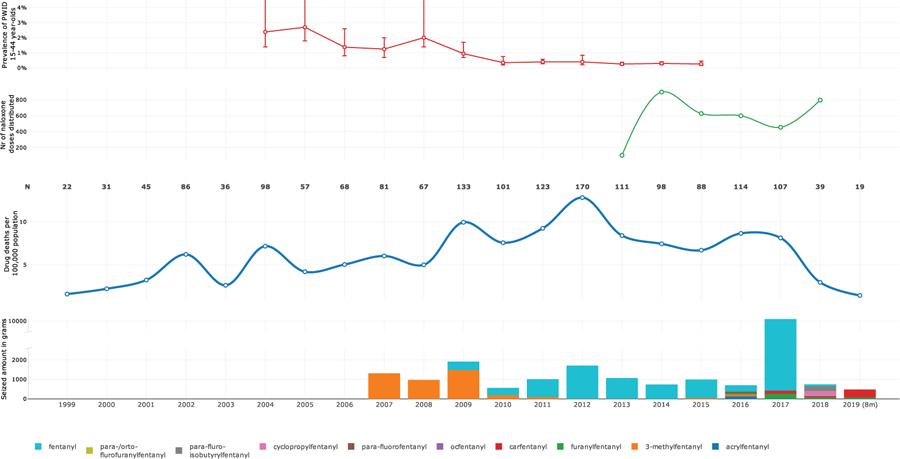
Results: For an over a decade up to 2017, Estonia has had the highest overdose death mortality in Europe. The use of (injected) fentanyl is a major contributor to the Estonian overdose death epidemic. Shutting down a major producer and distributor of illicit fentanyl has been extremely effective in curbing the number of overdose deaths. Unfortunately, this supply-side intervention came ten years into the epidemic, and might be difficult to replicate in settings with decentralized production. In areas faced by fentanyl we would recommend large-scale implementation of opiate substitution treatment and naloxone distribution, syringe service programs to provide for safer injecting and link to other services (high frequencies of fentanyl injection create high risk for HIV and HCV transmission), and programs, such as "Break the Cycle," to reduce initiation into injecting drug use. Further, the means of responding to emerging substances should match the world in which different substances can be rapidly introduced, and where people who use drugs can change preferences based on market availability.
Conclusion: Addressing illicitly manufactured fentanyl may serve as a public health learning experience for developing early detection and rapid response programs in rapidly changing drug use environments.
Keywords: Estonia; Fentanyl; HIV; drug death; illicitly produced fentanyl; overdose.
Copyright © 2020 Elsevier B.V. All rights reserved.
Conflict of interest statement
Declaration of Competing Interest None
Figures
References
-
- Abel-Ollo K, Talu A, Vals K, Vorobjov S, Paimre M, Ahven A, et al. (2007) National Report (2006 data) to the EMCDDA by the REITOX National Focal Point. Estonia. New developments and trends and in-depth information on selected issues. Available at: http://www.emcdda.europa.eu/system/files/publications/949/NR2007Estonia.pdf (accessed 15 October 2019).
-
- Abel-Ollo K Fentanyl overdose deaths emergency and response in Estonia. Lisbon Addictions2019, Lisbon, Portugal, October 24, 2019. Available at: https://www.lisbonaddictions.eu/lisbon-addictions-2019/presentations/fen... (accessed October 15, 2019).
-
- Arksey H, & O’Malley L (2005). Scoping studies: towards a methodological framework. Int J Soc Res Methodol, 8(1), 19–32.
-
- Ashilevi J (2016). AASTA KÕIGE UNCOOL’IM RAAMAT [The most uncool book of the year]. Müürileht 2016; September 19. Available at: https://www.muurileht.ee/aastakoige-uncoolim-raamat/ (accessed on 19 December 2019).
Publication types
MeSH terms
Substances
Grants and funding
LinkOut - more resources
Full Text Sources
