


Effects of environmental complexity on welfare indicators of fast-growing broiler chickens
- PMID: 32416804
- PMCID: PMC7587623
- DOI: 10.3382/ps/pez510
Effects of environmental complexity on welfare indicators of fast-growing broiler chickens
Abstract
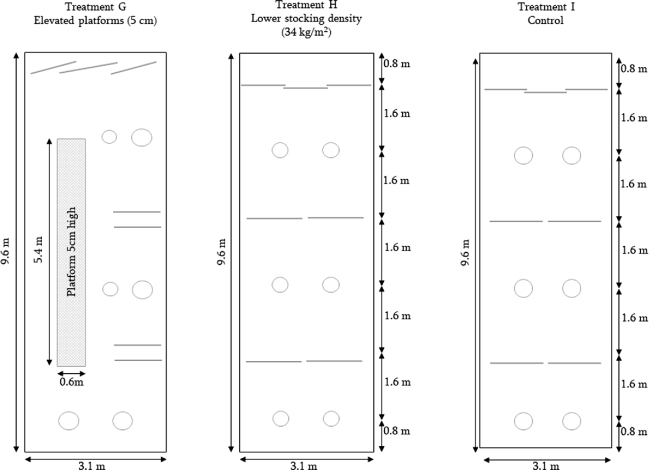
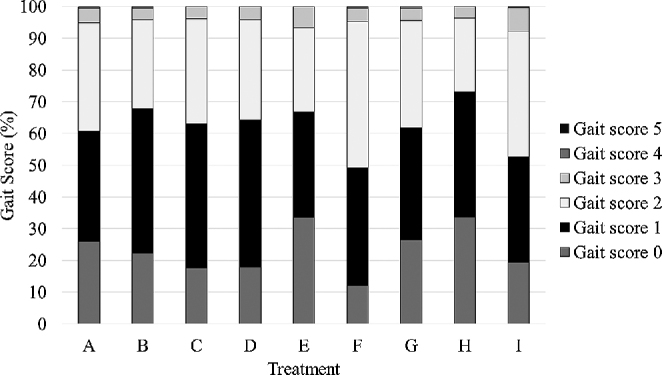
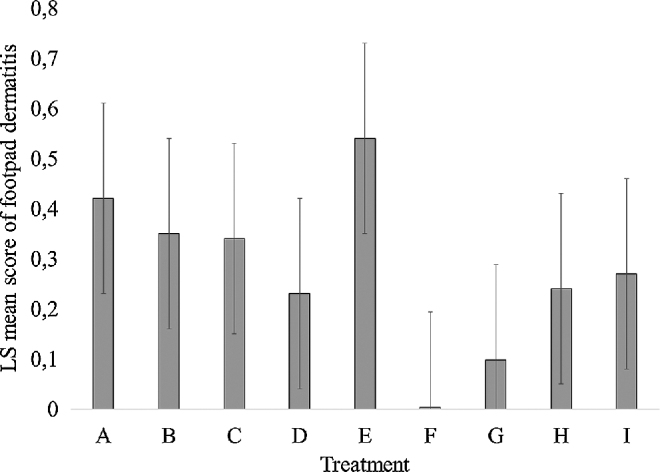
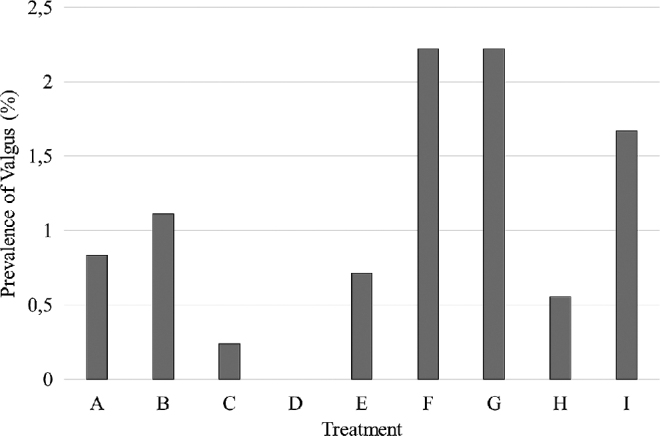
Increasing environmental complexity, e.g., by providing environmental enrichment, has been suggested as a way to increase activity levels and improve leg health in broilers. The aim of this study was to investigate the effects of different types of environmental complexity on leg health and measures of welfare of fast-growing broilers housed according to conventional European legislation. A total of 58 pens with approximately 500 broilers each (Ross 308), corresponding to a stocking density of 40 kg/m2, were used. A total of 8 treatment groups, of which 5 were enrichment treatments (roughage, vertical panels, straw bales, and elevated platforms at 5 and 30 cm) and 3 were standard resources manipulations [increased distances between feed and water (7 m and 3.5 m), stocking density reduced to 34 kg/m2, and 1 control group (1.5 m distance between feed and water and no enrichment objects)] were randomly assigned to each pen. At 35 D of age, 60 birds from each pen were assessed for gait, footpad dermatitis, hock burns, plumage cleanliness, presence of scratches, and leg deformities. Birds housed with 30 cm elevated platforms had worse gait compared to those housed with straw bales and at the lower stocking density of 34 kg/m2 (P = 0.004 and P = 0.001). Broilers from the control group also had worse gait compared to those housed at 34 kg/m2 stocking density. In addition, birds housed with access to a 30 cm elevated platform had healthier footpads compared to birds housed with access to straw bales (P = 0.0001) and with increased distance between feed and water (P = 0.011). Furthermore, birds housed with straw bales had worse footpad condition compared to birds with access to a 5 cm elevated platform (P = 0.002). There were no observed treatment effects on scratches, plumage cleanliness, leg deformities and body weight (P > 0.05). Based on the welfare indicators used in the present study, decreased stocking density has the potential of improving animal welfare, whereas the effects of elevated platforms need to be further studied before a final conclusion can be drawn, as footpad health was positively affected, but walking ability was impaired.
Keywords: broiler chicken; contact dermatitis; environmental enrichment; gait score; welfare.
Copyright © 2019 The Author(s). Published by Elsevier Inc. All rights reserved.
Figures

References
-
- Arnould C., Bizeray D., Faure J.M., Leterrier C. Effects of the addition of sand and string to pens on use of space, activity, tarsal angulations and bone composition in broiler chickens. Anim. Welf. 2004;13:87–94.
-
- Bach M.H., Tahamtani F.M., Pedersen I.J., Riber A.R. Effects of environmental complexity on behaviour in fast-growing broiler chickens. Applied Animal Behaviour Science. 2019;219 doi: 10.1016/j.applanim.2019.104840. - DOI
-
- Bailie C.L., Ball M.E.E., O'Connell N.E. Influence of the provision of natural light and straw bales on activity levels and leg health in commercial broiler chickens. Animal. 2013;7:618–626. - PubMed
-
- Bassler A.W., Arnould C., Butterworth A., Colin L., De Jong I.C., Ferrante V., Ferrari P., Haslam S., Wemelsfelder F., Blokhuis H.J. Potential risk factors associated with contact dermatitis, lameness, negative emotional state, and fear of humans in broiler chicken flocks. Poult. Sci. 2013;92:2811–2826. - PubMed
-
- Baxter M., O'Connell N.E. Proc. EAAP 67th Annual Meeting Belfast, Northern Ireland. Aug. 29–Sept. 1. 2016. Commercial comparison of potential dustbathing substrates for intensively farmed broilers.
MeSH terms
LinkOut - more resources
Full Text Sources
