


Evaluation of COVID-19 epidemic outbreak caused by temporal contact-increase in South Korea
- PMID: 32417246
- PMCID: PMC7224674
- DOI: 10.1016/j.ijid.2020.05.036
Evaluation of COVID-19 epidemic outbreak caused by temporal contact-increase in South Korea
Abstract
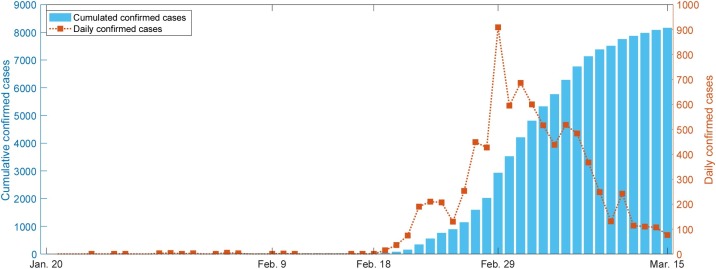
Objectives: On March 15, 2020, 61.3% of the confirmed cases of COVID-19 infection in South Korea are associated with the worship service that was organized on February 9 in the Shincheonji Church of Jesus in Daegu. We aim to evaluate the effects of mass infection in South Korea and assess the preventive control intervention.
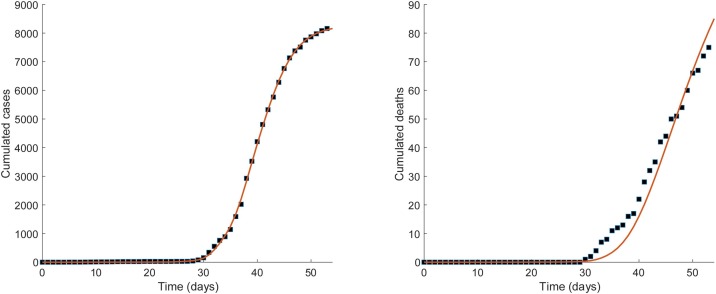
Method: Using openly available data of daily cumulative confirmed cases and deaths, the basic and effective reproduction numbers was estimated using a modified susceptible-exposed-infected-recovered-type epidemic model.
Results: The basic reproduction number was estimated to be R0=1.77. The effective reproduction number increased approximately 20 times after the mass infections from the 31 st patient, which was confirmed on February 9 in the Shincheonji Church of Jesus, Daegu. However, the effective reproduction number decreased to less than unity after February 28 owing to the implementation of high-level preventive control interventions in South Korea, coupled with voluntary prevention actions by citizens.
Conclusion: Preventive action and control intervention were successfully established in South Korea.
Keywords: 2019 novel coronavirus disease; Effective reproduction number; Epidemic model; SARS-CoV-2.
Copyright © 2020 The Author(s). Published by Elsevier Ltd.. All rights reserved.
Figures
References
-
- A Singapore Government Agency . 2020. COVID-19: cases in Singapore [Internet] Available from: https://www.gov.sg/article/covid-19-cases-in-singapore.
-
- Champredon D., Dushoff J., Earn D.J.D. Equivalence of the Erlang-distributed SEIR epidemic model and the renewal equation. SIAM J Appl Math. 2018;78(6):3258–3278.
Publication types
MeSH terms
LinkOut - more resources
Full Text Sources
Miscellaneous
