


Promises and Pitfalls of Latent Variable Approaches to Understanding Psychopathology: Reply to Burke and Johnston, Eid, Junghänel and Colleagues, and Willoughby
- PMID: 32418162
- PMCID: PMC8020488
- DOI: 10.1007/s10802-020-00656-1
Promises and Pitfalls of Latent Variable Approaches to Understanding Psychopathology: Reply to Burke and Johnston, Eid, Junghänel and Colleagues, and Willoughby
Erratum in
-
Correction to: Promises and Pitfalls of Latent Variable Approaches to Understanding Psychopathology: Reply to Burke and Johnston, Eid, Junghänel and Colleagues, and Willoughby.J Abnorm Child Psychol. 2020 Nov;48(11):1527. doi: 10.1007/s10802-020-00690-z. J Abnorm Child Psychol. 2020. PMID: 32894415
Abstract
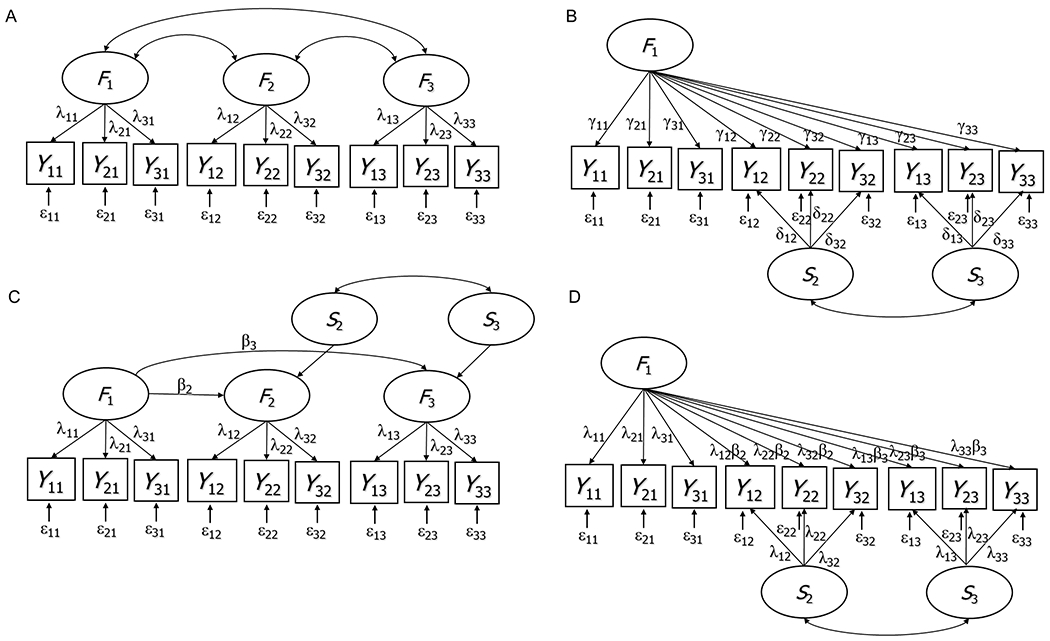
The commentaries by Burke and Johnston (this issue), Eid (this issue), Junghänel et al. (this issue), and Willoughby (this issue) on Burns et al. (this issue) provide useful context for comparing three latent variable modeling approaches to understanding psychopathology-the correlated first-order syndrome-specific factors model, the bifactor S - 1 model, and the symmetrical bifactor model. The correlated first-order syndrome-specific factors model has proven useful in constructing explanatory models of psychopathology. The bifactor S - 1 model is also useful for examining the latent structure of psychopathology, especially in contexts with clear theoretical predictions. Joint use of correlated first-order syndrome-specific model and bifactor S - 1 model provides leverage for explaining psychopathology, and both models can also guide individual clinical assessment. In this reply, we further clarify reasons why the symmetrical bifactor model should not be used to study the latent structure of psychopathology and also discuss a restricted bifactor S - 1 model that is equivalent to the first-order syndrome-specific factors model.
Keywords: ADHD; Attention-deficit/hyperactivity disorder; Bifactor model; Factor analysis; Oppositional defiant disorder; Psychopathology; Restricted bifactor S – 1 model; p factor.
Conflict of interest statement
Figures
Comment on
-
The Bifactor S-1 Model: a Psychometrically Sounder Alternative to Test the Structure of ADHD and ODD?J Abnorm Child Psychol. 2020 Jul;48(7):911-915. doi: 10.1007/s10802-020-00645-4. J Abnorm Child Psychol. 2020. PMID: 32285353
References
Publication types
MeSH terms
Grants and funding
LinkOut - more resources
Full Text Sources
