


Persistent viral shedding of SARS-CoV-2 in faeces - a rapid review
- PMID: 32418307
- PMCID: PMC7276890
- DOI: 10.1111/codi.15138
Persistent viral shedding of SARS-CoV-2 in faeces - a rapid review
Abstract
Aim: In addition to respiratory symptoms, COVID-19 can present with gastrointestinal complaints suggesting possible faeco-oral transmission. The primary aim of this review was to establish the incidence and timing of positive faecal samples for SARS-CoV-2 in patients with COVID-19.
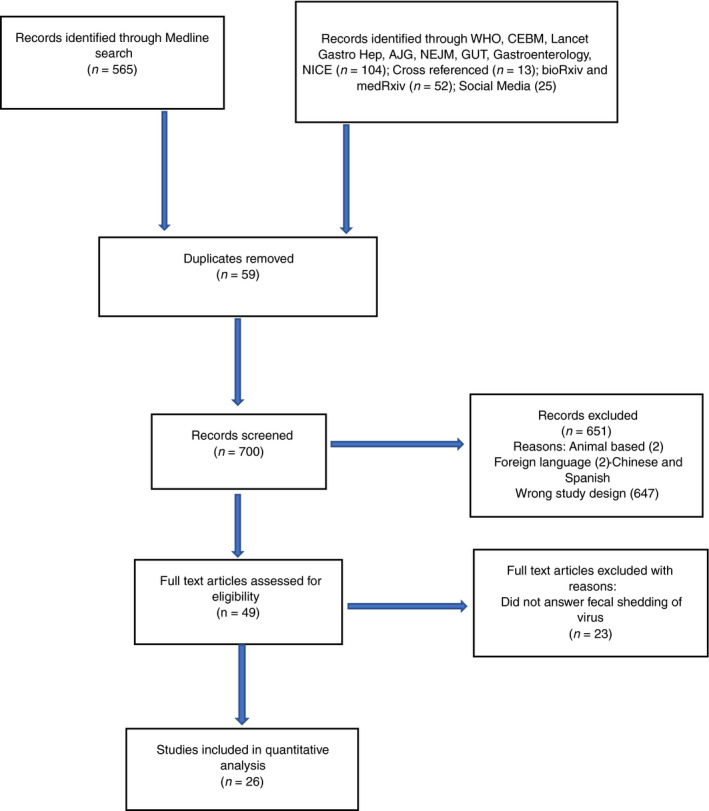
Methods: A systematic literature review identified studies describing COVID-19 patients tested for faecal virus. Search terms for MEDLINE included 'clinical', 'faeces', 'gastrointestinal secretions', 'stool', 'COVID-19', 'SARS-CoV-2' and '2019-nCoV'. Additional searches were done in the American Journal of Gastroenterology, Gastroenterology, Gut, Lancet Gastroenterology and Hepatology, the World Health Organization Database, the Centre for Evidence-Based Medicine, New England Journal of Medicine, social media and the National Institute for Health and Care Excellence, bioRxiv and medRxiv preprints. Data were extracted concerning the type of test, number and timing of positive samples, incidence of positive faecal tests after negative nasopharyngeal swabs and evidence of viable faecal virus or faeco-oral transmission of the virus.
Results: Twenty-six relevant articles were identified. Combining study results demonstrated that 53.9% of those tested for faecal RNA were positive. The duration of faecal viral shedding ranged from 1 to 33 days after a negative nasopharyngeal swab with one result remaining positive 47 days after onset of symptoms. There is insufficient evidence to suggest that COVID-19 is transmitted via faecally shed virus.
Conclusion: There is a high rate of positive polymerase chain reaction tests with persistence of SARS-CoV-2 in faecal samples of patients with COVID-19. Further research is needed to confirm if this virus is viable and the degree of transmission through the faeco-oral route. This may have important implications on isolation, recommended precautions and protective equipment for interventional procedures involving the gastrointestinal tract.
Keywords: COVID-19; SARS-CoV-2; faeces; gastrointestinal; viral shedding.
© 2020 The Authors. Colorectal Disease published by John Wiley & Sons Ltd on behalf of Association of Coloproctology of Great Britain and Ireland.
Conflict of interest statement
None declared.
Comment in
-
Viability of SARS-CoV-2 in faecal bio-aerosols.Colorectal Dis. 2020 Sep;22(9):1022. doi: 10.1111/codi.15181. Epub 2020 Jun 20. Colorectal Dis. 2020. PMID: 32515130 Free PMC article. No abstract available.
References
-
- Nobel YR, Phipps M, Zucker J et al. Gastrointestinal symptoms and COVID‐19: case–control study from the United States [published online ahead of print]. Gastroenterology 2020; 5085(20)30490‐X 10.1053/j.gastro.2020.04.017 - DOI
-
- PHE . Guidance for stepdown of infection control precautions and discharging COVID‐19 patients [Internet]. [Cited 2020 Apr 17]. Available from: https://www.gov.uk/government/publications/covid‐19‐guidance‐for‐stepdow...
-
- ECDC . Discharge criteria for confirmed COVID‐19 cases – when is it safe to discharge COVID‐19 cases from the hospital or end home isolation? (pp. 1–5). https://www.ecdc.europa.eu/en/publications‐data/novel‐coronavirus‐sars‐c....
-
- Santarpia JL, Rivera DN, Herrera V et al. Transmission potential of SARS‐CoV‐2 in viral shedding observed at the University of Nebraska Medical Center. medRxiv 2020; 1–12. 10.1101/2020.03.23.20039446 - DOI
Publication types
MeSH terms
Grants and funding
LinkOut - more resources
Full Text Sources
Medical
Miscellaneous
