


Review
doi: 10.1016/j.clim.2020.108459.
Epub 2020 May 11.
Immunoglobulins in the treatment of COVID-19 infection: Proceed with caution!
Affiliations
- PMID: 32418917
- PMCID: PMC7211658
- DOI: 10.1016/j.clim.2020.108459
Item in Clipboard
Review
Immunoglobulins in the treatment of COVID-19 infection: Proceed with caution!
Clin Immunol.
2020 Jul.
Abstract
The COVID-19 pandemic is one of the greatest infectious challenges in recent history. Presently, few treatment options exist and the availability of effective vaccines is at least one year away. There is an urgent need to find currently available, effective therapies in the treatment of patients with COVID-19 infection. In this review, we compare and contrast the use of intravenous immunoglobulin and hyperimmune globulin in the treatment of COVID-19 infection.
Keywords: COVID-19; Coronavirus; Hyperimmune globulin; Intravenous immunoglobulin; SARS-CoV-2.
Published by Elsevier Inc.
Conflict of interest statement
Declaration of Competing Interest The authors declare no conflicts of interest.
Figures
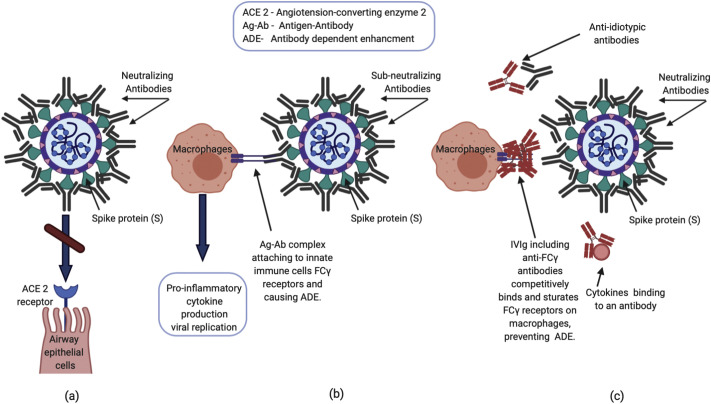
Proposed mechanisms of neutralizing antibodies and IVIG in COVID-19 infection. (a) Neutralizing antibodies prevent SARS-CoV2 spike protein from attaching to the ACE2 receptor, inhibiting viral entry into the cell. (b) Immune complexes consisting of viral antigens and anti-viral sub-neutralizing antibodies can activate Fcγ receptors on innate immune cells (e.g. macrophages) in the lung, triggering an exaggerated inflammatory response leading to acute lung injury via antibody dependent enhancement (ADE). Additionally, antibody-bound virus can be internalized through Fcγ receptors, enhancing viral replication. (c) Proposed mechanisms whereby IVIG exerts anti-inflammatory action include saturation of Fcγ receptor binding, anti-idiotypic binding to anti-viral antibodies, and binding of proinflammatory cytokines.
References
-
- Prompetchara E., Ketloy C., Palaga T. Immune responses in COVID-19 and potential vaccines: lessons learned from SARS and MERS epidemic. Asian Pac. J. Allergy Immunol. 2020;38(1):1–9. - PubMed
Publication types
MeSH terms
Substances
Grants and funding
LinkOut - more resources
Full Text Sources
Miscellaneous
