


Extinction of eastern Sahul megafauna coincides with sustained environmental deterioration
- PMID: 32418985
- PMCID: PMC7231803
- DOI: 10.1038/s41467-020-15785-w
Extinction of eastern Sahul megafauna coincides with sustained environmental deterioration
Abstract
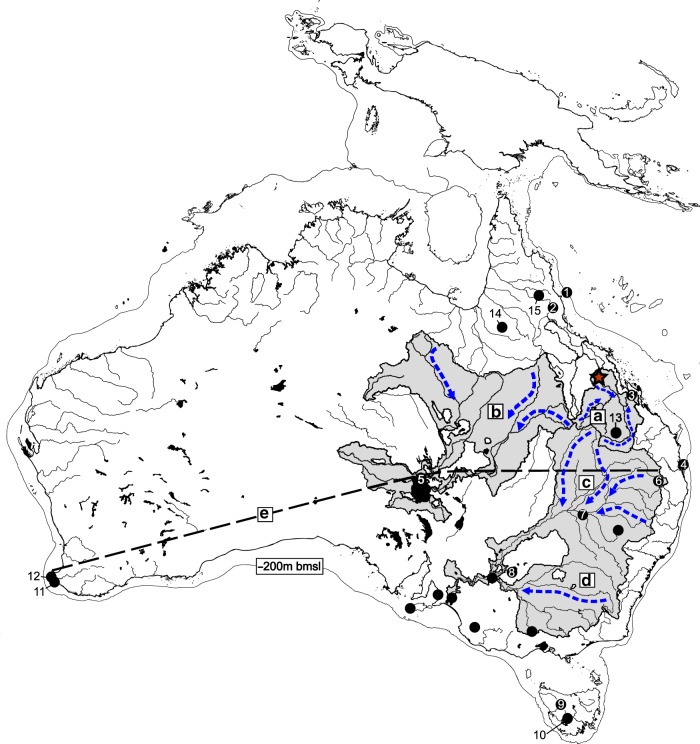
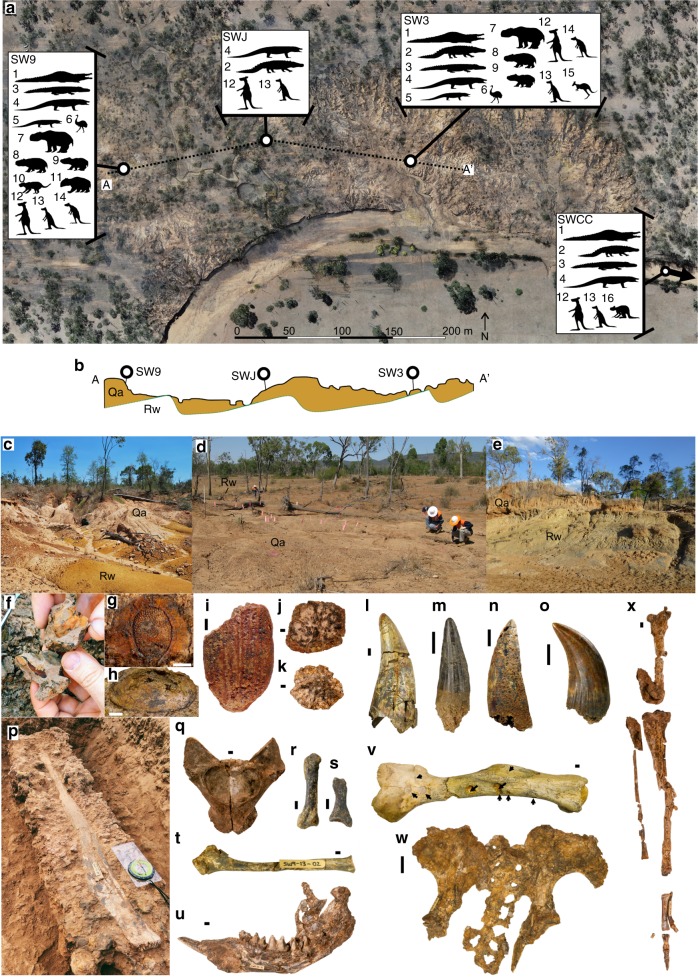
Explanations for the Upper Pleistocene extinction of megafauna from Sahul (Australia and New Guinea) remain unresolved. Extinction hypotheses have advanced climate or human-driven scenarios, in spite of over three quarters of Sahul lacking reliable biogeographic or chronologic data. Here we present new megafauna from north-eastern Australia that suffered extinction sometime after 40,100 (±1700) years ago. Megafauna fossils preserved alongside leaves, seeds, pollen and insects, indicate a sclerophyllous forest with heathy understorey that was home to aquatic and terrestrial carnivorous reptiles and megaherbivores, including the world's largest kangaroo. Megafauna species diversity is greater compared to southern sites of similar age, which is contrary to expectations if extinctions followed proposed migration routes for people across Sahul. Our results do not support rapid or synchronous human-mediated continental-wide extinction, or the proposed timing of peak extinction events. Instead, megafauna extinctions coincide with regionally staggered spatio-temporal deterioration in hydroclimate coupled with sustained environmental change.
Conflict of interest statement
The authors declare no competing interests.
Figures

References
-
- Martin, P. S. & Klein, R. G. Quaternary Extinctions: A Prehistoric Revolution (University of Arizona Press, 1984).
-
- Long, J. A., Archer, M., Flannery, T. & Hand, S. Prehistoric Mammals of Australia and New Guinea: One Hundred Million Years of Evolution (JHU Press, 2002).
-
- Price GJ, Webb GE. Late Pleistocene sedimentology, taphonomy and megafauna extinction on the Darling Downs, southeastern Queensland. Aust. J. Earth Sci. 2006;53:947–970.
-
- Hocknull SA, Zhao J-X, Feng Y-X, Webb GE. Responses of Quaternary rainforest vertebrates to climate change in Australia. Earth Planet. Sci. Lett. 2007;264:317–331.
-
- Prideaux GJ, et al. An arid-adapted middle Pleistocene vertebrate fauna from south-central Australia. Nature. 2007;445:422. - PubMed
Publication types
MeSH terms
Substances
LinkOut - more resources
Full Text Sources
Medical
