. 2020 Jul;123(2):207-215.
doi: 10.1038/s41416-020-0882-y. Epub 2020 May 18.

Immune checkpoint inhibitor-related colitis assessment and prognosis: can IBD scoring point the way?

Affiliations

Immune checkpoint inhibitor-related colitis assessment and prognosis: can IBD scoring point the way?

Vincent Ting Fung Cheung et al. Br J Cancer. 2020 Jul.

Abstract

Background: Immune checkpoint inhibitors (ICI) improve survival but cause immune-related adverse events (irAE). We sought to determine if CTCAE classification, IBD biomarkers/endoscopic/histological scores correlate with irAE colitis outcomes.

Methods: A dual-centre retrospective study was performed on patients receiving ICI for melanoma, NSCLC or urothelial cancer from 2012 to 2018. Demographics, clinical data, endoscopies (reanalysed using Mayo/Ulcerative Colitis Endoscopic Index of Severity (UCEIS) scores), histology (scored with Nancy Index) and treatment outcomes were analysed.

Results: In all, 1074 patients were analysed. Twelve percent (134) developed irAE colitis. Median patient age was 66, 59% were male. CTCAE diarrhoea grade does not correlate with steroid/ infliximab use. G3/4 colitis patients are more likely to need infliximab (p < 0.0001) but colitis grade does not correlate with steroid duration. CRP, albumin and haemoglobin do not correlate with severity. The UCEIS (p = 0.008) and Mayo (p = 0.016) scores correlate with severity/infliximab requirement. Patients with higher Nancy indices (3/4) are more likely to require infliximab (p = 0.03).

Conclusions: CTCAE assessment does not accurately reflect colitis severity and our data do not support its use in isolation, as this may negatively impact timely management. Our data support utilising endoscopic scoring for patients with >grade 1 CTCAE disease, and demonstrate the potential prognostic utility of objective histologic scoring.


Conflict of interest statement

V.T.F.C. has received speaker fees from Janssen. A.O.-B. is an MRC Clinical Training Fellow based at the University of Liverpool supported by the North West England Medical Research Council Fellowship Scheme in Clinical Pharmacology and Therapeutics, which is funded by the Medical Research Council, Roche Pharma, Eli Lilly and Company Limited, UCB Pharma, Novartis, the University of Liverpool and the University of Manchester. She has received honoraria for speaking at educational events from Roche Pharma, Bristol-Myers-Squibb (BMS) and MSD. She has received honoraria for attending BMS advisory boards. J.J.S. has received speaker fees from BMS and Pierre Fabre; acted as a consultant for BMS, MSD, Amgen, Delcath and Immunocore; and his institution has received research grants from BMS and AZ. M.P. is the director of the North West England Medical Research Council Fellowship Scheme in Clinical Pharmacology and Therapeutics. M.R.M. has acted as a consultant for Amgen, AstraZeneca, Bristol-Myers Squibb, Eisai, GlaxoSmithKline, Immunocore, Lilly, Merck, Millennium, Novartis, Physiomics, Rigontec, and Roche; his institution has received research grants from Abbvie, Amgen, AstraZeneca, Bristol-Myers Squibb, Clovis, Eisai, GlaxoSmithKline, Immunocore, Merck, Millennium, Novartis, Pfizer, Rigontec, Roche, and Vertex. O.B. has received speaker fees from BMS and has received a research grant from Celgene. M.T. has performed Advisory/Consultancy work for Pfizer, Novartis, Lilly, Janssen, Roche, Vaccitech, BMS, and has been a paid speaker for and received paid speaking engagements and education support from Novartis, Pfizer, Roche, Janssen, BMS, Genomic Health, Astellas, Esai, Everything Genetics. A.P. has received honoraria from Ipsen, Roche Bayer, Merck and BMC; and has received non-financial support from Ipsen and grants from Merck. The other authors have no conflicts of interest.

Figures
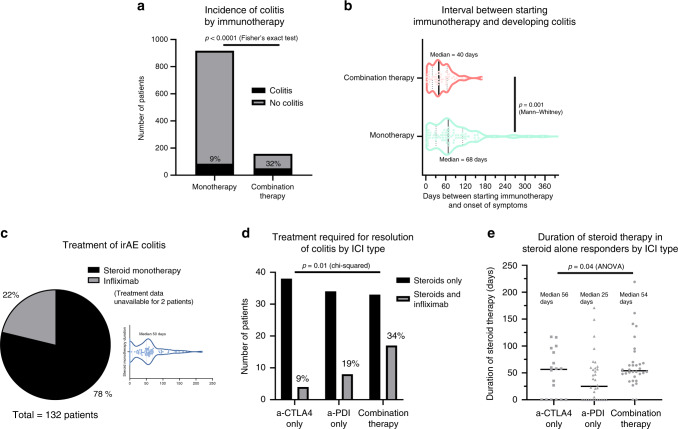
Fig. 1
Fig. 1. Presentation and treatment of immunotherapy-induced (irAE) colitis in this cohort (n = 1074) of patients.
a The incidence of colitis in single vs. combination immunotherapy (9% vs. 32%; Fisher’s exact test: p < 0.0001). b Onset of colitis after immunotherapy initiation (median 40 days in combination therapy vs. 68 days in monotherapy; Mann−Whitney test: p = 0.001). c 22% or 29 patients required infliximab for resolution of their colitis. Median duration of steroids in those who were treated with steroids alone was 50 days. d Number of patients requiring steroids monotherapy vs. steroids plus infliximab rescue therapy for treatment of their colitis; subdivided by immunotherapy regimen. Percentages requiring infliximab denoted in figure. Chi-squared test: p = 0.005 for difference between the CTLA4 and the combination therapy groups. e Mean duration of steroids in patients whose colitis responded to steroid monotherapy alone (patients requiring infliximab excluded); subdivided by immunotherapy regimen (median 56 days in anti-CTLA-4, 25 days in anti-PD-1, 54 days in combination; ANOVA: p = 0.04) (N.B. Data unavailable for 50% of patients in the aCTLA4 cohort).
Fig. 2
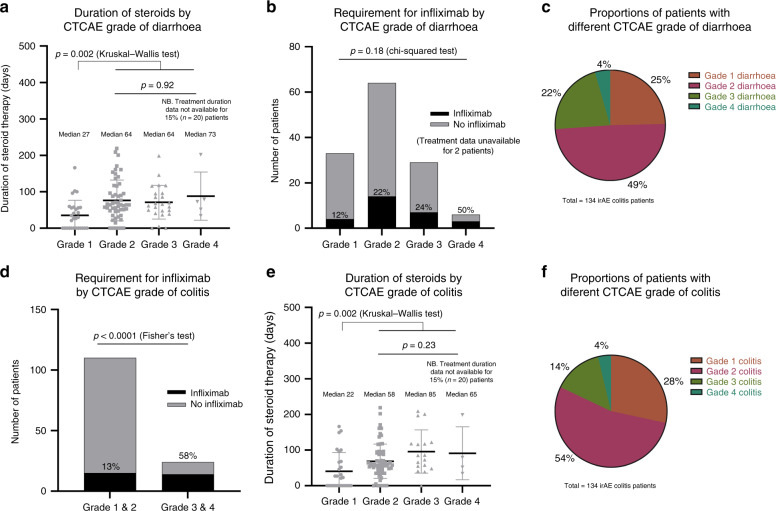
Fig. 2. CTCAE as predictor of disease severity and clinical course.
a Duration of steroids by CTCAE grade of diarrhoea shows difference between G1 and higher (G1 median 27 days, G2 64 days, G3 64 days, G4 73 days) (Kruskal−Wallis G1 vs. rest: p = 0.002) but no difference between other grades (Kruskal−Wallis: p = 0.92) (N.B. Treatment duration data not available for 15% (20) of patients). b Requirement for infliximab by CTCAE grade of diarrhoea shows no difference (chi-squared test: p = 0.18). c Proportion of patients by CTCAE grade of diarrhoea. d Requirement for infliximab by CTCAE grade of colitis shows patients with grade 3/4 colitis were more likely to be treated with infliximab than those with grade 1/2 (Fisher’s exact: p < 0.0001). e Duration of steroids by CTCAE grade of colitis shows difference between G1 and higher (G1 median 22 days, G2 58 days, G3 85 days, G4 65 days) (Kruskal−Wallis G1 vs. rest: p = 0.002) but no difference between other grades (Kruskal−Wallis: p = 0.23). f Proportion of patients by CTCAE grade of colitis.
Fig. 3
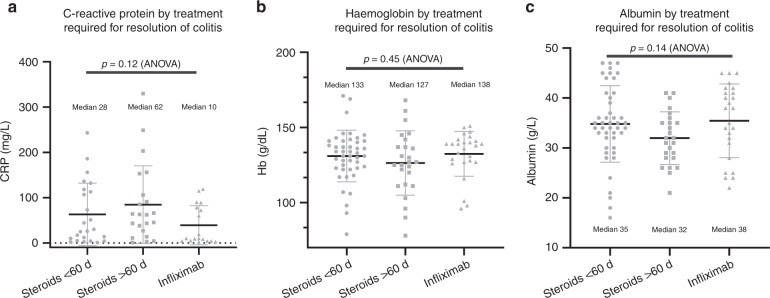
Fig. 3. Biochemical markers as predictor of disease severity and clinical course.
a C-reactive protein by treatment required for resolution of colitis (ANOVA: p = 0.12). b Haemoglobin by treatment required for resolution of colitis (ANOVA: p = 0.45). c Albumin by treatment required for resolution of colitis (ANOVA: p = 0.14).
Fig. 4
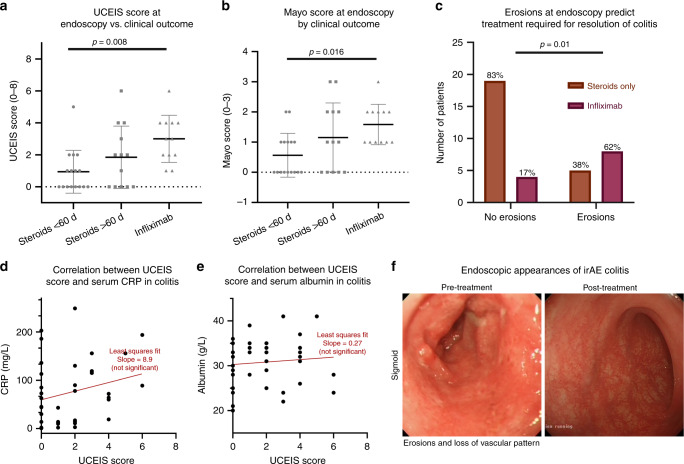
Fig. 4. Endoscopic predictors of disease severity and clinical course.
Patients classified by the treatment required for the resolution of their colitis into three groups—steroid monotherapy <60 days, steroid monotherapy >60 days, or requirement for infliximab in addition to steroids. UCEIS and Mayo scores as assessed by two independent assessors (κ = 0.51, 0.54 respectively). a UCEIS score by treatment required for resolution (ANOVA: p = 0.008). b Mayo score by treatment required for resolution (ANOVA: p = 0.016). c The correlation between the presence of ulcers at endoscopy and the odds of eventually requiring infliximab (Fisher’s exact test: p = 0.01, odds ratio 7.6). The correlation between the serum CRP (d) (Least squares fit: 8.9; not significant) and serum albumin (e) (Least squares fit: 0.27; not significant) with the severity of inflammation as assessed by the UCEIS score. f Characteristic endoscopy appearances during irAE colitis and after resolution. UCEIS ulcerative colitis endoscopic index of severity score, CRP C-reactive protein, irAE immunotherapy-related adverse events.
Fig. 5
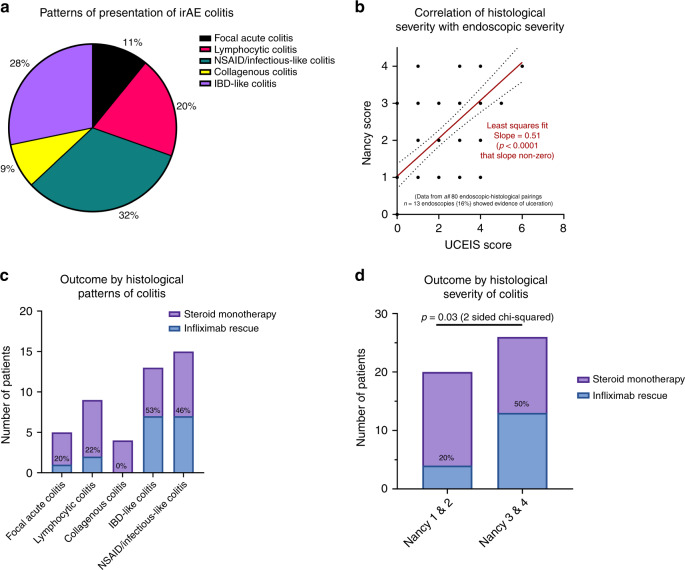
Fig. 5. Histopathological predictors of disease severity and clinical course.
a Patterns of presentation of histology in irAE colitis. b Correlation between histological severity and endoscopic severity (Least squares fit = 0.51; p < 0.0001). c Need for infliximab defined by type of histopathological pattern. d Need for infliximab defined by histological severity of colitis (Nancy 1&2 vs. Nancy 3&4; chi-squared test = p = 0.03)..

References

    1. Wolchok J, Kluger H, Callahan M, Postow M, Rizvi N, Lesokhin A, et al. Nivolumab plus ipilimumab in advanced melanoma. N. Engl. J. Med. 2013;369:122–133. doi: 10.1056/NEJMoa1302369. - DOI - PMC - PubMed
    1. Hodi F, O’Day S, McDermott D, Weber R, Sosman J, Haanen J, et al. Improved survival with ipilimumab in patients with metastatic melanoma. N. Engl. J. Med. 2010;363:711–723. doi: 10.1056/NEJMoa1003466. - DOI - PMC - PubMed
    1. Garon E, Rizvi N, Hui R, Leighl N, Balmanoukian A, Eder J, et al. Pembrolizumab for the treatment of non-small-cell lung cancer. N. Engl. J. Med. 2015;372:2018–2028. doi: 10.1056/NEJMoa1501824. - DOI - PubMed
    1. Motzer R, Escudier B, McDermott D, George S, Hammers H, Srinivas S, et al. Nivolumab versus everolimus in advanced renal-cell carcinoma. N. Engl. J. Med. 2015;373:1803–1813. doi: 10.1056/NEJMoa1510665. - DOI - PMC - PubMed
    1. Herbst R, Soria J-C, Kowanetz M, Fine G, Hamid O, Gordon M, et al. Predictive correlates of response to the anti-PD-L1 antibody MPDL3280A in cancer patients. Nature. 2014;515:563–567. doi: 10.1038/nature14011. - DOI - PMC - PubMed

Publication types

MeSH terms