Review
. 2020 Jun 9;100(12):adv00166.
doi: 10.2340/00015555-3516.

Prevention of Atopic Dermatitis

Affiliations
Review

Prevention of Atopic Dermatitis

Hywel C Williams et al. Acta Derm Venereol. .

Abstract

Despite advances in atopic dermatitis (AD) treatments, research into AD prevention has been slow. Systematic reviews of prevention strategies promoting exclusive and prolonged breastfeeding, or interventions that reduce ingested or airborne allergens during pregnancy and after birth have generally not shown convincing benefit. Maternal/infant supplements such as Vitamin D have also not shown any benefit with the possible exception of omega-3 fatty acids. Systematic reviews suggest that probiotics could reduce AD incidence by around 20%, although the studies are quite variable and might benefit from individual patient data meta-analysis. Skin barrier enhancement from birth to prevent AD and food allergy has received recent interest, and results from national trials are awaited. It is possible that trying to influence major immunological changes that characterise AD at birth through infant-directed interventions may be too late, and more attention might be directed at fetal programming in utero.

Keywords: atopic eczema; eczema; prevention; atopic dermatitis.


Figures
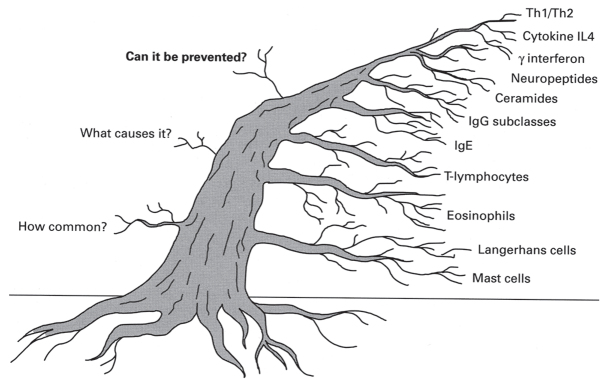
Fig. 1
Fig. 1
A skewed interest toward cellular and molecular atopic dermatitis (AD) mechanisms relative to research into AD populations. Research into AD over the last 50 years has been dominated by interest in cells rather than broader questions such as whether disease prevention is possible.
Fig. 2
Fig. 2
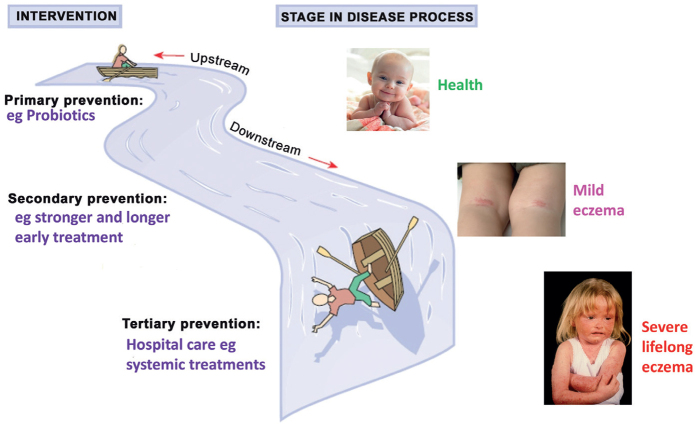
Where is intervention most effective? Although the concept of prevention of atopic dermatitis is rarely discussed at international meetings, an upstream approach is a far more logical approach to reduce the burden of disease at a population level than the current approach of treating sick individuals with expensive drugs who present to secondary care after a long chain of pathological events.
Fig. 3
Fig. 3
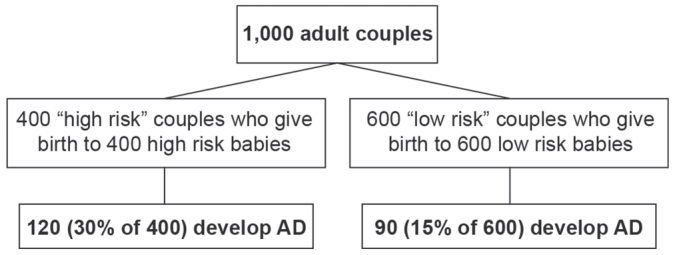
Hypothetical example of the prevention yield from a high risk vs low risk prevention approach for atopic dermatitis. Depicts an average Western population where 40% of 1,000 adult couples have a strong family history of atopy and 60% do not. If 30% of the high risk babies develop AD compared with 15% without such a family history, a high risk approach would only prevent 57% (120/120+90) of AD cases at a population level. Adapted from Williams HC. Atopic Dermatitis. In: Williams HC, Strachan DP (eds). The Challenge of Dermato-Epidemiology. Boca Raton, CRC Press Inc., 1997.
Fig. 4
Fig. 4
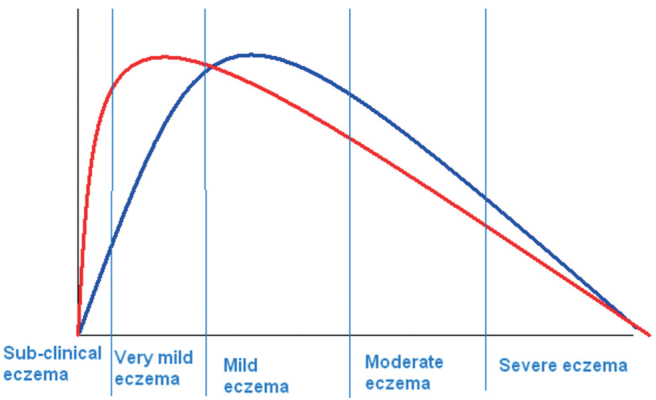
Schematic representation of atopic dermatitis severity (x-axis) versus number with atopic dermatitis in two hypothesized populations. Even if atopic dermatitis cannot be prevented completely, shifting the population severity distribution of disease to the left (red curve) could have a huge impact on pushing more into subclinical disease and reducing the absolute proportion with severe disease who suffer the most and who consume most health resources.
Fig. 5
Fig. 5
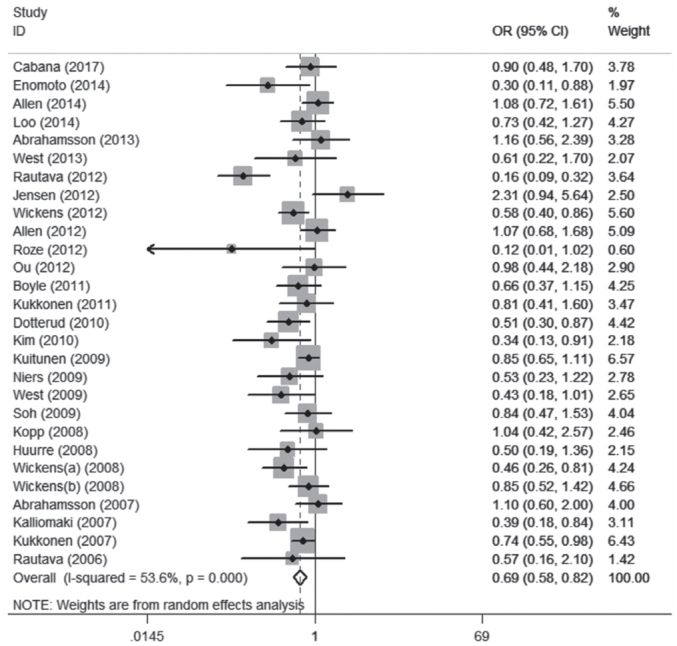
The preventive effect of probiotics in atopic dermatitis. Forest plot depicting a meta-analysis that used a random effects model combining 28 evaluated studies. Although the summary odds ratio (OR) suggests clear benefit (OR 0.69; 95% confidence interval (CI) 0.58–0.82; p<0.0001), there was considerable heterogeneity between the studies (I2=53.6%) (33). Reproduced with kind permission from the American Journal of Clinical Dermatology.
Fig. 6
Fig. 6
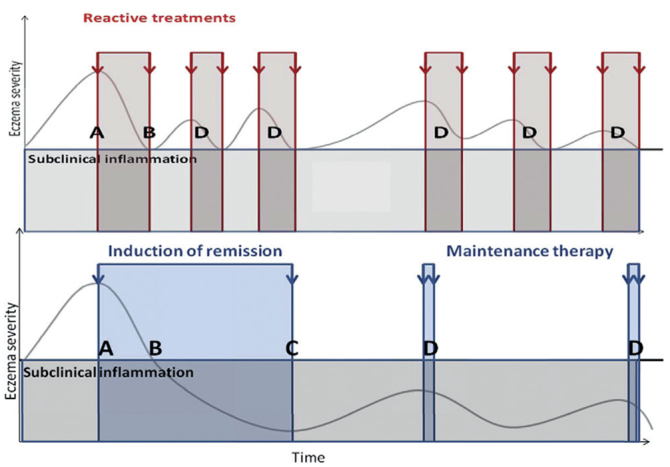
The concept of getting control then keeping control in atopic dermatitis. A more subtle interpretation of tertiary prevention is the principle of inducing remission of atopic dermatitis with an initial blast of topical treatment followed by prevention of disease flares with weekly pulses of two consecutive days of topical treatment (also known as the Centre of Evidence-Based Dermatology “get control and keep control” approach). When contrasted against more traditional reactive approaches, the proactive approach results in more disease being pushed into a subclinical state and hence better overall disease control. Reproduced with kind permission from the Journal of Allergy and Clinical Immunology.

References

    1. Kim JE, Kim HS. microbiome of the skin and gut in atopic dermatitis (AD): understanding the pathophysiology and finding novel management strategies. J Clin Med 2019; 8: pii: E444. - PMC - PubMed
    1. Brown SJ. Molecular mechanisms in atopic eczema: insights gained from genetic studies. J Pathol 2017; 241: 140–145. - PubMed
    1. Doll R, Hill AB. Smoking and carcinoma of the lung; preliminary report. BMJ 1950; 2: 739–748. - PMC - PubMed
    1. Johansson SG, Bieber T, Dahl R, Friedmann PS, Lanier BQ, Lockey RF, et al. . Revised nomenclature for allergy for global use: Report of the Nomenclature Review Committee of the World Allergy Organization, October 2003. J Allergy Clin Im munol 2004; 113: 832–836. - PubMed
    1. Centre of Evidence Based Dermatology systematic reviews on eczema https://www.nottingham.ac.uk/research/groups/cebd/resources/eczema-syste..., accessed 14th August 2019.

LinkOut - more resources