


Quality of care evaluation in non-functioning pituitary adenoma with chiasm compression: visual outcomes and timing of intervention clinical recommendations based on a systematic literature review and cohort study
- PMID: 32419072
- PMCID: PMC7316692
- DOI: 10.1007/s11102-020-01044-0
Quality of care evaluation in non-functioning pituitary adenoma with chiasm compression: visual outcomes and timing of intervention clinical recommendations based on a systematic literature review and cohort study
Erratum in
-
Correction to: Quality of care evaluation in non-functioning pituitary adenoma with chiasm compression: visual outcomes and timing of intervention clinical recommendations based on a systematic literature review and cohort study.Pituitary. 2020 Aug;23(4):430-431. doi: 10.1007/s11102-020-01061-z. Pituitary. 2020. PMID: 32567033 Free PMC article.
Abstract
Purpose: Surgery in patients with non-functioning pituitary macroadenomas (NFMA) is effective in ameliorating visual function. The urgency for decompression, and preferred timing of surgery related to the preoperative severity of dysfunction is unknown.
Methods: Systematic review for evidence to provide clinical guidance for timing of surgical decompression of the optic chiasm, and a cohort study of 30 NFMA patients, in whom mean deviation (MD), and severity of visual dysfunction was assessed.
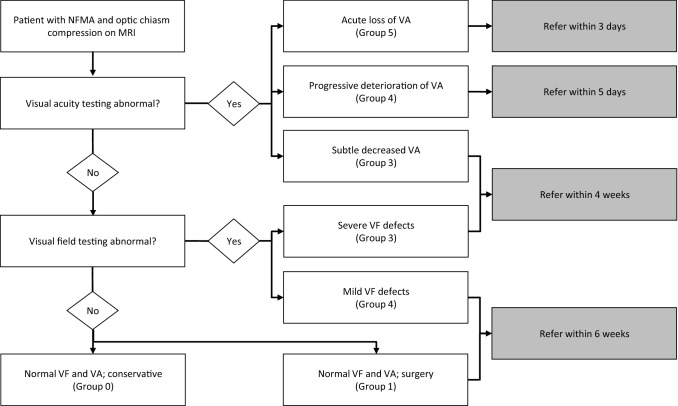
Results: Systematic review 44 studies were included with a total of 4789 patients. Postoperatively, visual field defects improved in 87.0% of patients, stabilized in 12.8% and worsened in 1.0%. Specific protocols regarding timing of surgery were not reported. Only seven studies (16.7%) reported on either the duration of visual symptoms, or diagnostic, or treatment delay. Cohort study 30 NFMA patients (50% female, 60 eyes, mean age 58.5 ± 14.8 years), had a median MD of - 5.3 decibel (IQR - 3.1 to - 10.1). MD was strongly correlated with clinical severity (r = - 0.94, P < 0.0001), and were used for severity of defects cut-off values: (1) normal > - 2 dB, (2) mild - 2 dB to - 4 dB, (3) moderate - 4 to - 8 dB, (4) severe - 8 to - 17 dB, (5) very severe < - 17 dB.
Conclusion: Surgical decompression is highly effective in improving visual function. Uniform, quantitative grading of visual dysfunction was lacking. MD is a promising quantitative outcome measure. We provide recommendations for the evaluation of timing of surgery, considering severity of visual impairment, which will need further validation based on expert clinical practice.
Keywords: Non-functioning pituitary adenoma; Optic chiasm compression; Pituitary tumor; Transsphenoidal surgery; Visual fields; Visual outcome.
Conflict of interest statement
The authors declare no financial or other conflicts of interest.
Figures

References
-
- Dekkers OM, Neelis KJ, de Keizer RJ, Voormolen JH, Pereira AM, Romijn JA. Nonfunctioning pituitary macroadenomas: diagnosis, treatment and follow-up. Ned Tijdschr Geneeskd. 2008;152(14):792–796. - PubMed
Publication types
MeSH terms
LinkOut - more resources
Full Text Sources
Medical
Miscellaneous
