


Investigation of the Effect of HATCH Score and Coronary Artery Disease Complexity on Atrial Fibrillation after On-Pump Coronary Artery Bypass Graft Surgery
- PMID: 32422635
- PMCID: PMC7923874
- DOI: 10.1159/000508726
Investigation of the Effect of HATCH Score and Coronary Artery Disease Complexity on Atrial Fibrillation after On-Pump Coronary Artery Bypass Graft Surgery
Abstract
Objective: Postoperative atrial fibrillation (PoAF) is the most frequently encountered rhythm problem after coronary artery bypass graft (CABG) surgery. This situation decreases the capacity of the patients with respect to functional exercise and creates a risk for stroke. In this study, we aimed to determine the effect of coronary artery disease extensiveness and HATCH score on PoAF in patients undergoing CABG surgery with cardiopulmonary bypass.
Subjects and methods: Patients who underwent CABG between December 2014 and December 2018 were included retrospectively. Preoperative demographic characteristics, laboratory parameters, and operative parameters of the patients were recorded retrospectively.
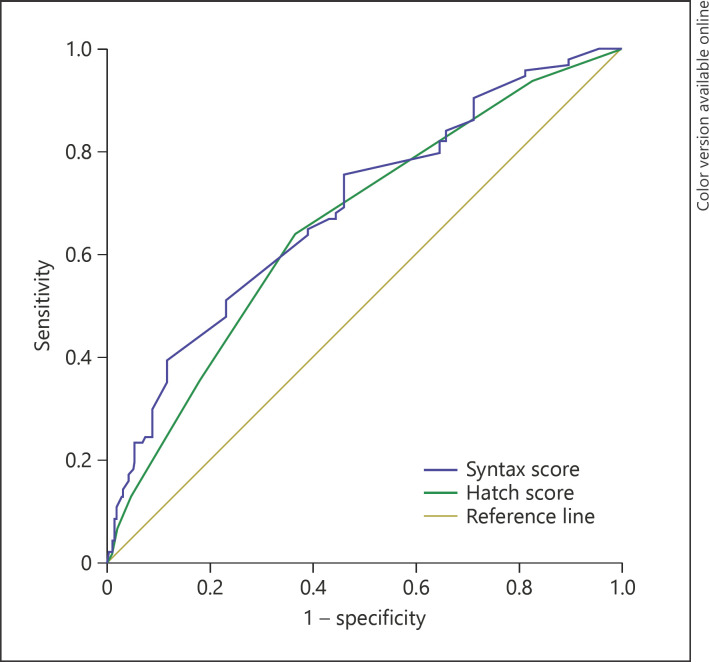
Results: Of the 352 patients, 274 had HATCH scores ≤2 (71.1% male, mean age: 61.7 ± 12.4 years), and 78 had HATCH scores >2 (69.2% male, mean age: 65.9 ± 11.7 years). Significant differences were found between the 2 groups in terms of the age (p = 0.014), presence of hypertension (p = 0.012), PoAF (p < 0.001), and SYNTAX (synergy between percutaneous coronary intervention with taxus and cardiac surgery) score I (p = 0.001). A HATCH score >2 and SYNTAX score I were identified as independent predictors of PoAF (OR: 1.022, 95% CI: 1.004-1.128, p = 0.032, and OR 1.098, 95% CI 1.035-1.164, p = 0.002, respectively). For predicting PoAF, the cutoff level in the ROC curve analysis was 19.7 for SYNTAX score (AUC 0.647, 95% CI 0.581-0.714, p < 0.001, 72.2% sensitivity and 66.4% specificity), and the cutoff level for HATCH score was 2 (AUC 0.656, 95% CI 0.595-0.722, p < 0.001, 69.4% sensitivity and 56.8% specificity) Conclusions: HATCH and SYNTAX scores are predictors of PoAF.
Keywords: Atrial fibrillation; Coronary artery bypass surgery; HATCH score; SYNTAX score.
© 2020 The Author(s) Published by S. Karger AG, Basel.
Conflict of interest statement
The authors have no conflicts of interest to declare.
Figures
References
-
- Haghjoo M, Saravi M, Hashemi MJ, Hosseini S, Givtaj N, Ghafarinejad MH, et al. Optimal beta-blocker for prevention of atrial fibrillation after on-pump coronary artery bypass graft surgery: carvedilol versus metoprolol. Heart Rhythm. 2007 Sep;4((9)):1170–4. - PubMed
-
- Mariscalco G, Engström KG. Atrial fibrillation after cardiac surgery: risk factors and their temporal relationship in prophylactic drug strategy decision. Int J Cardiol. 2008 Oct;129((3)):354–62. - PubMed
-
- Smit MD, Van Gelder IC. New treatment options for atrial fibrillation: towards patient tailored therapy. Heart. 2011 Nov;97((21)):1796–802. - PubMed
-
- Sianos G, Morel MA, Kappetein AP, Morice MC, Colombo A, Dawkins K, et al. The SYNTAX Score: an angiographic tool grading the complexity of coronary artery disease. EuroIntervention. 2005 Aug;1((2)):219–27. - PubMed
-
- Aktürk E, Aşkın L, Taşolar H, Türkmen S, Kaya H. Comparison of the predictive roles of risk scores of in-hospital major adverse cardiovascular events in patients with non-ST elevation myocardial infarction undergoing percutaneous coronary intervention. Med Princ Pract. 2018;27((5)):459–65. - PMC - PubMed
MeSH terms
LinkOut - more resources
Full Text Sources
Medical
