


Probiotic Potential and Technological Properties of Bacteriocinogenic Lactococcus lactis Subsp. Lactis UTNGt28 from a Native Amazonian Fruit as a Yogurt Starter Culture
- PMID: 32422963
- PMCID: PMC7285064
- DOI: 10.3390/microorganisms8050733
Probiotic Potential and Technological Properties of Bacteriocinogenic Lactococcus lactis Subsp. Lactis UTNGt28 from a Native Amazonian Fruit as a Yogurt Starter Culture
Abstract
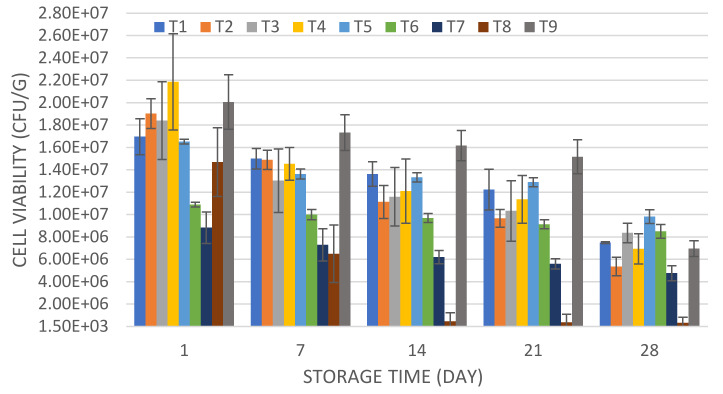
A native Lactococcus lactis subsp. lactis UTNGt28 (GenBank accession no: MG675576.1) isolated from Amazonian fruit of the tropical Caimitillo (Chrysophyllum oliviforme) tree and the commercial strain Lactococcus lactis subsp lactis ATCC11454 (LacAT) were targeted ex vitro in whole milk in combination with Streptococcus thermophilus ATCC19258 to obtain a fermented probiotic beverage. Concomitant with cell viability determination during storage (28 days), the pH, titratable acidity, syneresis, protein and fat were evaluated. The results indicated that neither UTNGt28 nor LacAT displayed a high capacity to ferment whole milk and survive during storage; a statistically significant difference (p < 0.05) in cell viability was registered for UTNGt28 compared with LacAT when inoculated alone or in combination with S. thermophilus. A principal component analysis showed a clear difference between the yogurt formulations at day 1 and 28 of storage. The PC 1 explained 46.8% of the total variance (day 28), was loaded in the negative (-) direction with titratable acidity (% lactic acid), while the PC 2 explained 22.5% (day 1) with pH. PC 1 was loaded in the positive (+) direction with pH, cell viability, syneresis, fat and protein. Overall results indicated that UTNGt28 has the technological properties for further development of a new probiotic product.
Keywords: Lactococcus lactis; Streptococcus thermophilus; probiotic; protein; starter culture.
Conflict of interest statement
The authors declare no conflict of interest
Figures



References
-
- Vedamuthu E. Starter cultures for yogurt and fermented milk. In: Chandan R., Kilara A., editors. Manufacturing Yogurt and Fermented Milks. 2nd ed. Blackwell Publishing; Ames, IA, USA: 2013. pp. 115–147.
-
- World Health Organization. Food and Agricultural Organization of the United Nations and World Health Organization Health and Nutrition Properties of Probiotics in Food Including Powder Milk and Live Lactic Acid Bacteria. [(accessed on 25 January 2020)];2001 Available online: http://www.fao.org/3/a-a0512e.pdf.
-
- Barrangou R., Lahtinen S., Ibrahim F., Ouwehand A. Genus Lactobacillus. In: En S. Lahtinen A., Ouwehand S., Salminen A., Von W., editors. Lactic Acid Bacteria: Microbiological and Functional Aspects. 4th ed. CRC Press; Boca Raton, FL, USA: 2011. pp. 77–86.
-
- Uriot O., Denis S., Junjua M., Roussel Y., Dary-Mourot A., Blanquet-Diot S. Streptococcus thermophilus: From yogurt starter to a new promising. J. Funct. Food. 2017;37:74–89. doi: 10.1016/j.jff.2017.07.038. - DOI
Grants and funding
LinkOut - more resources
Full Text Sources
Molecular Biology Databases
