. 2020 May 14;21(10):3478.
doi: 10.3390/ijms21103478.

Seminal Plasma, Sperm Concentration, and Sperm-PMN Interaction in the Donkey: An In Vitro Model to Study Endometrial Inflammation at Post-Insemination

Affiliations

Seminal Plasma, Sperm Concentration, and Sperm-PMN Interaction in the Donkey: An In Vitro Model to Study Endometrial Inflammation at Post-Insemination

Jordi Miró et al. Int J Mol Sci. .

Abstract

In the donkey, artificial insemination (AI) with frozen-thawed semen is associated with low fertility rates, which could be partially augmented through adding seminal plasma (SP) and increasing sperm concentration. On the other hand, post-AI endometrial inflammation in the jenny is significantly higher than in the mare. While previous studies analyzed this response through recovering Polymorphonuclear Neutrophils (PMN) from uterine washings, successive lavages can detrimentally impact the endometrium, leading to fertility issues. For this reason, the first set of experiments in this work intended to set an in vitro model through harvesting PMN from the peripheral blood of jennies. Thereafter, how PMN, which require a triggering agent like formyl-methionyl-leucyl-phenylalanine (FMLP) to be activated, are affected by donkey semen was interrogated. Finally, we tested how four concentrations of spermatozoa (100 × 106, 200 × 106, 500 × 106 and 1000 × 106 spermatozoa/mL) affected their interaction with PMN. We observed that semen, which consists of sperm and SP, is able to activate PMN. Whereas there was a reduced percentage of spermatozoa phagocytosed by PMN, most remained attached on the PMN surface or into a surrounding halo. Spermatozoa not attached to PMN were viable, and most of those bound to PMN were also viable and showed high tail beating. Finally, only sperm concentrations higher than 500 × 106 spermatozoa/mL showed free sperm cells after 3 h of incubation, and percentages of spermatozoa not attached to PMN were higher at 3 h than at 1 h, exhibiting high motility. We can thus conclude that semen activates PMN in the donkey, and that the percentage of spermatozoa phagocytosed by PMN is low. Furthermore, because percentages of spermatozoa not attached to PMN were higher after 3 h than after 1 h of incubation, we suggest that PMN-sperm interaction plays an instrumental role in the reproductive strategy of the donkey.

Keywords: donkey; polymorphonuclear neutrophils; seminal plasma; sperm.


Conflict of interest statement

The authors declare no conflict of interest.

Figures
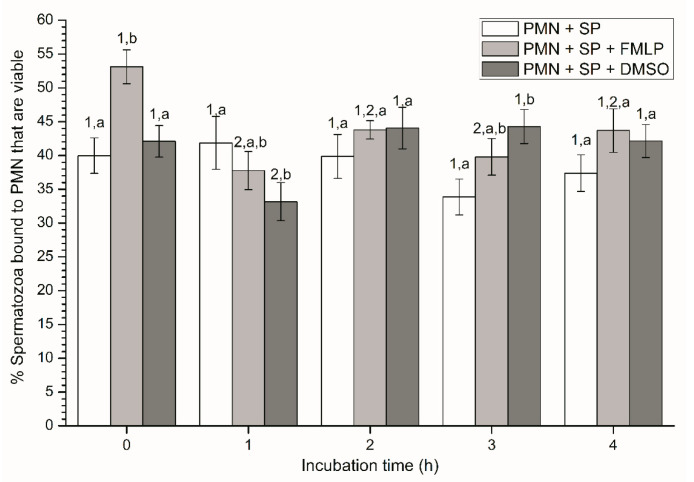
Figure 1
Figure 1
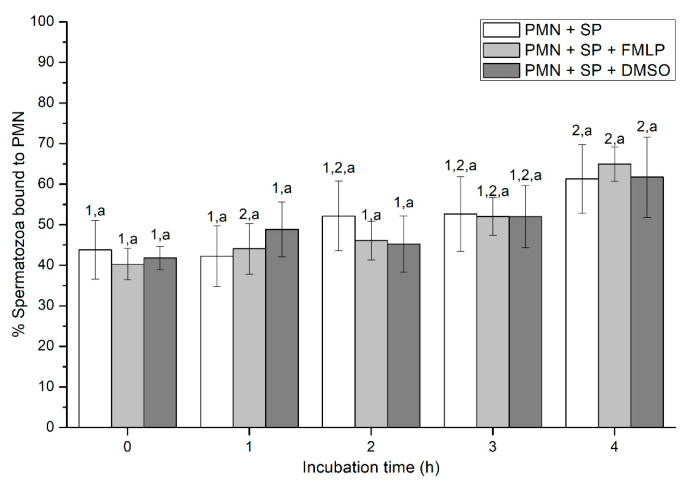
Percentages of viable spermatozoa bound to PMN in the three treatments (PMN + SP, PMN +SP + FMLP and PMN + SP + DMSO) throughout the incubation time (4 h; Experiment 2). Different superscripts (a, b) mean significant (p < 0.05) differences between treatments within a given time point, and different numbers (1, 2) mean significant (p < 0.05) differences between incubation times within a given treatment. Data are shown as mean ± SEM for seven experiments. Sperm concentration: 500 × 106 sperm/mL. PMN concentration: 100 × 106 PMN/mL. PMN: polymorphonuclear neutrophils; SP: seminal plasma; DMSO: dimethyl sulfoxide; FMLP: formyl-methionyl-leucyl-phenylalanine.
Figure 2
Figure 2
Percentages of spermatozoa bound to PMN in the three treatments (PMN + SP, PMN + SP + FMLP and PMN + SP + DMSO) throughout the incubation time (4 h; Experiment 2). Different superscripts (a, b) mean significant (p < 0.05) differences between treatments within a given time point, and different numbers (1, 2) mean significant (p < 0.05) differences between incubation times within a given treatment. Data are shown as mean ± SEM for seven experiments. Sperm concentration: 500 × 106 sperm/mL. PMN concentration: 100 × 106 PMN/mL. PMN: polymorphonuclear neutrophils; SP: seminal plasma; DMSO: dimethyl sulfoxide; FMLP: formyl-methionyl-leucyl-phenylalanine.
Figure 3
Figure 3
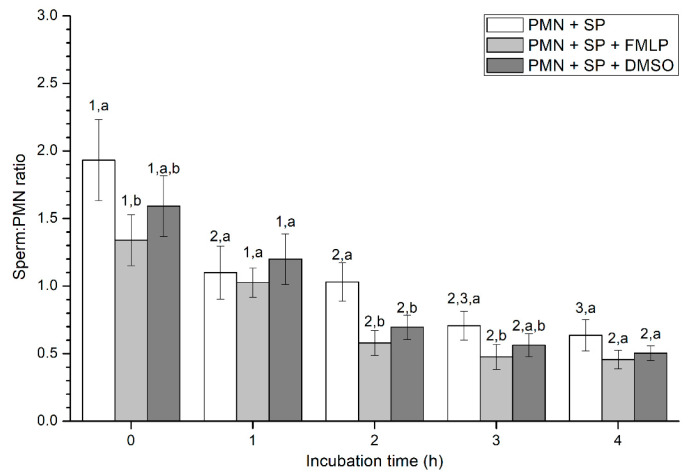
Number of spermatozoa bound to PMN (sperm:PMN ratio) in the three treatments (PMN+SP, PMN+SP+FMLP and PMN+SP+DMSO) throughout the incubation time (4 h; Experiment 2). Different superscripts (a, b) mean significant (p < 0.05) differences between treatments within a given time point, and different numbers (1, 2) mean significant (p < 0.05) differences between incubation times within a given treatment. Data are shown as mean ± SEM for seven experiments. Sperm concentration: 500 × 106 sperm/mL. PMN concentration: 100 × 106 PMN/mL. PMN: polymorphonuclear neutrophils; SP: seminal plasma; DMSO: dimethyl sulfoxide; FMLP: formyl-methionyl-leucyl-phenylalanine.
Figure 4
Figure 4
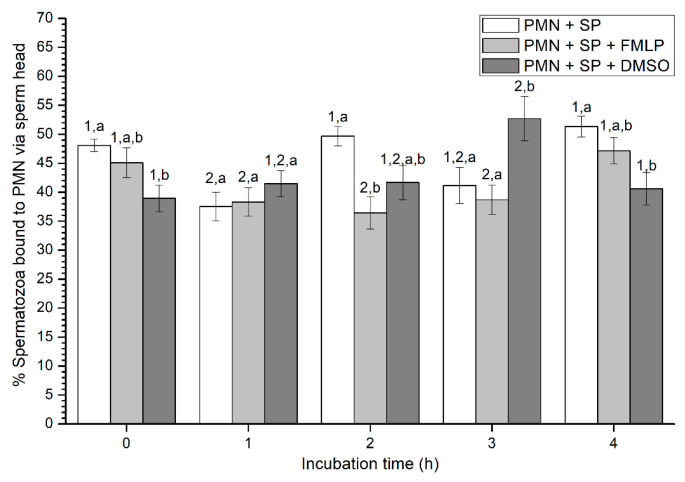
Percentages of viable spermatozoa bound to PMN via sperm head in the three treatments (PMN + SP, PMN + SP + FMLP and PMN + SP + DMSO) throughout the incubation time (4 h; Experiment 2). Different superscripts (a, b) mean significant (p < 0.05) differences between treatments within a given time point, and different numbers (1, 2) mean significant (p < 0.05) differences between incubation times within a given treatment. Data are shown as mean ± SEM for seven experiments. Sperm concentration: 500 × 106 sperm/mL. PMN concentration: 100 × 106 PMN/mL. PMN: polymorphonuclear neutrophils; SP: seminal plasma; DMSO: dimethyl sulfoxide; FMLP: formyl-methionyl-leucyl-phenylalanine.
Figure 5
Figure 5
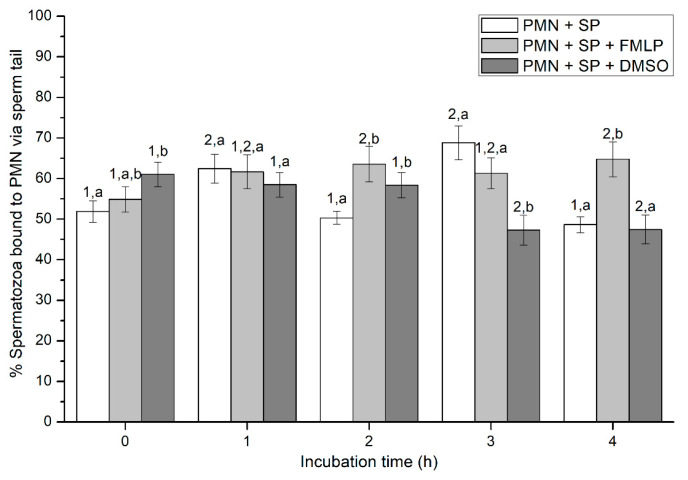
Percentages of viable spermatozoa bound to PMN via sperm tail in the three treatments (PMN + SP, PMN + SP + FMLP and PMN + SP + DMSO) throughout the incubation time (4 h; Experiment 2). Different superscripts (a, b) mean significant (p < 0.05) differences between treatments within a given time point, and different numbers (1, 2) mean significant (p < 0.05) differences between incubation times within a given treatment. Data are shown as mean ± SEM for seven experiments. Sperm concentration: 500 × 106 sperm/mL. PMN concentration: 100 × 106 PMN/mL. PMN: polymorphonuclear neutrophils; SP: seminal plasma; DMSO: dimethyl sulfoxide; FMLP: formyl-methionyl-leucyl-phenylalanine.
Figure 6
Figure 6
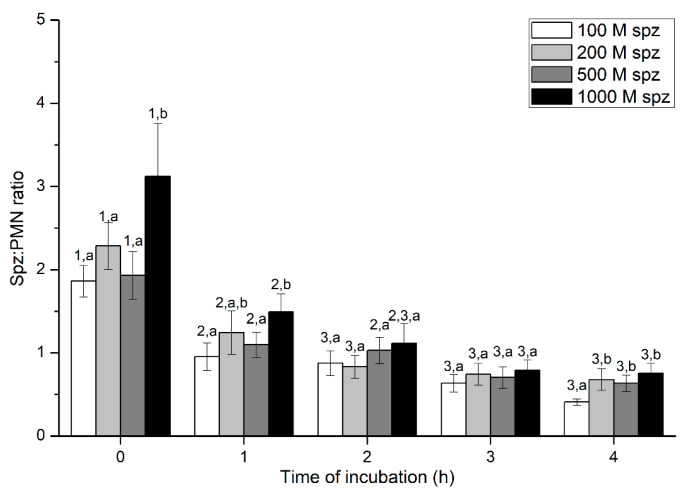
Number of spermatozoa bound to PMN (sperm:PMN ratio) after incubation with four different sperm concentrations (100 × 106, 250 × 106, 500 × 106, and 1000 × 106 spermatozoa/mL) for 4 h (Experiment 3). Different superscripts (a, b) mean significant (p < 0.05) differences between treatments within a given time point, and different numbers (1, 2) mean significant (p < 0.05) differences between incubation times within a given treatment. Data are shown as mean ± SEM for seven experiments. PMN concentration: 100 × 106 PMN/mL.
Figure 7
Figure 7
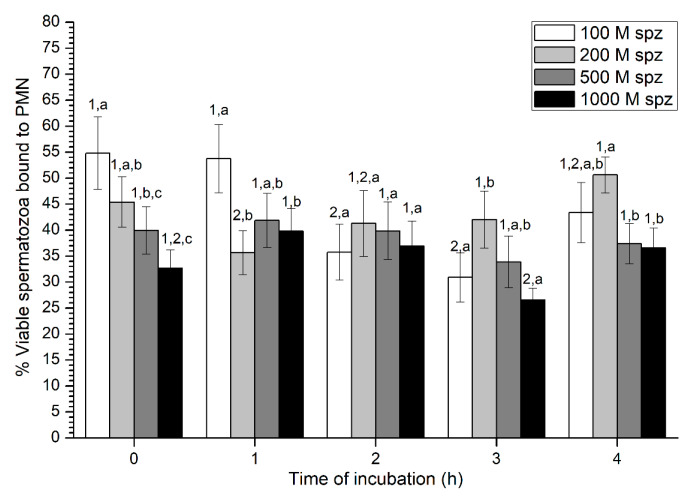
Percentages of viable spermatozoa bound to PMN after incubation with four different sperm concentrations (100 × 106, 250 × 106, 500 × 106, and 1000 × 106 spermatozoa/mL) for 4 h (Experiment 3). Different superscripts (a, b) mean significant (p < 0.05) differences between treatments within a given time point, and different numbers (1, 2) mean significant (p < 0.05) differences between incubation times within a given treatment. Data are shown as mean ± SEM for seven experiments. PMN concentration: 100 × 106 PMN/mL.

References

    1. Canisso I.F., Panzani D., Miró J., Ellerbrock R.E. Key Aspects of Donkey and Mule Reproduction. Vet. Clin. N. Am. Equine Pract. 2019;35:607–642. doi: 10.1016/j.cveq.2019.08.014. - DOI - PubMed
    1. Quintero-Moreno A., Miró J., Teresa Rigau A., Rodríguez-Gil J.E. Identification of sperm subpopulations with specific motility characteristics in stallion ejaculates. Theriogenology. 2003;59:1973–1990. doi: 10.1016/S0093-691X(02)01297-9. - DOI - PubMed
    1. Miró J., Lobo V., Quintero-Moreno A., Medrano A., Peña A., Rigau T. Sperm motility patterns and metabolism in Catalonian donkey semen. Theriogenology. 2005;63:1706–1716. doi: 10.1016/j.theriogenology.2004.07.022. - DOI - PubMed
    1. Flores E., Taberner E., Rivera M.M., Peña A., Rigau T., Miró J., Rodríguez-Gil J.E. Effects of freezing/thawing on motile sperm subpopulations of boar and donkey ejaculates. Theriogenology. 2008;70:936–945. doi: 10.1016/j.theriogenology.2008.05.056. - DOI - PubMed
    1. Rota A., Magelli C., Panzani D., Camillo F. Effect of extender, centrifugation and removal of seminal plasma on cooled-preserved Amiata donkey spermatozoa. Theriogenology. 2008;69:176–185. doi: 10.1016/j.theriogenology.2007.09.003. - DOI - PubMed

MeSH terms

LinkOut - more resources