


Cadaveric Simulation of Endoscopic Endonasal Procedures: Analysis of Droplet Splatter Patterns During the COVID-19 Pandemic
- PMID: 32423283
- PMCID: PMC7240308
- DOI: 10.1177/0194599820929274
Cadaveric Simulation of Endoscopic Endonasal Procedures: Analysis of Droplet Splatter Patterns During the COVID-19 Pandemic
Abstract
Objective: The primary mode of viral transmission of severe acute respiratory syndrome coronavirus 2 (SARS-CoV-2) is thought to occur through the spread of respiratory droplets. The objective of this study was to investigate droplet and splatter patterns resulting from common endoscopic endonasal procedures.
Study design: Cadaver simulation series.
Setting: Dedicated surgical laboratory.
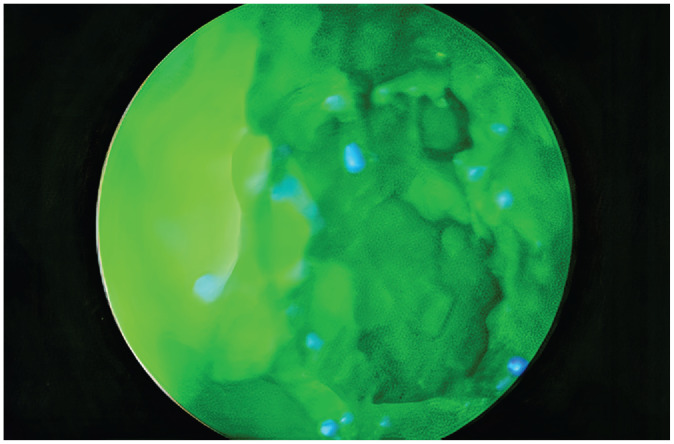
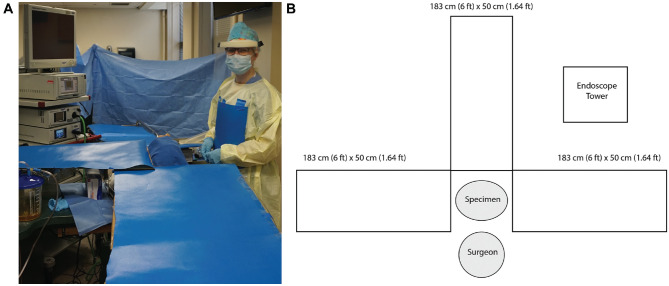
Subjects and methods: After instilling cadaver head specimens (n = 2) with fluorescein solution, endoscopic endonasal procedures were systematically performed to evaluate the quantity, size, and distance of droplets and splatter following each experimental condition.
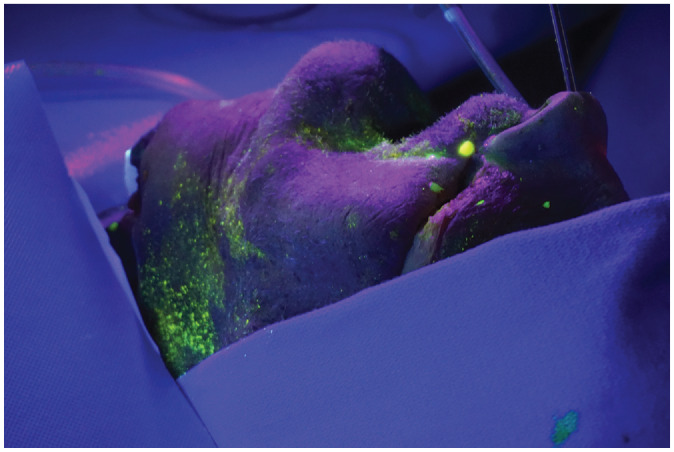
Results: There were no observable fluorescein droplets or splatter noted in the measured surgical field in any direction after nasal endoscopy, septoplasty with microdebrider-assisted turbinoplasty, cold-steel functional endoscopic sinus surgery (FESS), and all experimental conditions using an ultrasonic aspirator. Limited droplet spread was noted with microdebrider FESS (2 droplets, <1 mm in size, within 10 cm), drilling of the sphenoid rostrum with a diamond burr (8, <1 mm, 12 cm), and drilling of the frontal beak with a cutting burr (5, <1 mm, 9 cm); however, the use of concurrent suction while drilling resulted in no droplets or splatter. The control condition of external activation of the drill resulted in gross contamination (11, 2 cm, 13 cm).
Conclusion: Our results indicate that there is very little droplet generation from routine rhinologic procedures. The droplet generation from drilling was mitigated with the use of concurrent suction. Extreme caution should be used to avoid activating powered instrumentation outside of the nasal cavity, which was found to cause droplet contamination.
Keywords: COVID-19; droplet; nasal endoscopy; sinus surgery; skull base surgery; splatter.
Figures
Comment in
-
Response to: "Cadaver Surgical Education and Research Under the SARS-CoV-2 Pandemic in Japan".Otolaryngol Head Neck Surg. 2022 May;166(5):1004. doi: 10.1177/01945998211036416. Epub 2021 Aug 3. Otolaryngol Head Neck Surg. 2022. PMID: 34340622 No abstract available.
-
Cadaver Surgical Education and Research Under the SARS-CoV-2 Pandemic in Japan.Otolaryngol Head Neck Surg. 2022 May;166(5):1003-1004. doi: 10.1177/01945998211036422. Epub 2021 Aug 3. Otolaryngol Head Neck Surg. 2022. PMID: 34340624 No abstract available.
References
-
- Vukkadala N, Qian ZJ, Holsinger FC, Patel ZM, Rosenthal E. COVID-19 and the otolaryngologist: preliminary evidence-based review [published online March 26, 2020]. Laryngoscope. - PubMed
MeSH terms
LinkOut - more resources
Full Text Sources
Medical
Miscellaneous
