. 2020 Apr;8(1):e000826.
doi: 10.1136/bmjdrc-2019-000826.

Association of dairy consumption with metabolic syndrome, hypertension and diabetes in 147 812 individuals from 21 countries

Affiliations

Association of dairy consumption with metabolic syndrome, hypertension and diabetes in 147 812 individuals from 21 countries

Balaji Bhavadharini et al. BMJ Open Diabetes Res Care. 2020 Apr.

Abstract

Objective: Our aims were to assess the association of dairy intake with prevalence of metabolic syndrome (MetS) (cross-sectionally) and with incident hypertension and incident diabetes (prospectively) in a large multinational cohort study.

Methods: The Prospective Urban Rural Epidemiology (PURE) study is a prospective epidemiological study of individuals aged 35 and 70 years from 21 countries on five continents, with a median follow-up of 9.1 years. In the cross-sectional analyses, we assessed the association of dairy intake with prevalent MetS and its components among individuals with information on the five MetS components (n=112 922). For the prospective analyses, we examined the association of dairy with incident hypertension (in 57 547 individuals free of hypertension) and diabetes (in 131 481 individuals free of diabetes).

Results: In cross-sectional analysis, higher intake of total dairy (at least two servings/day compared with zero intake; OR 0.76, 95% CI 0.71 to 0.80, p-trend<0.0001) was associated with a lower prevalence of MetS after multivariable adjustment. Higher intakes of whole fat dairy consumed alone (OR 0.72, 95% CI 0.66 to 0.78, p-trend<0.0001), or consumed jointly with low fat dairy (OR 0.89, 95% CI 0.80 to 0.98, p-trend=0.0005), were associated with a lower MetS prevalence. Low fat dairy consumed alone was not associated with MetS (OR 1.03, 95% CI 0.77 to 1.38, p-trend=0.13). In prospective analysis, 13 640 people with incident hypertension and 5351 people with incident diabetes were recorded. Higher intake of total dairy (at least two servings/day vs zero serving/day) was associated with a lower incidence of hypertension (HR 0.89, 95% CI 0.82 to 0.97, p-trend=0.02) and diabetes (HR 0.88, 95% CI 0.76 to 1.02, p-trend=0.01). Directionally similar associations were found for whole fat dairy versus each outcome.

Conclusions: Higher intake of whole fat (but not low fat) dairy was associated with a lower prevalence of MetS and most of its component factors, and with a lower incidence of hypertension and diabetes. Our findings should be evaluated in large randomized trials of the effects of whole fat dairy on the risks of MetS, hypertension, and diabetes.

Keywords: adult diabetes; endocrinology; hypertension; nutrition.


Conflict of interest statement

Competing interests: None declared.

Figures
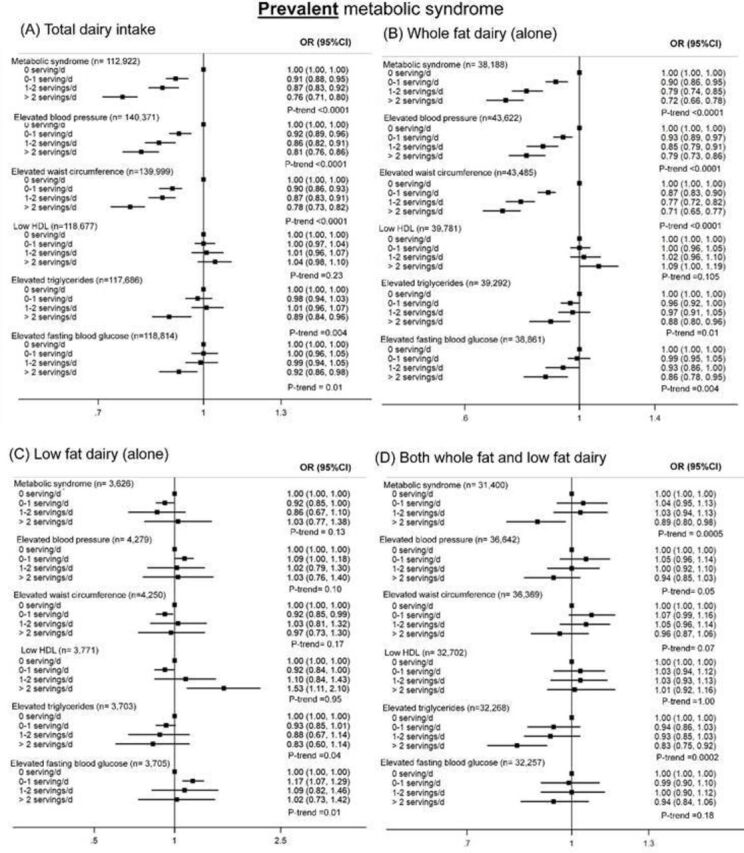
Figure 1
Figure 1
Association of (A) total dairy, (B) whole fat dairy alone, (C) low fat dairy alone and (D) among those who consumed both whole fat and low fat dairy with prevalent metabolic syndrome and its component (OR, 95% CI). Metabolic syndrome: defined as presence of any three of the four components: elevated blood pressure (defined as those on blood pressure lowering medication, or systolic blood pressure) ≥130 mm Hg or diastolic blood pressure (DBP) ≥85 mm Hg); elevated waist circumference (defined as women with waist >80 cm, men with waist ≥94 cm, except among Asians or South Americans in whom waist was ≥90 cm), reduced high density lipoprotein cholesterol (HDL-C) (defined as men on cholesterol lowering medications or with HDL-C<1 mmol/dL (40 mg/dL), or women with HDL-C<1.3 mmol/L (50 mg/dL)); elevated triglycerides (defined as triglyceride levels>1.7 mmmol/dL (150 mg/dL)); and elevated fasting blood glucose (defined as as those on glucose lowering medications or with a fasting glucose value ≥5.5 mmol/L). OR models for metabolic syndrome and waist circumference are adjusted for age (continuous), sex, smoking status, education, location, physical activity, energy intake, percent energy from carbohydrate, fruit and vegetable intake, and study center as random effect. Models for whole dairy intake are adjusted for low fat dairy intake and vice versa. OR model for elevated blood pressure, low HDL-C, elevated triglycerides and elevated fasting blood glucose are adjusted for age (continuous), sex, body mass index (continuous), smoking status, location, education, physical activity, energy intake, quintiles of percent energy from carbohydrate, fruit and vegetable intake, and study center as random effect. Models for whole dairy intake are adjusted for low fat dairy intake and vice versa. Panel (A) shows a significant inverse association between total dairy intake and metabolic syndrome and each of its components, except low HDL-C (no association); (B) shows a significant inverse association between whole fat dairy (alone) intake and metabolic syndrome, elevated blood pressure, elevated waist circumference, elevated triglycerides, and elevated fasting blood glucose. No association was observed between whole fat dairy and low HDL-C; (C) shows no association between low fat dairy (alone) intake and metabolic syndrome and its components, except elevated triglycerides and elevated fasting blood glucose (a trend towards lower prevalence); and (D) shows a significant inverse association between consumption of both whole fat and low fat dairy and metabolic syndrome, elevated blood pressure and elevated triglycerides, and no association with elevated waist circumference or HDL-C or elevated fasting blood glucose.
Figure 2
Figure 2
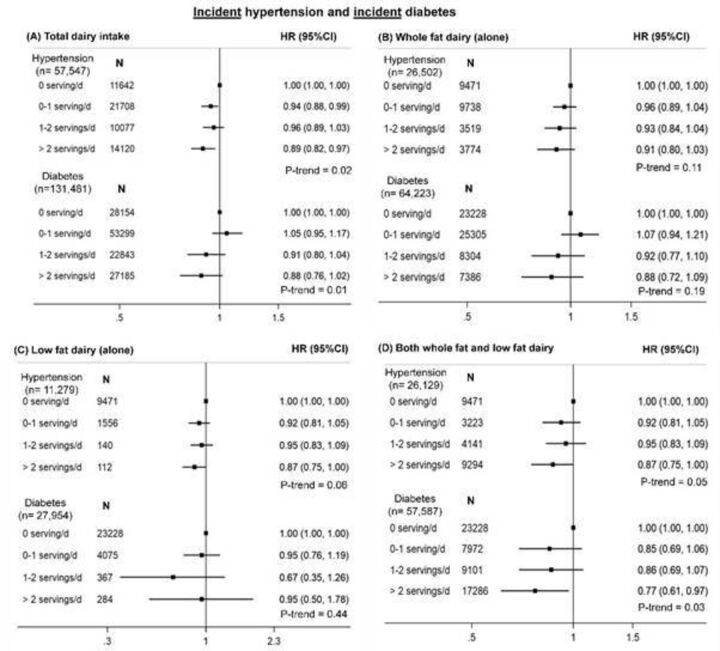
Associations of (A) total dairy, (B) whole fat dairy alone, (C) low fat dairy alone, and (D) both whole fat and low fat dairy with incident hypertension and incident diabetes (HR, 95% CI). Incident hypertension was defined as self-reported hypertension, with or without use of antihypertensive medications or a systolic blood pressure of >140 mm Hg, or a diastolic blood pressure of >90 mm Hg.10 Incident diabetes was defined as self-reported diabetes, with or without use of oral hypoglycemic agents or insulin, or having a documented fasting glucose level of ≥7.0 mmol/L.11 Hypertension model adjusted for age (continuous), sex, body mass index (continuous), education, smoking status, location, physical activity, energy, quintiles of percent energy from carbohydrates, fruit and vegetable intake and study center as random effect. Models for whole dairy intake adjusted for low fat dairy intake and vice versa. Diabetesmodel adjusted for age (continuous), sex, body mass index (continuous), education, smoking status, location, family history of diabetes, physical activity, energy, quintiles of percent energy from carbohydrates, fruit and vegetable intake, and study center as random effect. Models for whole dairy intake are adjusted for low fat dairy intake and vice versa. Panel (A) shows a significant inverse association between total dairy and incident hypertension and a trend towards lower incidence of diabetes; (B) shows a trend towards lower incidence of hypertension and diabetes with higher intake of whole fat dairy (alone); (C) shows no association between low fat dairy intake (alone) and incident hypertension and incident diabetes; and (D) shows a trend towards lower incidence of hypertension and diabetes with higher intake of both whole fat and low fat dairy.

References

    1. Alberti KGMM, Eckel RH, Grundy SM, et al. Harmonizing the metabolic syndrome: a joint interim statement of the International diabetes Federation Task force on epidemiology and prevention; National heart, lung, and blood Institute; American heart association; world heart Federation; international atherosclerosis Society; and international association for the study of obesity. Circulation 2009;120:1640–5. 10.1161/CIRCULATIONAHA.109.192644 - DOI - PubMed
    1. Hu FB. Globalization of diabetes: the role of diet, lifestyle, and genes. Diabetes Care 2011;34:1249–57. 10.2337/dc11-0442 - DOI - PMC - PubMed
    1. Hu FB, Manson JE, Stampfer MJ, et al. Diet, lifestyle, and the risk of type 2 diabetes mellitus in women. N Engl J Med 2001;345:790–7. 10.1056/NEJMoa010492 - DOI - PubMed
    1. Willett W, Manson J, Liu S. Glycemic index, glycemic load, and risk of type 2 diabetes. Am J Clin Nutr 2002;76:274S–80. 10.1093/ajcn/76.1.274S - DOI - PubMed
    1. Drouin-Chartier J-P, Brassard D, Tessier-Grenier M, et al. Systematic review of the association between dairy product consumption and risk of Cardiovascular-Related clinical outcomes. Adv Nutr 2016;7:1026–40. 10.3945/an.115.011403 - DOI - PMC - PubMed

Publication types