. 2020 May 18;10(1):8158.
doi: 10.1038/s41598-020-65098-7.

Increasing carbohydrate oxidation improves contractile reserves and prevents hypertrophy in porcine right heart failure

Affiliations

Increasing carbohydrate oxidation improves contractile reserves and prevents hypertrophy in porcine right heart failure

Nikolaj Bøgh et al. Sci Rep. .

Abstract

In heart failure, myocardial overload causes vast metabolic changes that impair cardiac energy production and contribute to deterioration of contractile function. However, metabolic therapy is not used in heart failure care. We aimed to investigate the interplay between cardiac function and myocardial carbohydrate metabolism in a large animal heart failure model. Using magnetic resonance spectroscopy with hyperpolarized pyruvate and magnetic resonance imaging at rest and during pharmacological stress, we investigated the in-vivo cardiac pyruvate metabolism and contractility in a porcine model of chronic pulmonary insufficiency causing right ventricular volume overload. To assess if increasing the carbohydrate metabolic reserve improves the contractile reserve, a group of animals were fed dichloroacetate, an activator of pyruvate oxidation. Volume overload caused heart failure with decreased pyruvate dehydrogenase flux and poor ejection fraction reserve. The animals treated with dichloroacetate had a larger contractile response to dobutamine stress than non-treated animals. Further, dichloroacetate prevented myocardial hypertrophy. The in-vivo metabolic data were validated by mitochondrial respirometry, enzyme activity assays and gene expression analyses. Our results show that pyruvate dehydrogenase kinase inhibition improves the contractile reserve and decreases hypertrophy by augmenting carbohydrate metabolism in porcine heart failure. The approach is promising for metabolic heart failure therapy.


Conflict of interest statement

The authors declare no competing interests.

Figures

Figure 1
Figure 1
Overview of the cytosolic and mitochondrial carbohydrate metabolic pathways involved in the progression of heart failure. The illustrated pathways are the major carbohydrate sources of the energy that is ultimately needed for myocardial contraction, and they thus represent potential targets for future metabolic therapy. Fatty-acid metabolism is omitted. GLUT = glucose transporters, LDH = lactate dehydrogenase, PDH = pyruvate dehydrogenase.
Figure 2
Figure 2
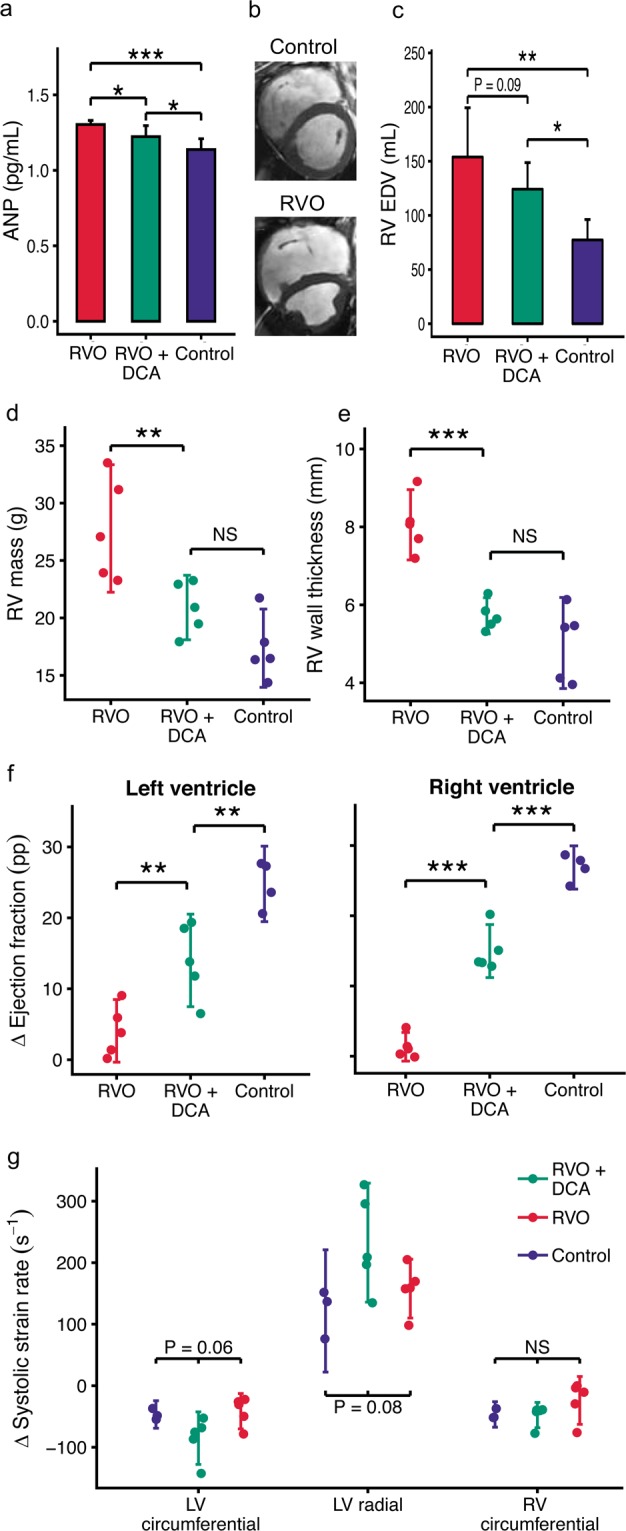
Dichloroacetate (DCA) attenuates hypertrophy and contractile impairment in pigs with right ventricular (RV) volume overload (RVO). (a): Atrial natriuretic peptide (ANP) in plasma. (b + c): CINE MRI shows dilation of the right ventricle after 19 weeks of overload, quantified as the end-diastolic volume (EDV). The white scale bars are 1 cm. (d) RV mass from MRI. (e) RV wall thickness ex-vivo after fixation. (f + g): MRI determined change in systolic function from rest to stress induced with dobutamine, pp indicates percentage points. Error bars indicate 95% confidence intervals. NS: P > 0.1, *P < 0.05, **P < 0.01, ***P < 0.001, (g) was tested with Kruskal-Wallis, (a + c-f) with ANOVA with Benjamini-Hochberg correction.
Figure 3
Figure 3
Dichloroacetate (DCA) reverts the deterioration of myocardial pyruvate metabolism after chronic right ventricular overload (RVO) in pigs. (a) We assessed metabolism with hyperpolarized [1-13C]pyruvate magnetic resonance spectroscopy under rest and dobutamine-induced stress. This technique allows assessment of flux through the pyruvate dehydrogenase (PDH), the lactate dehydrogenase (LDH) and the alanine transaminase (ALT). (b) The lactate and bicarbonate production of the heart after injection of hyperpolarized pyruvate. (c) The metabolism quantified using a model-free approach. The asterisks indicate significance vs. controls. Only significant comparisons are shown for display purposes. (d) Myocardial pH modelled from the spectroscopy data. e: In-vitro enzyme activity. Error bars and ribbons indicate 95% confidence intervals. NS: P > 0.1, *P < 0.05, **P < 0.01. ***P < 0.001, tested with ANOVA with Benjamini-Hochberg correction.
Figure 4
Figure 4
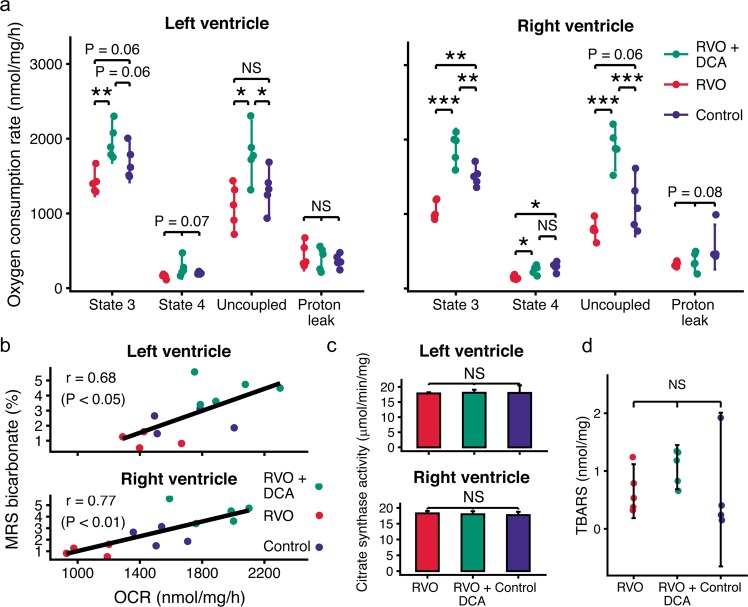
Dichloroacetate (DCA) increases mitochondrial respiratory function after right ventricular volume overload (RVO) in pigs. (a) The respiration rates of isolated cardiac mitochondria in a closed-chamber system with pyruvate and malate as substrates after 19 weeks of overload. (b) The maximal in-vitro mitochondrial state 3 oxygen consumption rates (OCR) correlates with bicarbonate production as determined with hyperpolarized [1-13C]pyruvate magnetic resonance spectroscopy (MRS) under dobutamine-induced stress. (c) Citrate synthase activity in the isolated mitochondria. (d) Thiobarbituric acid reactive substances (TBARS), an end-product of oxidative stress, in the overloaded right ventricle. Error bars indicate 95% confidence intervals. NS: P > 0.1, * P < 0.05, ** P < 0.01. *** P < 0.001, ANOVA with Benjamini-Hochberg correction. Correlation was assessed with Pearson’s method.

References

    1. Peterzan MA, Lygate CA, Neubauer S, Rider OJ. Metabolic remodeling in hypertrophied and failing myocardium: a review. Am. J. Physiol. Heart Circ. Physiol. 2017;313:H597–H616. doi: 10.1152/ajpheart.00731.2016. - DOI - PubMed
    1. Karwi QG, Uddin GM, Ho KL, Lopaschuk GD. Loss of Metabolic Flexibility in the Failing Heart. Front. Cardiovasc. Med. 2018;5:68. doi: 10.3389/fcvm.2018.00068. - DOI - PMC - PubMed
    1. Seymour A-ML, et al. In vivo assessment of cardiac metabolism and function in the abdominal aortic banding model of compensated cardiac hypertrophy. Cardiovascular Res. 2015;106:249–260. doi: 10.1093/cvr/cvv101. - DOI - PMC - PubMed
    1. Schroeder MA, et al. Hyperpolarized 13C magnetic resonance reveals early- and late-onset changes to in vivo pyruvate metabolism in the failing heart. Eur. J. Heart Fail. 2014;15:130–140. doi: 10.1093/eurjhf/hfs192. - DOI - PMC - PubMed
    1. Doenst T, et al. Decreased rates of substrate oxidation ex vivo predict the onset of heart failure and contractile dysfunction in rats with pressure overload. Cardiovascular Res. 2010;86:461–470. doi: 10.1093/cvr/cvp414. - DOI - PubMed

Publication types

MeSH terms