


Further delineation of the clinical spectrum of KAT6B disorders and allelic series of pathogenic variants
- PMID: 32424177
- PMCID: PMC7737399
- DOI: 10.1038/s41436-020-0811-8
Further delineation of the clinical spectrum of KAT6B disorders and allelic series of pathogenic variants
Abstract
Purpose: Genitopatellar syndrome and Say-Barber-Biesecker-Young-Simpson syndrome are caused by variants in the KAT6B gene and are part of a broad clinical spectrum called KAT6B disorders, whose variable expressivity is increasingly being recognized.
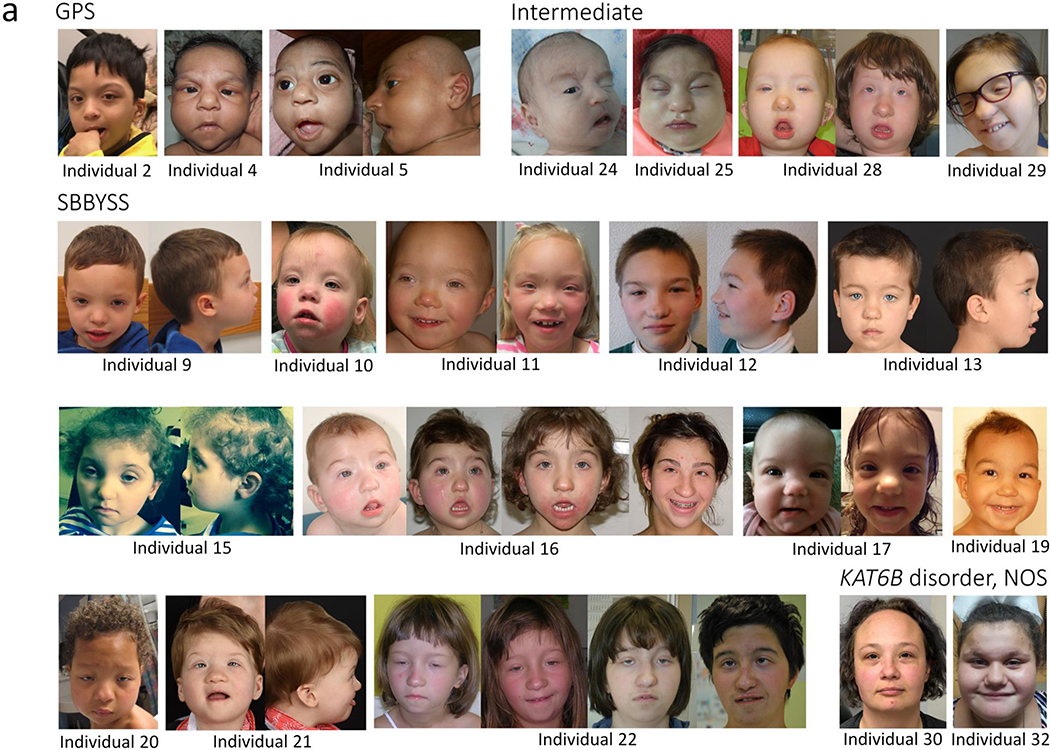
Methods: We herein present the phenotypes of 32 previously unreported individuals with a molecularly confirmed diagnosis of a KAT6B disorder, report 24 new pathogenic KAT6B variants, and review phenotypic information available on all published individuals with this condition. We also suggest a classification of clinical subtypes within the KAT6B disorder spectrum.
Results: We demonstrate that cerebral anomalies, optic nerve hypoplasia, neurobehavioral difficulties, and distal limb anomalies other than long thumbs and great toes, such as polydactyly, are more frequently observed than initially reported. Intestinal malrotation and its serious consequences can be present in affected individuals. Additionally, we identified four children with Pierre Robin sequence, four individuals who had increased nuchal translucency/cystic hygroma prenatally, and two fetuses with severe renal anomalies leading to renal failure. We also report an individual in which a pathogenic variant was inherited from a mildly affected parent.
Conclusion: Our work provides a comprehensive review and expansion of the genotypic and phenotypic spectrum of KAT6B disorders that will assist clinicians in the assessment, counseling, and management of affected individuals.
Keywords: KAT6B; KAT6B disorders; SBBYSS; Say–Barber–Biesecker–Young–Simpson syndrome; genitopatellar syndrome.
Conflict of interest statement
CONFLICT OF INTEREST
Baylor College of Medicine (BCM) and Miraca Holdings have formed a joint venture with shared ownership and governance of Baylor Genetics (BG), which performs clinical microarray analysis and clinical exome sequencing. J.R.L. serves on the Scientific Advisory Board of BG. J.R.L. has stock ownership in 23andMe, is a paid consultant for Regeneron Pharmaceuticals, and is a coinventor on multiple United States and European patents related to molecular diagnostics for inherited neuropathies, eye diseases, and bacterial genomic fingerprinting. The Department of Molecular and Human Genetics at Baylor College of Medicine derives revenue from molecular genetic testing offered in the Baylor Genetics Laboratories.
Figures


References
-
- Voss AK, Thomas T. MYST family histone acetyltransferases take center stage in stem cells and development. Bioessays. 2009;31(10):1050–1061. - PubMed
-
- Doyon Y, Cayrou C, Ullah M, et al. ING tumor suppressor proteins are critical regulators of chromatin acetylation required for genome expression and perpetuation. Molecular cell. 2006;21(1):51–64. - PubMed
-
- Yang XJ. MOZ and MORF acetyltransferases: Molecular interaction, animal development and human disease. Biochimica et biophysica acta. 2015;1853(8):1818–1826. - PubMed
Publication types
MeSH terms
Substances
Grants and funding
LinkOut - more resources
Full Text Sources
