


Speckle tracking echocardiography in hypokinetic non-dilated cardiomyopathy: comparison with dilated cardiomyopathy
- PMID: 32424892
- PMCID: PMC7373909
- DOI: 10.1002/ehf2.12764
Speckle tracking echocardiography in hypokinetic non-dilated cardiomyopathy: comparison with dilated cardiomyopathy
Abstract
Aims: Hypokinetic non-dilated cardiomyopathy (HNDC), which is determined by impaired left ventricular (LV) systolic function despite normal LV size, has been categorized as a subgroup of dilated cardiomyopathy (DCM) spectrum. Lack of data regarding advanced echocardiographic data in this population motivated us to design the present study in order to assess LV myocardial deformation properties of HNDC patients against the ones with dilated left ventricle.
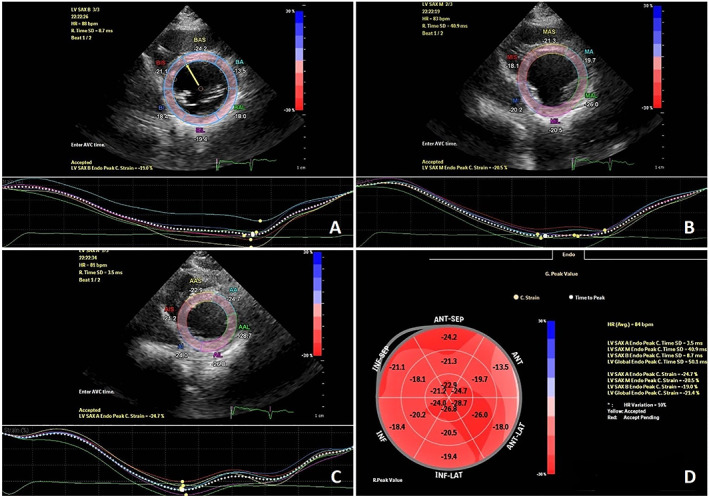
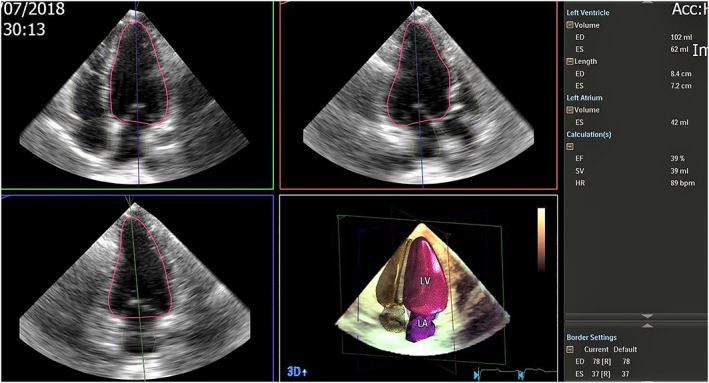
Methods and results: Thirty-one HNDC patients and 23 DCM patients were enrolled in the study consecutively. Myocardial deformation parameters including global longitudinal strain, global circumferential strain, LV basal and apical rotation, LV twist, and LV mechanical dispersion were obtained with the use of two-dimensional speckle tracking-based methods in all patients. Left cardiac chamber volume was also measured using three-dimensional HeartModel application. Patients with enlarged left ventricle tend to have lower LV ejection fraction. Comparing with HNDC group, DCM patients showed worse global circumferential strain (coefficient ± standard error 3.59 ± 0.94, P < 0.001) and LV mechanical dispersion (coefficient ± standard error 16.46 ± 7.09, P = 0.02) after regression analysis, while neither the global longitudinal strain nor the LV twist was not significantly different between two study population.
Conclusions: Left ventricular enlargement has a substantial effect on the circumferential strain and mechanical dispersion more than other deformation parameters that may play a role in the assumed poor prognosis of heart failure patients with dilated left ventricle.
Keywords: DCM (dilated cardiomyopathy); GCS (global circumferential strain); GLS (global longitudinal strain); HNDC (hypokinetic non-dilated cardiomyopathy); Left ventricular mechanical dispersion; Speckle tracking echocardiography.
© 2020 The Authors. ESC Heart Failure published by John Wiley & Sons Ltd on behalf of the European Society of Cardiology.
Conflict of interest statement
None declared.
Figures
References
-
- Gulati A, Ismail TF, Jabbour A, Alpendurada F, Guha K, Ismail NA, Raza S, Khwaja J, Brown TD, Morarji K, Liodakis E, Roughton M, Wage R, Pakrashi TC, Sharma R, Carpenter JP, Cook SA, Cowie MR, Assomull RG, Pennell DJ, Prasad SK. The prevalence and prognostic significance of right ventricular systolic dysfunction in nonischemic dilated cardiomyopathy. Circulation 2013; 128: 1623–1633. - PubMed
-
- Pinto YM, Elliott PM, Arbustini E, Adler Y, Anastasakis A, Boehm M, Duboc D, Gimeno J, De Groote P, Imazio M, Heymans S. Proposal for a revised definition of dilated cardiomyopathy, hypokinetic non‐dilated cardiomyopathy, and its implications for clinical practice: a position statement of the ESC working group on myocardial and pericardial diseases. Eur Heart J 2016; 37: 1850–1858. - PubMed
-
- Keren A, Billingham M, Weintraub D, Stinson E, Popp R. Mildly dilated congestive cardiomyopathy. Circulation 1985; 72: 302–309. - PubMed
-
- Guo X, Li Z, Guo L, Yu S, Li T, Zheng L, Pan G, Yang J, Sun Y, Hui R, Pletcher MJ. Prevalence of hypokinetic non‐dilated cardiomyopathy in a large general Chinese population. Int J Cardiol 2016; 223: 708–710. - PubMed
-
- Gigli M, Stolfo D, Merlo M, Barbati G, Ramani F, Brun F, Pinamonti B, Sinagra G. Insights into mildly dilated cardiomyopathy: temporal evolution and long‐term prognosis. Eur J Heart Fail 2017; 19: 531–539. - PubMed
Publication types
MeSH terms
LinkOut - more resources
Full Text Sources
Miscellaneous
