


Adaptation of Vibrio cholerae to Hypoxic Environments
- PMID: 32425907
- PMCID: PMC7212424
- DOI: 10.3389/fmicb.2020.00739
Adaptation of Vibrio cholerae to Hypoxic Environments
Abstract
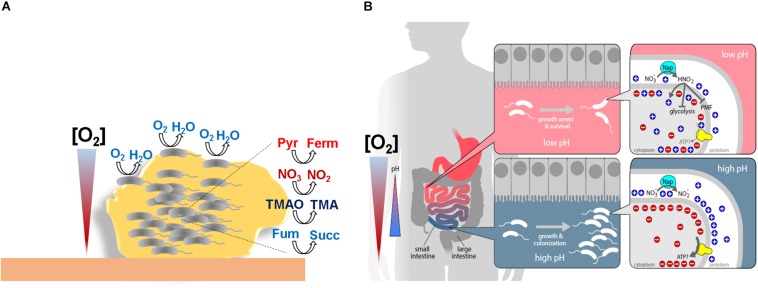
Bacteria can colonize virtually any environment on Earth due to their remarkable capacity to detect and respond quickly and adequately to environmental stressors. Vibrio cholerae is a cosmopolitan bacterium that inhabits a vast range of environments. The V. cholerae life cycle comprises diverse environmental and infective stages. The bacterium is found in aquatic ecosystems both under free-living conditions or associated with a wide range of aquatic organisms, and some strains are also capable of causing epidemics in humans. In order to adapt between environments, V. cholerae possesses a versatile metabolism characterized by the rapid cross-regulation of energy-producing pathways. Low oxygen concentration is a key environmental factor that governs V. cholerae physiology. This article reviews the metabolic plasticity that enables V. cholerae to thrive on low oxygen concentrations and its role in environmental and host adaptation.
Keywords: TMAO; Vibrio cholerae; enteropathogen; fermentation; fitness; fumarate; nitrate; respiration.
Copyright © 2020 Bueno, Pinedo and Cava.
Figures

References
-
- Baraquet C., Théraulaz L., Guiral M., Lafitte D., Méjean V., Jourlin-Castelli C. (2006). TorT, a member of a new periplasmic binding protein family, triggers induction of the Tor respiratory system upon trimethylamine N-oxide electron-acceptor binding in Escherichia coli. J. Biol. Chem. 281 38189–38199. 10.1074/jbc.M604321200 - DOI - PubMed
Publication types
LinkOut - more resources
Full Text Sources
Molecular Biology Databases
