. 2020 Apr 30:11:356.
doi: 10.3389/fgene.2020.00356. eCollection 2020.

Post-translational Modification Crosstalk and Hotspots in Sirtuin Interactors Implicated in Cardiovascular Diseases

Affiliations

Post-translational Modification Crosstalk and Hotspots in Sirtuin Interactors Implicated in Cardiovascular Diseases

Suruchi Aggarwal et al. Front Genet. .

Abstract

Sirtuins are protein deacetylases that play a protective role in cardiovascular diseases (CVDs), as well as many other diseases. Absence of sirtuins can lead to hyperacetylation of both nuclear and mitochondrial proteins leading to metabolic dysregulation. The protein post-translational modifications (PTMs) are known to crosstalk among each other to bring about complex phenotypic outcomes. Various PTM types such as acetylation, ubiquitination, and phosphorylation, and so on, drive transcriptional regulation and metabolism, but such crosstalks are poorly understood. We integrated protein-protein interactions (PPI) and PTMs from several databases to integrate information on 1,251 sirtuin-interacting proteins, of which 544 are associated with cardiac diseases. Based on the ∼100,000 PTM sites obtained for sirtuin interactors, we observed that the frequency of PTM sites (83 per protein), as well as PTM types (five per protein), is higher than the global average for human proteome. We found that ∼60-70% PTM sites fall into ordered regions. Approximately 83% of the sirtuin interactors contained at least one competitive crosstalk (in situ) site, with half of the sites occurring in CVD-associated proteins. A large proportion of identified crosstalk sites were observed for acetylation and ubiquitination competition. We identified 614 proteins containing PTM hotspots (≥5 PTM sites) and 133 proteins containing crosstalk hotspots (≥3 crosstalk sites). We observed that a large proportion of disease-associated sequence variants were found in PTM motifs of CVD proteins. We identified seven proteins (TP53, LMNA, MAPT, ATP2A2, NCL, APEX1, and HIST1H3A) containing disease-associated variants in PTM and crosstalk hotspots. This is the first comprehensive bioinformatics analysis on sirtuin interactors with respect to PTMs and their crosstalks. This study forms a platform for generating interesting hypotheses that can be tested for a deeper mechanistic understanding gained or derived from big-data analytics.

Keywords: cancer; cardiovascular diseases; crosstalk; hotspot; modifications; neurodegenerative; protein–protein interactions; variant.


Figures

FIGURE 1
FIGURE 1
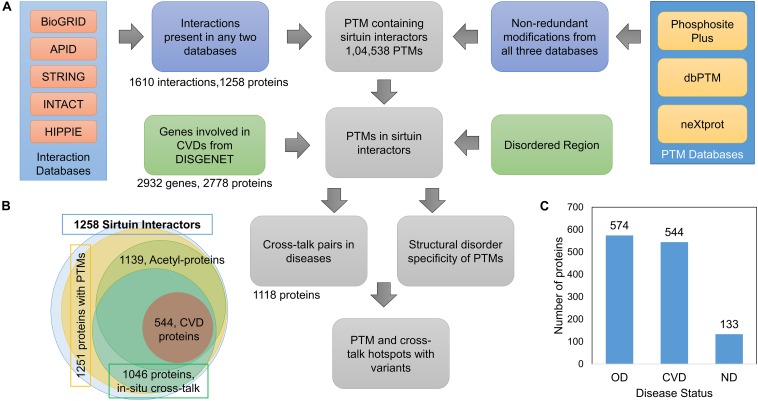
(A) Schematic overview of workflow to extract sirtuin interactors and their PTM sites from different databases. (B) Overview of proteins involved in interactions with SIRTs, the interactors containing PTMs, acetyl-containing proteins, and proteins with in situ crosstalks. It also shows proteins known to be associated with cardiovascular diseases (CVDs). (C) Proteins in the SIRTUIN interaction network to be associated with CVDs, other diseases (OD), and no-disease (ND).
FIGURE 2
FIGURE 2
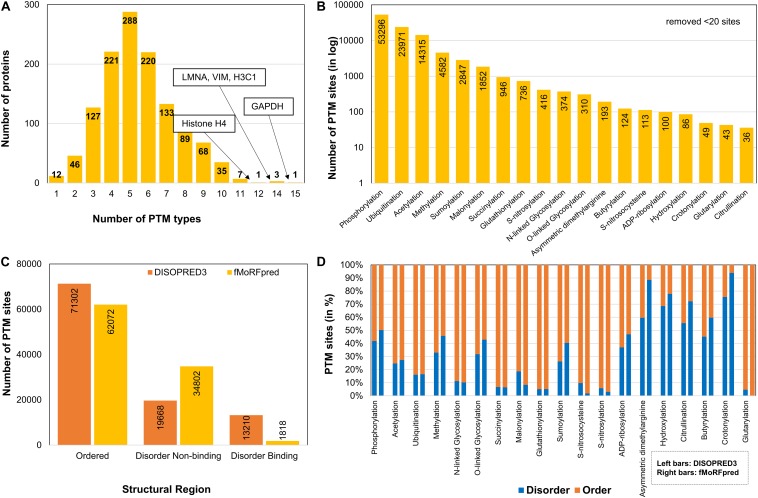
Dataset description after parsing and integrating for different PTM types in sirtuin interactors. (A) Frequency bar chart depicting the number of proteins that contain one or more PTM types. Most histones and GAPDH contained a higher number of PTM types than other proteins. (B) Distribution of sites for each PTM type shows phosphorylation, ubiquitination, and acetylation to be most predominant ones in sirtuin interactors. (C) Post-translational modification sites found in structural regions as predicted by DISOPRED3 and fMoRFpred. It shows most PTM sites map to ordered regions. (D) The division of each PTM in the type of structural region.
FIGURE 3
FIGURE 3
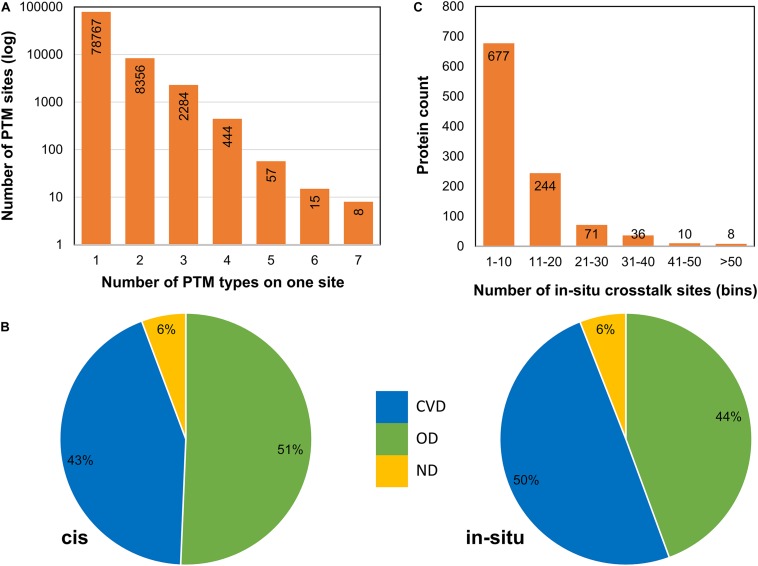
Post-translational modification crosstalks in sirtuin interactor proteins. (A) The frequency of proteins with number of PTM types at each site. Apart from the first bar (with single PTM type), the rest have in situ crosstalks. (B) cis and in situ crosstalks for sirtuin interactors reveal that most crosstalks occur in CVDs and other diseases, whereas very few (only 6% sites) were not involved with any disease. The in situ crosstalk seems to play an important role in CVDs in sirtuin interactors. (C) The frequency of proteins in each bin of in situ crosstalk sites reveals that most proteins have 1–10 crosstalk sites. Few proteins have more than 50 such sites.
FIGURE 4
FIGURE 4
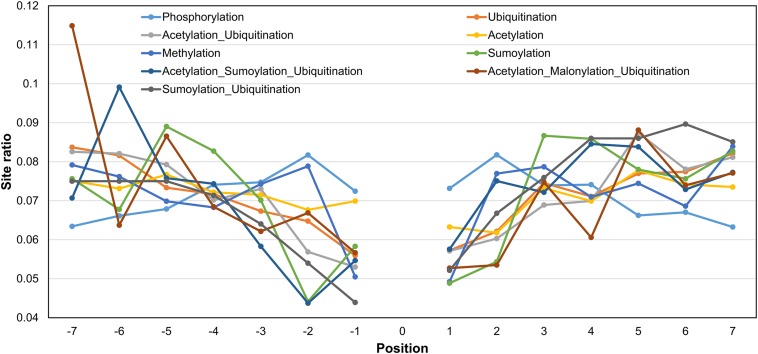
Fraction of sites around the central position for various PTMs and their in situ crosstalks. The x-axis represents the PTM motif position, and y-axis represents the ratio of sites present on that position with respect to the total number of sites for a particular PTM/crosstalk excluding the central site. While phosphorylation tends to decrease with distance from center, acetylation, ubiquitination, and their combination follow opposite trend. The competition between acetylation–malonylation and ubiquitination shows a preference for -7 position, whereas competition between acetylation, sumoylation, and ubiquitination shows preference for -6 position in the motif.
FIGURE 5
FIGURE 5
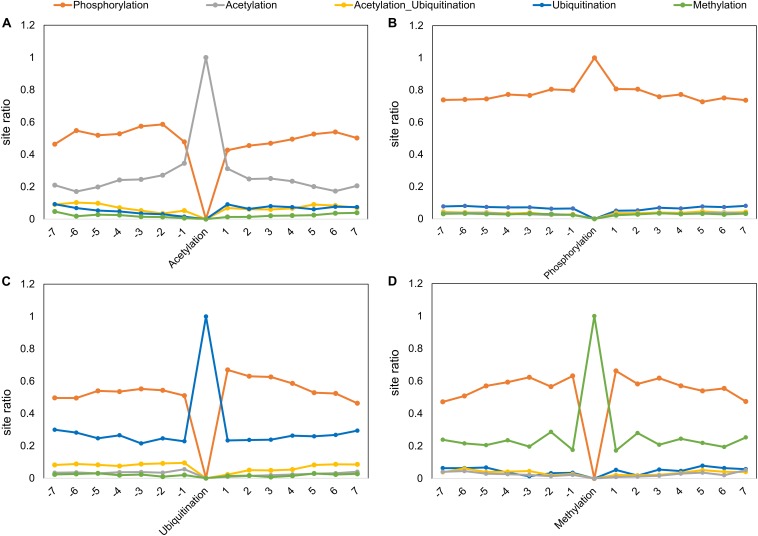
Post-translational modification motifs and occurrence of other PTMs or combination around (A) Acetylation, (B) phosphorylation, (C) ubiquitination, and (D) methylation. The x-axis represents the site position in the motif. The y-axis represents the ratio of sites with respect to the total sites for a particular PTM.
FIGURE 6
FIGURE 6
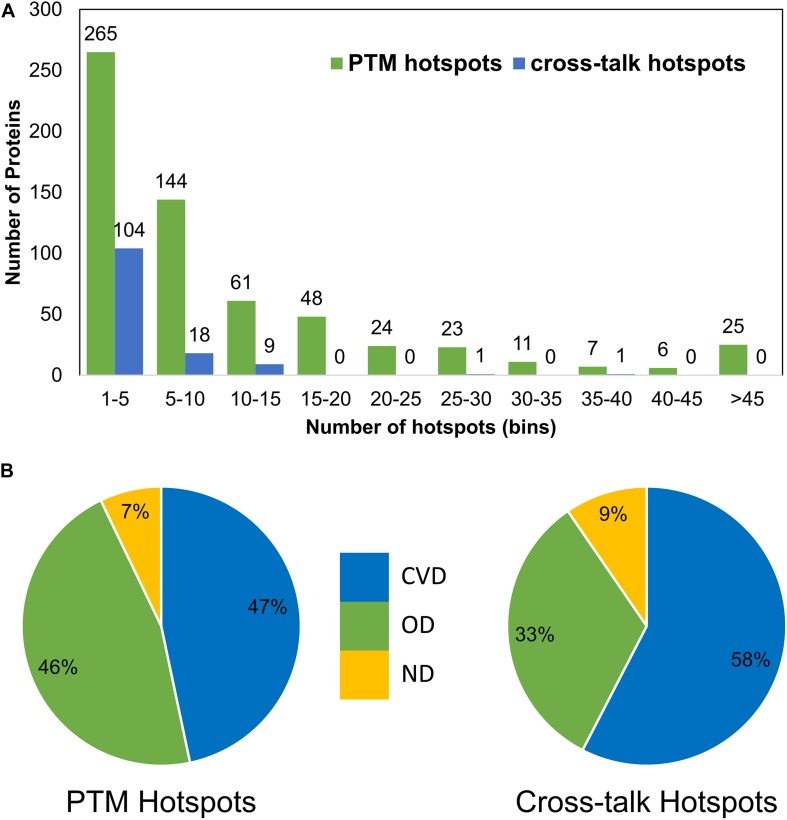
Post-translational modification and crosstalk hotspots in sirtuin interactors. (A) Frequency of proteins in each hotspot bin. (B) Disease category distribution in PTM hotspots (left) and crosstalk hotspots (right) shows their occurrence in CVDs and other diseases. While PTM hotspots have similar association with CVDs like OD, the crosstalk hotspots show much higher association (58%).
FIGURE 7
FIGURE 7
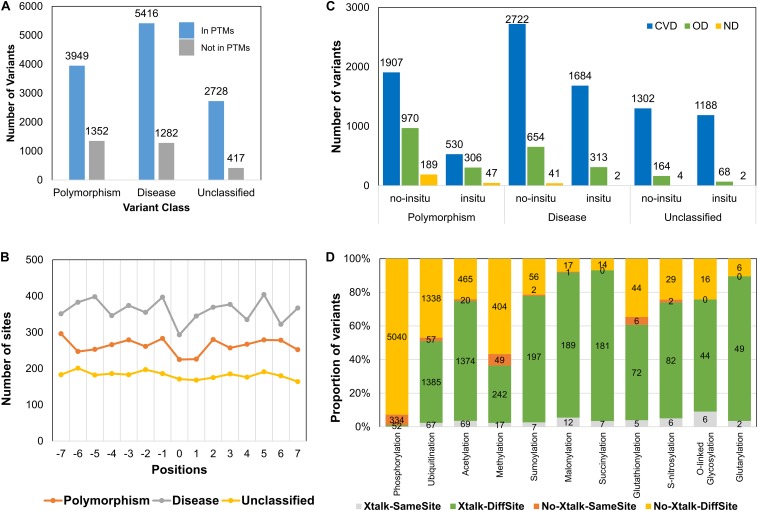
Distribution of variants in PTM motifs. (A) Number of motif-associated variants (MAVs) in each category (polymorphic, disease-related, or unclassified). (B) Motif-associated variants as observed in disease class of proteins and their occurrence in crosstalk motifs (in situ). (C) Number of MAVs observed at different positions in the PTM motif. (D) Proportion of MAVs in crosstalk/PTM motifs for each PTM type.
FIGURE 8
FIGURE 8
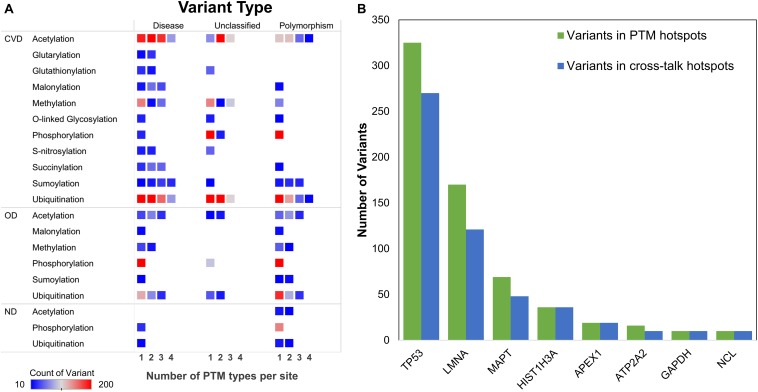
(A) Distribution of MAVs in disease-associated proteins with respect to the number of PTM types per site. (B) Proteins with ≥10 MAVs in PTM and crosstalk hotspot regions.

References

    1. Adam T., Sharp S., Opie L. H., Lecour S. (2013). Loss of cardioprotection with ischemic preconditioning in aging hearts: role of sirtuin 1? J. Cardiovasc. Pharmacol. Ther. 18 46–53. 10.1177/1074248412458723 - DOI - PubMed
    1. Aggarwal S., Kandpal M., Asthana S., Yadav A. K. (2017). “Perturbed signaling and role of posttranslational modifications in cancer drug resistance,” in Drug Resistance in Bacteria, Fungi, Malaria, and Cancer, eds Arora G., Sajid A., Kalia V. C. (Cham: Springer International Publishing; ), 483–510. 10.1007/978-3-319-48683-3_22 - DOI
    1. Alanis-Lobato G., Andrade-Navarro M. A., Schaefer M. H. (2017). HIPPIE v2.0: enhancing meaningfulness and reliability of protein-protein interaction networks. Nucleic Acids Res. 45 D408–D414. 10.1093/nar/gkw985 - DOI - PMC - PubMed
    1. Alonso-Lopez D., Gutierrez M. A., Lopes K. P., Prieto C., Santamaria R., De Las Rivas J. (2016). APID interactomes: providing proteome-based interactomes with controlled quality for multiple species and derived networks. Nucleic Acids Res. 44 W529–W535. 10.1093/nar/gkw363 - DOI - PMC - PubMed
    1. Aparicio-Trejo O. E., Reyes-Fermin L. M., Briones-Herrera A., Tapia E., Leon-Contreras J. C., Hernandez-Pando R., et al. (2019). Protective effects of N-acetyl-cysteine in mitochondria bioenergetics, oxidative stress, dynamics and S-glutathionylation alterations in acute kidney damage induced by folic acid. Free Radic. Biol. Med. 130 379–396. 10.1016/j.freeradbiomed.2018.11.005 - DOI - PubMed