


Targeted metabolomic analysis of serum phospholipid and acylcarnitine in the adult Fontan patient with a dominant left ventricle
- PMID: 32426103
- PMCID: PMC7222265
- DOI: 10.1177/2040622320916031
Targeted metabolomic analysis of serum phospholipid and acylcarnitine in the adult Fontan patient with a dominant left ventricle
Abstract
Background: Patients with a Fontan circulation have altered cholesterol and lipoprotein values. We analysed small organic molecules in extended phopsholipid and acylcarnitine metabolic pathways ('metabolomes') in adult Fontan patients with a dominant left ventricle, seeking differences between profiles in baseline and Fontan circulations.
Methods: In an observational matched cross-sectional study, we compared phosphatidylcholine (PC), sphingomyelin (SM), and acylcarnitine metabolomes (105 analytes; AbsoluteIDQ® p180 kit (Biocrates Life Sciences AG, Innsbruck, Austria) in 20 adult Fontan patients having a dominant left ventricle with those in 20 age- and sex-matched healthy controls.
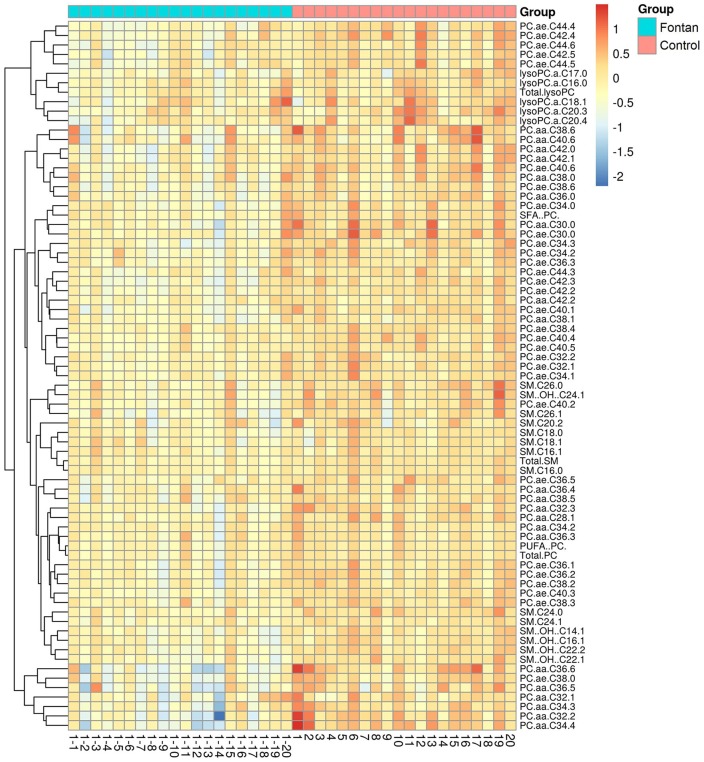
Results: Serum levels of total PC (q-value 0.01), total SM (q-value 0.0002) were significantly lower, and total acylcarnitines (q-value 0.02) were significantly higher in patients than in controls. After normalisation of data, serum levels of 12 PC and 1 SM Fontan patients were significantly lower (q-values <0.05), and concentrations of 3 acylcarnitines were significantly higher than those in controls (q-values <0.05).
Conclusion: Metabolomic profiling can use small specimens to identify biomarker patterns that track derangement in multiple metabolic pathways. The striking alterations in the phospholipid and acylcarnitine metabolome that we found in Fontan patients may reflect altered cell signalling and metabolism as found in heart failure in biventricular patients, chronic low-level inflammation, and alteration of functional or structural properties of lymphatic or blood vessels.
Trial registration number: ClinicalTrials.gov Identifier NCT03886935.
Keywords: Fontan; acylcarnitine; angiogenesis; congenital heart disease; heart failure; inflammation; lipid; lymphatic vessel; metabolism; metabolomics; phosphatidylcholine; phospholipid; sphingomyelin; vascular stiffening.
© The Author(s), 2020.
Conflict of interest statement
Conflict of interest statement: MM, KOD, MZ, DK, MGA, AE, MK, JK, IOK, RG, CS, CN, UM, SS-B, and KTL declare that they have no financial or non-financial competing interests with respect to the research, authorship, and/or publication of this article.
Figures


References
-
- Shaddy RE, Webb G. Applying heart failure guidelines to adult congenital heart disease patients. Expert Rev Cardiovasc Ther 2008; 6: 165–174. - PubMed
-
- Larsson DA, Meurling CJ, Holmqvist F, et al. The diagnostic and prognostic value of brain natriuretic peptides in adults with a systemic morphologically right ventricle or Fontan-type circulation. Int J Cardiol 2007; 114: 345–351. - PubMed
-
- Diller GP, Dimopoulos K, Okonko D, et al. Exercise intolerance in adult congenital heart disease: Comparative severity, correlates, and prognostic implication. Circulation 2005; 112: 828–835. - PubMed
-
- Giannakoulas G, Dimopoulos K, Bolger AP, et al. Usefulness of natriuretic peptide levels to predict mortality in adults with congenital heart disease. Am J Cardiol 2010; 105: 869–873. - PubMed
-
- Eindhoven JA, van den Bosch AE, Jansen PR, et al. The usefulness of brain natriuretic peptide in complex congenital heart disease: a systematic review. J Am Coll Cardiol 2012; 60: 2140–2149. - PubMed
Associated data
LinkOut - more resources
Full Text Sources
Other Literature Sources
Medical
