


Does treatment method matter? A meta-analysis of the past 20 years of research on therapeutic interventions for self-harm and suicidal ideation in adolescents
- PMID: 32426138
- PMCID: PMC7216729
- DOI: 10.1186/s40479-020-00123-9
Does treatment method matter? A meta-analysis of the past 20 years of research on therapeutic interventions for self-harm and suicidal ideation in adolescents
Abstract
Background: Self-harm is a clinically relevant and prevalent behaviour which peaks in adolescence. Given the high prevalence of self-harm, the high levels of psychiatric comorbidity, and its role as a risk factor for suicide, delivering evidence-based care is critical.
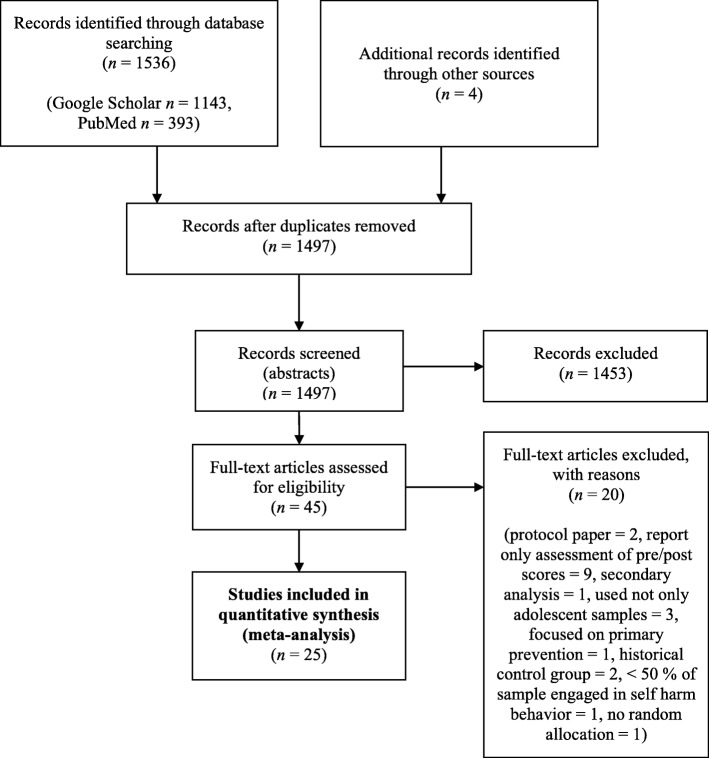
Methods: We conducted a systematic review and meta-analysis of the literature on treating self-harm in adolescents (12-19 years) published in the last 20 years, identifying 25 randomised controlled trials. We calculated the effect of treatment interventions relative to active control conditions in reducing self-harm, suicidal ideation and depressive symptoms.
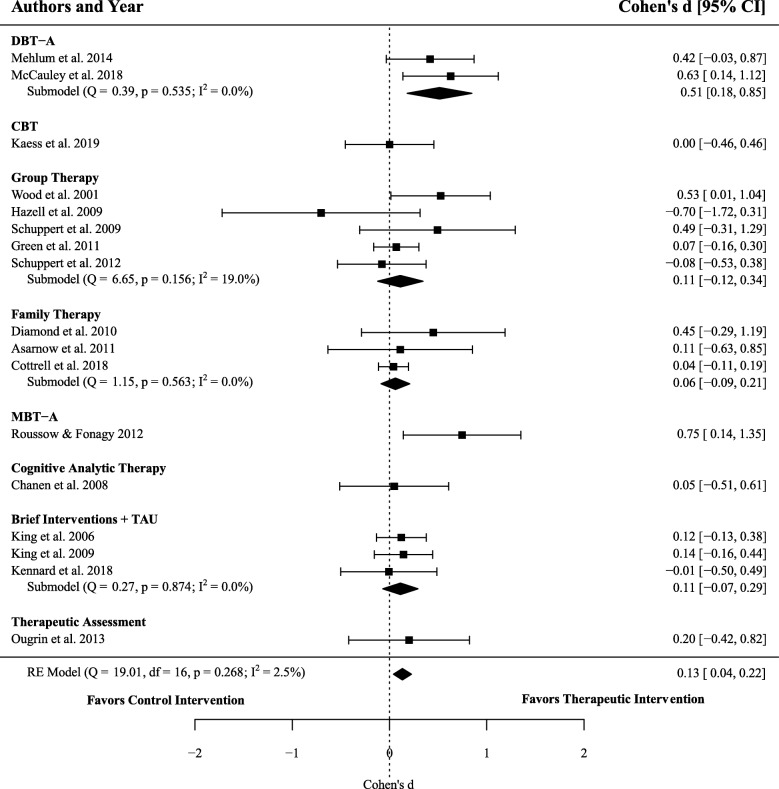
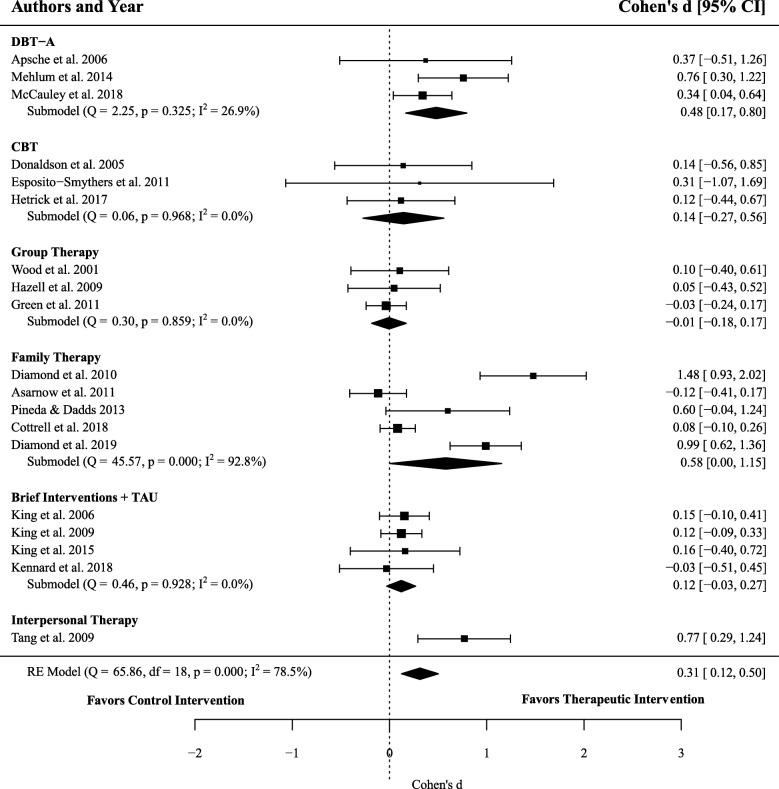
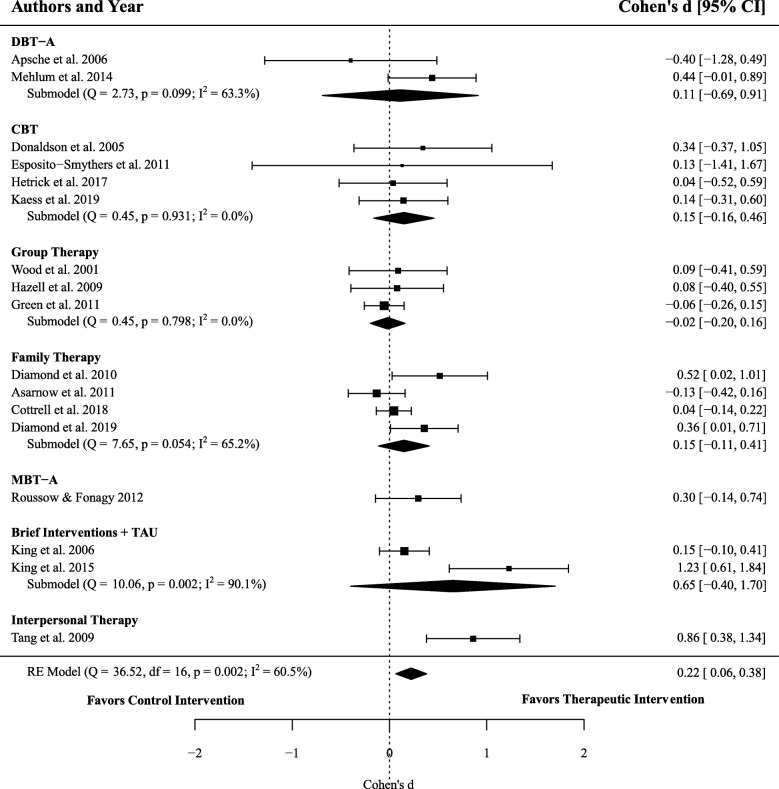
Results: Overall, treatment interventions fared slightly better than active controls in decreasing self-harm (d = 0.13, 95% CI 0.04-0.22, p = .004), suicidal ideation (d = 0.31, 95% CI 0.12-0.50, p = .001) and depressive symptoms (d = 0.22, 95% CI 0.07-0.38, p = .006). Subgroup analysis of specific therapies revealed moderate effects of DBT-A in reducing self-harm (d = 0.51, 95% CI 0.18-0.85, p = .002) and suicidal ideation (d = 0.48, 95% CI 0.17-0.80, p = .003), as well as moderate effects of family-centred therapy in the treating suicidal ideation (d = 0.58, 95% CI 0.01-1.15, p = .049).
Conclusions: The findings of our meta-analysis indicate that, overall, currently available treatments are effective in treating self-harm, suicidal ideation, and depressive symptoms in adolescence. Although the treatment intervention conditions showed only small to moderate effects in comparison to active controls, these differences were statistically significant and are clinically important. Further research is needed to understand the reduction in self-harm within active controls, which may arise due to the natural course of self-harm, or the potential efficacy of treatment as usual and enhanced usual care. Given the significant reduction of self-harm in active control conditions, delivering effective care to a large number of adolescents with self-harm may require developing stepped-care models in clinical practice. Expensive and poorly available treatments should be targeted at young people who most need them.
Keywords: Adolescence; Depression; NSSI; Nonsuicidal self-injury; Self-harm; Self-injury; Suicidal behaviour; Suicidal ideation.
© The Author(s) 2020.
Conflict of interest statement
Competing interestsAll authors declare that they don’t have any competing interests regarding this manuscript.
Figures
References
-
- American Psychiatric Association (APA) Diagnostic and Statistical Manual of Mental Disorder (5th ed.) (DSM-5) Arlington, VA: American Psychiatric Publishing; 2013.
-
- Apsche JA, Bass CK, Houston MA. A one year study of adolescent males with aggression and problems of conduct and personality: a comparison of MDT and DBT. Int J Behav Consult Ther. 2006;2(4):544–552. doi: 10.1037/h0101006. - DOI
-
- Card NA. Applied meta-analysis for social science research. New York: Guilford; 2012.
-
- Castellví P, Lucas-Romero E, Miranda-Mendizábal A, Parés-Badell O, Almenara J, Alonso I, et al. Longitudinal association between self-injurious thoughts and behaviors and suicidal behavior in adolescents and young adults: a systematic review with meta-analysis. J Affect Disord. 2017;215:37–48. doi: 10.1016/j.jad.2017.03.035. - DOI - PubMed
Publication types
LinkOut - more resources
Full Text Sources
Miscellaneous
