


Healing Status of Meniscal Ramp Lesion Affects Anterior Knee Stability After ACL Reconstruction
- PMID: 32426412
- PMCID: PMC7222250
- DOI: 10.1177/2325967120917674
Healing Status of Meniscal Ramp Lesion Affects Anterior Knee Stability After ACL Reconstruction
Abstract
Background: Although the biomechanical importance of the ramp lesion in the anterior cruciate ligament (ACL)-deficient knee has been demonstrated, there is no clear consensus on the appropriate treatment for ramp lesions during ACL reconstruction.
Purpose: To compare the postoperative outcomes for ramp lesions between patients treated with all-inside repair through the posteromedial portal and those whose ramp lesions were left in situ without repair during ACL reconstruction. We also determined whether ramp lesion healing status affected postoperative knee stability.
Study design: Cohort study; Level of evidence, 3.
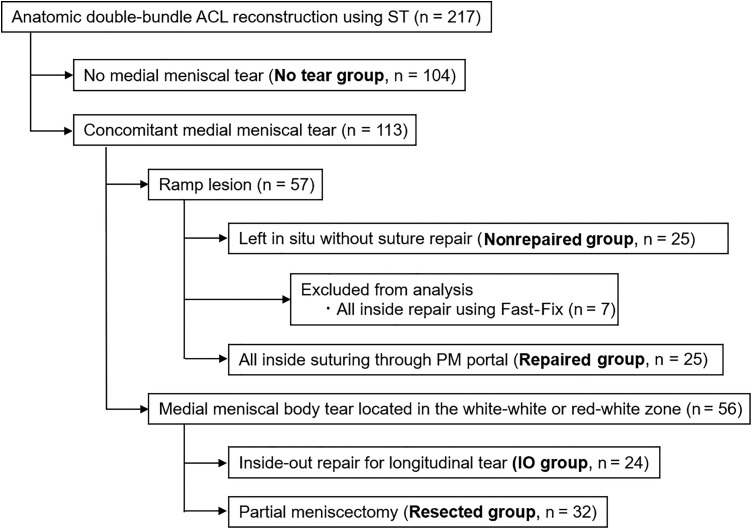
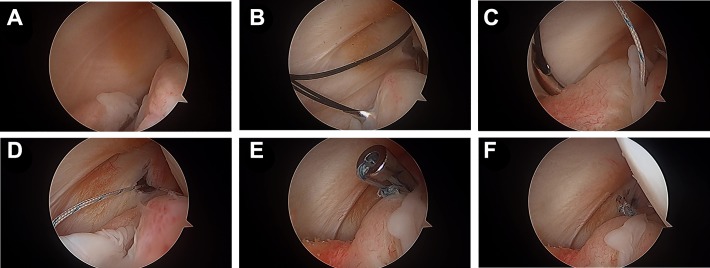
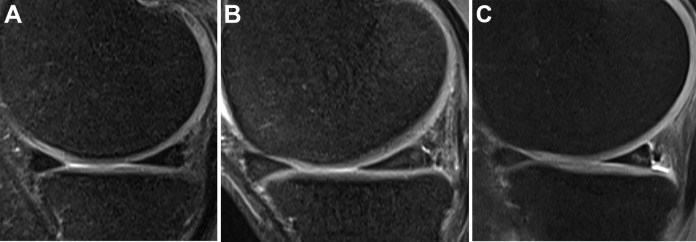
Methods: A total of 57 patients who underwent anatomic double-bundle ACL reconstruction between August 2011 and December 2017 had attendant ramp lesions. Of these, 25 ramp lesions that were considered stable were left in situ without repair (Nonrepaired group), and 25 ramp lesions, including 21 stable and 4 unstable lesions, were treated using all-inside repair through the posteromedial portal (Repaired group). We evaluated the side-to-side difference (SSD) in anterior tibial translation on stress radiographs and rotational stability by using the pivot-shift test 2 years after surgery, and healing status of the ramp lesions was evaluated on 3.0-T magnetic resonance imaging (MRI) scans 1 year after surgery.
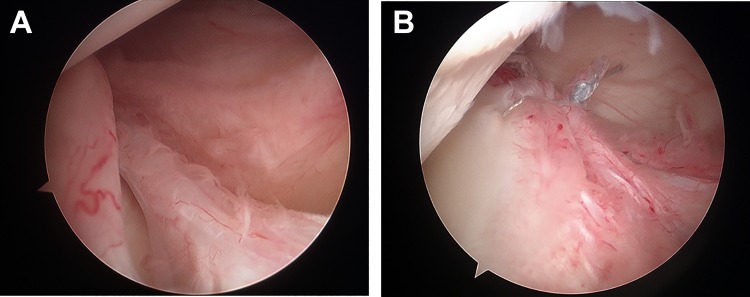
Results: The mean SSDs in anterior translation were 2.4 ± 1.6 mm for the Nonrepaired group and 1.9 ± 1.6 mm for the Repaired group, with no significant differences. The positive ratios on the pivot-shift test were not significantly different between groups. Healing rates of ramp lesions on MRI scans showed a significant difference between the Nonrepaired group (60%) and the Repaired group (100%) (P = .001). The mean SSDs for knees in which the ramp lesion had healed as shown on MRI scans and those in which it had not healed were 1.9 ± 1.6 mm and 3.2 ± 1.1 mm, respectively, which was a significant difference (P = .02).
Conclusion: Healing rates of ramp lesions were significantly better in the Repaired group than in the Nonrepaired group, although postoperative knee stability was not significantly different between groups. Anterior laxity in the knees in which the ramp lesion was unhealed was significantly greater compared with the knees in which the ramp lesion healed. All-inside repair through the posteromedial portal was a reliable surgical procedure to heal ramp lesions.
Keywords: anterior cruciate ligament; anterior stability; ramp lesion; repair.
© The Author(s) 2020.
Conflict of interest statement
The authors declared that there are no conflicts of interest in the authorship and publication of this contribution. AOSSM checks author disclosures against the Open Payments Database (OPD). AOSSM has not conducted an independent investigation on the OPD and disclaims any liability or responsibility relating thereto.
Figures
References
-
- Ahlden M, Samuelsson K, Sernert N, Forssblad M, Karlsson J, Kartus J. The Swedish National Anterior Cruciate Ligament Register: a report on baseline variables and outcomes of surgery for almost 18,000 patients. Am J Sports Med. 2012;40:2230–2235. - PubMed
-
- Ahn JH, Wang JH, Yoo JC. Arthroscopic all-inside suture repair of medial meniscus lesion in anterior cruciate ligament-deficient knees: results of second-look arthroscopies in 39 cases. Arthroscopy. 2004;20:101–108. - PubMed
-
- Ahn JH, Lee YS, Yoo JC, Chang MJ, Koh KH, Kim MH. Clinical and second-look arthroscopic evaluation of repaired medial meniscus in anterior cruciate ligament-reconstructed knees. Am J Sports Med. 2010;38:472–477. - PubMed
-
- Bollen SR. Posteromedial meniscocapsular injury associated with rupture of the anterior cruciate ligament: a previously unrecognized association. Bone Joint J. 2010;92:222–223. - PubMed
-
- Crues JV III, Ryu R, Morgan FW. Meniscal pathology: the expanding role of magnetic resonance imaging. Clin Orthop Relat Res. 1990;252:80–87. - PubMed
LinkOut - more resources
Full Text Sources
