


Communication training and the prescribing pattern of antibiotic prescription in primary health care
- PMID: 32428012
- PMCID: PMC7237035
- DOI: 10.1371/journal.pone.0233345
Communication training and the prescribing pattern of antibiotic prescription in primary health care
Abstract
Background: The treatment of upper respiratory tract infections (URTIs) accounts for the majority of antibiotic prescriptions in primary care, although an antibiotic therapy is rarely indicated. Non-clinical factors, such as time pressure and the perceived patient expectations are considered to be reasons for prescribing antibiotics in cases where they are not indicated. The improper use of antibiotics, however, can promote resistance and cause serious side effects. The aim of the study was to clarify whether the antibiotic prescription rate for infections of the upper respiratory tract can be lowered by means of a short (2 x 2.25h) communication training based on the MAAS-Global-D for primary care physicians.
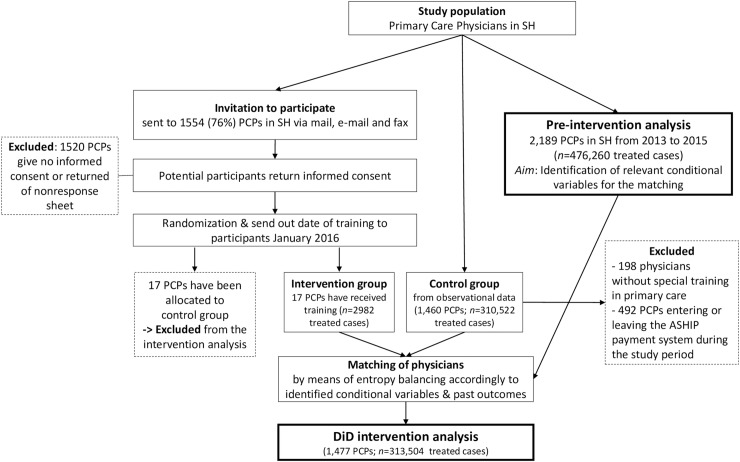
Methods: In total, 1554 primary care physicians were invited to participate in the study. The control group was formed from observational data. To estimate intervention effects we applied a combination of difference-in-difference (DiD) and statistical matching based on entropy balancing. We estimated a corresponding multi-level logistic regression model for the antibiotic prescribing decision of German primary care physicians for URTIs.
Results: Univariate estimates detected an 11-percentage-point reduction of prescriptions for the intervention group after the training. For the control group, a reduction of 4.7% was detected. The difference between both groups in the difference between the periods was -6.5% and statistically significant. The estimated effects were nearly identical to the effects estimated for the multi-level logistic regression model with applied matching. Furthermore, for the treatment of young women, the impact of the training on the reduction of antibiotic prescription was significantly stronger.
Conclusions: Our results suggest that communication skills, implemented through a short communication training with the MAAS-Global-D-training, lead to a more prudent prescribing behavior of antibiotics for URTIs. Thereby, the MAAS-Global-D-training could not only avoid unnecessary side effects but could also help reducing the emergence of drug resistant bacteria. As a consequence of our study we suggest that communication training based on the MAAS-Global-D should be applied in the postgraduate training scheme of primary care physicians.
Conflict of interest statement
CS, KG, TE and JS: the authors declare that they have no competing interests. I have read the journal's policy and the author AS of this manuscript have the following competing interests: AS is an editor of the German version of EbMG. The online access is provided free of charge to the study PCPs by Verlagshaus der Aerzte, Vienna. This does not alter our adherence to PLOS ONE policies on sharing data and materials.
References
-
- WHO: Antibiotic Resistance—Fact Sheet. Available online. February 2018:. http://www.who.int/mediacentre/factsheets/antibiotic-resistance/ (Accessed 9 May 2019).
-
- Kollef MH: Broad-spectrum antimicrobials and the treatment of serious bacterial infections: getting it right up front. Clin Infect Dis 2008, 47(Supplement_1):S3–S13. - PubMed
Publication types
MeSH terms
Substances
Associated data
LinkOut - more resources
Full Text Sources
Research Materials
