


Feasibility and acceptability of the 'Acutely Presenting Older Patient' screener in routine emergency department care
- PMID: 32428199
- PMCID: PMC7583525
- DOI: 10.1093/ageing/afaa078
Feasibility and acceptability of the 'Acutely Presenting Older Patient' screener in routine emergency department care
Abstract
Background: risk stratification tools for older patients in the emergency department (ED) have rarely been implemented successfully in routine care.
Objective: to evaluate the feasibility and acceptability of the 'Acutely Presenting Older Patient' (APOP) screener, which identifies older ED patients at the highest risk of adverse outcomes within 2 minutes at presentation.
Design and setting: 2-month prospective cohort study, after the implementation of the APOP screener in ED routine care in the Leiden University Medical Center.
Subjects: all consecutive ED patients aged ≥70 years.
Methods: feasibility of screening was assessed by measuring the screening rate and by identifying patient- and organisation-related determinants of screening completion. Acceptability was assessed by collecting experienced barriers of screening completion from triage-nurses.
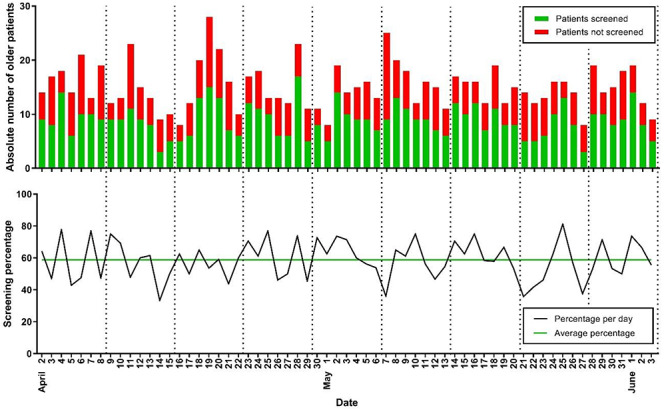
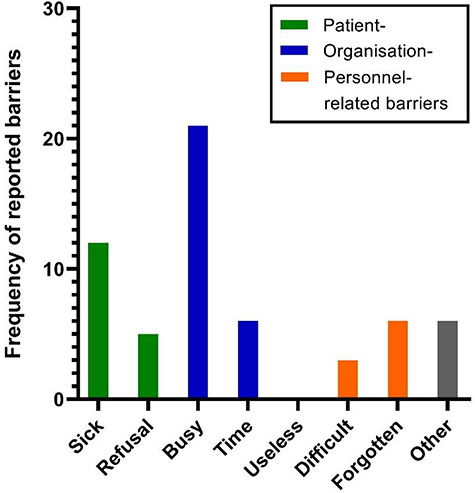
Results: we included 953 patients with a median age of 77 (IQR 72-82) years, of which 560 (59%) patients were screened. Patients had a higher probability of being screened when they had a higher age (OR 1.03 (95%CI 1.01-1.06), P = 0.017). Patients had a lower probability of being screened when they were triaged very urgent (OR 0.55 (0.39-0.78), P = 0.001) or when the number of patients upon arrival was high (OR 0.63 (0.47-0.86), P = 0.003). Experienced barriers of screening completion were patient-related ('patient was too sick'), organisation-related ('ED was too busy') and personnel-related ('forgot to complete screening').
Conclusion: with more than half of all older patients screened, feasibility and acceptability of screening in routine ED care is very promising. To further improve screening completion, solutions are needed for patients who present with high urgency and during ED rush hours.
Keywords: emergency department; feasibility studies; geriatric assessment; geriatric emergency medicine; implementation science; older people.
© The Author(s) 2020. Published by Oxford University Press on behalf of the British Geriatrics Society.
Figures
References
-
- Elliott A, Hull L, Conroy SP. Frailty identification in the emergency department-a systematic review focussing on feasibility. Age Ageing 2017; 46: 509–13. - PubMed
-
- Aminzadeh F, Dalziel WB. Older adults in the emergency department: a systematic review of patterns of use, adverse outcomes, and effectiveness of interventions. Ann Emerg Med 2002; 39: 238–47. - PubMed
-
- Salvi F, Morichi V, Grilli A, Giorgi R, De Tommaso G, Dessi-Fulgheri P. The elderly in the emergency department: a critical review of problems and solutions. Intern Emerg Med 2007; 2: 292–301. - PubMed
-
- Samaras N, Chevalley T, Samaras D, Gold G. Older patients in the emergency department: a review. Ann Emerg Med 2010; 56: 261–9. - PubMed
-
- Nickel C, Bellou A, Conroy S, eds. Geriatric Emergency Medicine. Switzerland: Springer International Publishing, 2018.
Publication types
MeSH terms
LinkOut - more resources
Full Text Sources
Medical
