


Molecular Bismuth Cations: Assessment of Soft Lewis Acidity
- PMID: 32428329
- PMCID: PMC7818483
- DOI: 10.1002/chem.202001674
Molecular Bismuth Cations: Assessment of Soft Lewis Acidity
Abstract
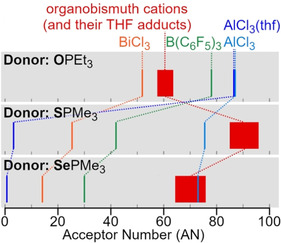
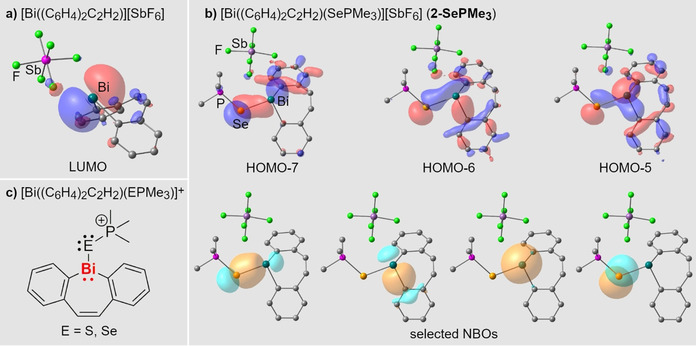
Three-coordinate cationic bismuth compounds [Bi(diaryl)(EPMe3 )][SbF6 ] have been isolated and fully characterized (diaryl=[(C6 H4 )2 C2 H2 ]2- , E=S, Se). They represent rare examples of molecular complexes with Bi⋅⋅⋅EPR3 interactions (R=monoanionic substituent). The 31 P NMR chemical shift of EPMe3 has been found to be sensitive to the formation of LA⋅⋅⋅EPMe3 Lewis acid/base interactions (LA=Lewis acid). This corresponds to a modification of the Gutmann-Beckett method and reveals information about the hardness/softness of the Lewis acid under investigation. A series of organobismuth compounds, bismuth halides, and cationic bismuth species have been investigated with this approach and compared to traditional group 13 and cationic group 14 Lewis acids. Especially cationic bismuth species have been shown to be potent soft Lewis acids that may prefer Lewis pair formation with a soft (S/Se-based) rather than a hard (O/N-based) donor. Analytical techniques applied in this work include (heteronuclear) NMR spectroscopy, single-crystal X-ray diffraction analysis, and DFT calculations.
Keywords: HSAB principle; Lewis acids; bismuth; bonding analysis; cationic species.
© 2020 Wiley-VCH Verlag GmbH & Co. KGaA, Weinheim.
Conflict of interest statement
The authors declare no conflict of interest.
Figures


References
-
- None
-
- Ollevier T., Org. Biomol. Chem. 2013, 11, 2740–2755; - PubMed
-
- Bothwell J. M., Krabbe S. W., Mohan R. S., Chem. Soc. Rev. 2011, 40, 4649–4707; - PubMed
-
- Ollevier T., Bismuth-Mediated Organic Reactions, Topics in Current Chemistry, Springer, 2012, Vol. 311; - PubMed
-
- Gagnon A., Dansereau J., Le Roch A., Synthesis 2017, 49, 1707–1745;
Grants and funding
LinkOut - more resources
Full Text Sources
Miscellaneous
