Review
. 2020 May 15;21(10):3505.
doi: 10.3390/ijms21103505.

From Environment to Genome and Back: A Lesson from HFE Mutations

Affiliations
Review

From Environment to Genome and Back: A Lesson from HFE Mutations

Raffaela Rametta et al. Int J Mol Sci. .

Abstract

The environment and the human genome are closely entangled and many genetic variations that occur in human populations are the result of adaptive selection to ancestral environmental (mainly dietary) conditions. However, the selected mutations may become maladaptive when environmental conditions change, thus becoming candidates for diseases. Hereditary hemochromatosis (HH) is a potentially lethal disease leading to iron accumulation mostly due to mutations in the HFE gene. Indeed, homozygosity for the C282Y HFE mutation is associated with the primary iron overload phenotype. However, both penetrance of the C282Y variant and the clinical manifestation of the disease are extremely variable, suggesting that other genetic, epigenetic and environmental factors play a role in the development of HH, as well as, and in its progression to end-stage liver diseases. Alcohol consumption and dietary habits may impact on the phenotypic expression of HFE-related hemochromatosis. Indeed, dietary components and bioactive molecules can affect iron status both directly by modulating its absorption during digestion and indirectly by the epigenetic modification of genes involved in its uptake, storage and recycling. Thus, the premise of this review is to discuss how environmental pressures led to the selection of HFE mutations and whether nutritional and lifestyle interventions may exert beneficial effects on HH outcomes and comorbidities.

Keywords: HFE; Hereditary hemochromatosis; insulin signaling; iron metabolism; miRNAs; polyphenols; vitamins.


Conflict of interest statement

The authors declare no conflict of interest.

Figures
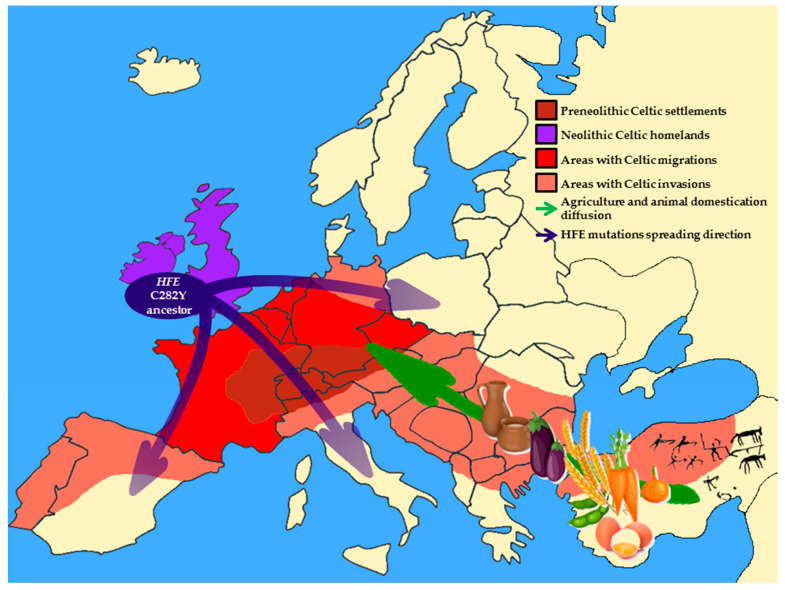
Figure 1
Figure 1
Schematic representation of Europe during the Neolithic Age. Brown area indicates pre-Neolithic original Celtic settlements; purple area shows Celtic homeland during the Neolithic Age; red area is regions occupied by the main Celtic settlements after Neolithic migrations; orange areas indicate the areas reached by the Celtic invasions. Blue arrows show the gradient of HFE C282Y spreading throughout Europe. The green arrow represents the diffusion of agriculture and the domestication of animals.
Figure 2
Figure 2
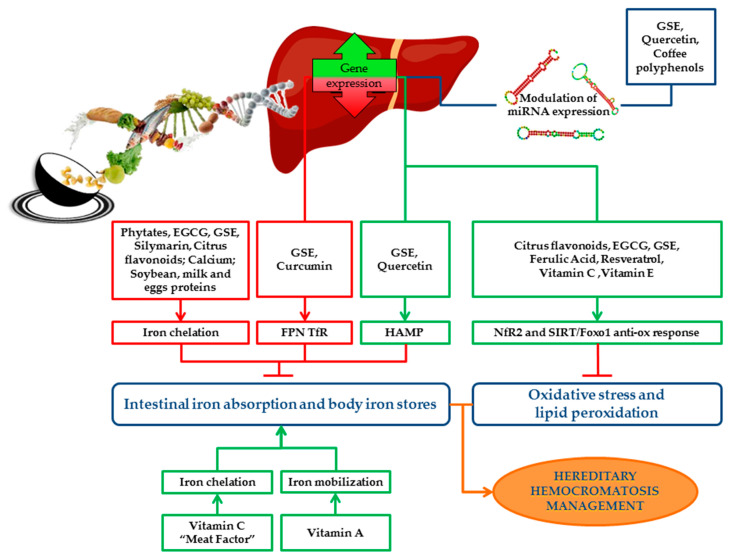
Schematic representation of the impact of bioactive compounds and dietary factors on iron metabolism. Dietary factors and bioactive compounds regulate iron metabolism directly, by enhancing/inhibiting its absorption, storage and recycling, or indirectly by the modulation of miRNAs, which regulate the expression of iron genes. Bioactive compounds act as antioxidants and protect cells and tissues from detrimental effects of iron overload by reducing oxidative stress and lipid peroxidation. The picture shows the main pathways induced (green boxes) or downregulated (red boxes) by bioactive compounds and the final effect on iron absorption, body iron stores, oxidative stress and lipid peroxidation (green arrows indicate positive effects; red “T” arrows indicate inhibitory ones). Nutritional interventions aimed at reducing iron absorption and improving iron-induced oxidative stress may be useful and safe strategies supporting phlebotomy in the management and treatment of HH patients. EGCG: Epigallocatechin-3-gallate; GSE: Grape seed extract; FPN: Ferroportin; TfR: Transferrin receptor; HAMP: Hepcidin antimicrobial peptide gene; ROS: Reactive oxygen species; Nrf2: Nuclear factor erythroid 2 related factor 2; SIRT1: Sirtuin 1; FOXO1: Forkhead box O1.

References

    1. Laland K.N., Odling-Smee J., Feldman M.W. Cultural niche construction and human evolution. J. Evol. Biol. 2001;14:22–33. doi: 10.1046/j.1420-9101.2001.00262.x. - DOI - PubMed
    1. Cordain L., Eaton S.B., Miller J.B., Mann N., Hill K. The paradoxical nature of hunter-gatherer diets: Meat-based, yet non-atherogenic. Eur. J. Clin. Nutr. 2002;56:S42–S52. doi: 10.1038/sj.ejcn.1601353. - DOI - PubMed
    1. Pinhasi R., Fort J., Ammerman A.J. Tracing the origin and spread of agriculture in Europe. PLoS Biol. 2005;3:e410. doi: 10.1371/journal.pbio.0030410. - DOI - PMC - PubMed
    1. Tishkoff S.A., Verrelli B.C. Role of evolutionary history on haplotype block structure in the human genome: Implications for disease mapping. Curr. Opin. Genet. Dev. 2003;13:569–575. doi: 10.1016/j.gde.2003.10.010. - DOI - PubMed
    1. Stover P.J. Human nutrition and genetic variation. Food Nutr. Bull. 2007;28:S101–S115. doi: 10.1177/15648265070281S109. - DOI - PubMed

Substances