


A near full-length HIV-1 genome from 1966 recovered from formalin-fixed paraffin-embedded tissue
- PMID: 32430331
- PMCID: PMC7275743
- DOI: 10.1073/pnas.1913682117
A near full-length HIV-1 genome from 1966 recovered from formalin-fixed paraffin-embedded tissue
Abstract
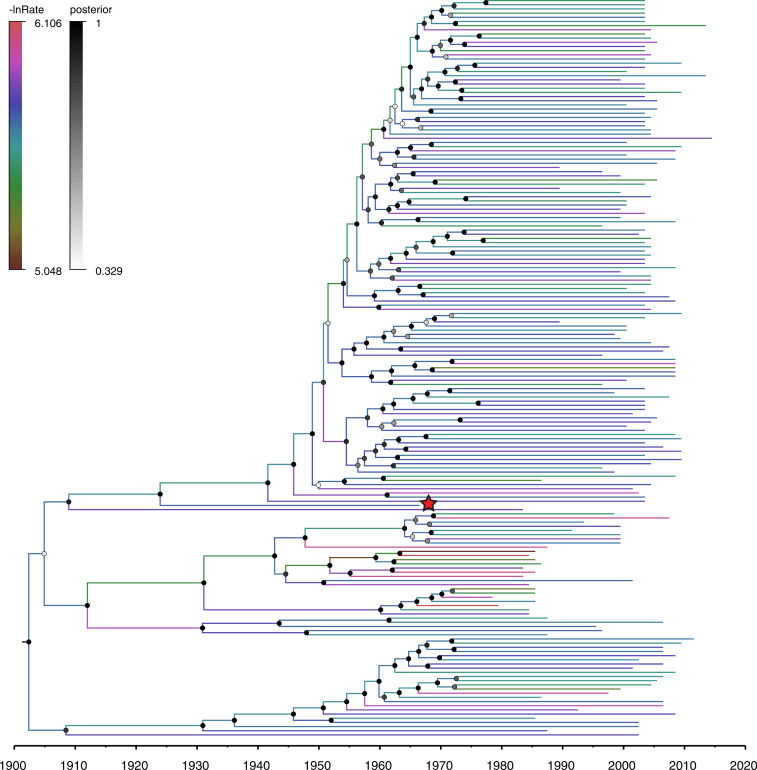
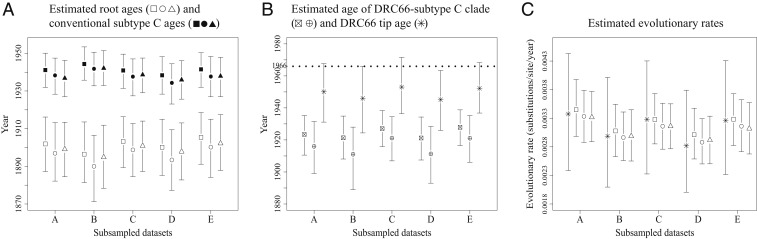
With very little direct biological data of HIV-1 from before the 1980s, far-reaching evolutionary and epidemiological inferences regarding the long prediscovery phase of this pandemic are based on extrapolations by phylodynamic models of HIV-1 genomic sequences gathered mostly over recent decades. Here, using a very sensitive multiplex RT-PCR assay, we screened 1,645 formalin-fixed paraffin-embedded tissue specimens collected for pathology diagnostics in Central Africa between 1958 and 1966. We report the near-complete viral genome in one HIV-1 positive specimen from Kinshasa, Democratic Republic of Congo (DRC), from 1966 ("DRC66")-a nonrecombinant sister lineage to subtype C that constitutes the oldest HIV-1 near full-length genome recovered to date. Root-to-tip plots showed the DRC66 sequence is not an outlier as would be expected if dating estimates from more recent genomes were systematically biased; and inclusion of the DRC66 sequence in tip-dated BEAST analyses did not significantly alter root and internal node age estimates based on post-1978 HIV-1 sequences. There was larger variation in divergence time estimates among datasets that were subsamples of the available HIV-1 genomes from 1978 to 2014, showing the inherent phylogenetic stochasticity across subsets of the real HIV-1 diversity. Our phylogenetic analyses date the origin of the pandemic lineage of HIV-1 to a time period around the turn of the 20th century (1881 to 1918). In conclusion, this unique archival HIV-1 sequence provides direct genomic insight into HIV-1 in 1960s DRC, and, as an ancient-DNA calibrator, it validates our understanding of HIV-1 evolutionary history.
Keywords: HIV-1; evolution; phylogeny; virus.
Conflict of interest statement
The authors declare no competing interest.
Figures

References
-
- World Health Organization , The 2018 Update, Global Health Workforce Statistics (World Health Organization, Geneva, 2018).
-
- Ho S. Y. W., et al. , Time-dependent rates of molecular evolution. Mol. Ecol. 20, 3087–3101 (2011). - PubMed
-
- Gifford R. J., Viral evolution in deep time: Lentiviruses and mammals. Trends Genet. 28, 89–100 (2012). - PubMed
Publication types
MeSH terms
Associated data
- Actions
Grants and funding
LinkOut - more resources
Full Text Sources
Medical
Molecular Biology Databases
