


Potential of Chitosan and Its Derivatives for Biomedical Applications in the Central Nervous System
- PMID: 32432095
- PMCID: PMC7214799
- DOI: 10.3389/fbioe.2020.00389
Potential of Chitosan and Its Derivatives for Biomedical Applications in the Central Nervous System
Abstract
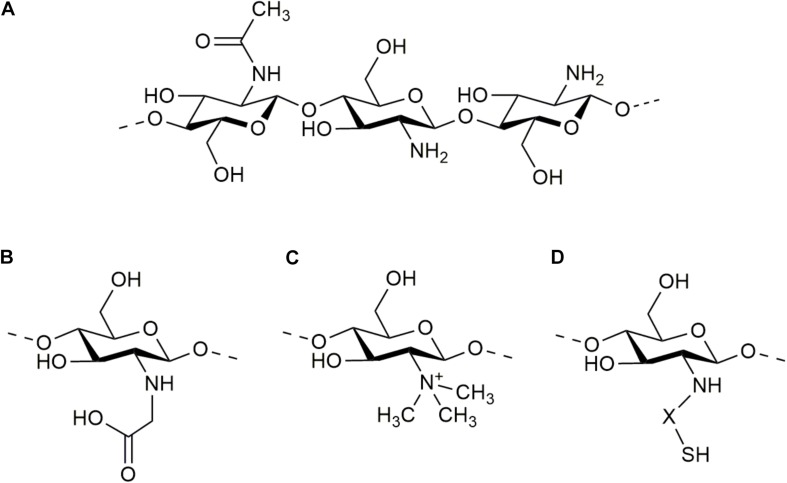
It is well known that the central nervous system (CNS) has a limited regenerative capacity and that many therapeutic molecules cannot cross the blood brain barrier (BBB). The use of biomaterials has emerged as an alternative to overcome these limitations. For many years, biomedical applications of chitosan have been studied due to its remarkable biological properties, biocompatibility, and high versatility. Moreover, the interest in this biomaterial for CNS biomedical implementation has increased because of its ability to cross the BBB, mucoadhesiveness, and hydrogel formation capacity. Several chitosan-based biomaterials have been applied with promising results as drug, cell and gene delivery vehicles. Moreover, their capacity to form porous scaffolds and to bear cells and biomolecules has offered a way to achieve neural regeneration. Therefore, this review aims to bring together recent works that highlight the potential of chitosan and its derivatives as adequate biomaterials for applications directed toward the CNS. First, an overview of chitosan and its derivatives is provided with an emphasis on the properties that favor different applications. Second, a compilation of works that employ chitosan-based biomaterials for drug delivery, gene therapy, tissue engineering, and regenerative medicine in the CNS is presented. Finally, the most interesting trends and future perspectives of chitosan and its derivatives applications in the CNS are shown.
Keywords: central nervous system; chitosan; chitosan derivatives; drug delivery; regenerative medicine; tissue engineering.
Copyright © 2020 Ojeda-Hernández, Canales-Aguirre, Matias-Guiu, Gomez-Pinedo and Mateos-Díaz.
Figures
References
Publication types
LinkOut - more resources
Full Text Sources
Other Literature Sources
