


Mortality in adults with chronic hepatitis B infection in the United States: a population-based study
- PMID: 32432816
- PMCID: PMC7935406
- DOI: 10.1111/apt.15803
Mortality in adults with chronic hepatitis B infection in the United States: a population-based study
Abstract
Background: Chronic hepatitis B infection is an important contributor to mortality in the United States, yet impact of available and effective oral antivirals on mortality among infected individuals is unknown.
Aims: To compare risks and predictors of mortality in a recent time period between those with chronic, prior and no hepatitis B infection.
Methods: This is a population-based cohort study of National Health and Nutrition Examination Surveys participants between 1999 and 2014 linked to National Death Index data. Adults aged 20 years or older with hepatitis B serologic testing were included. Outcomes of all-cause and liver-related mortality were evaluated using Cox regression.
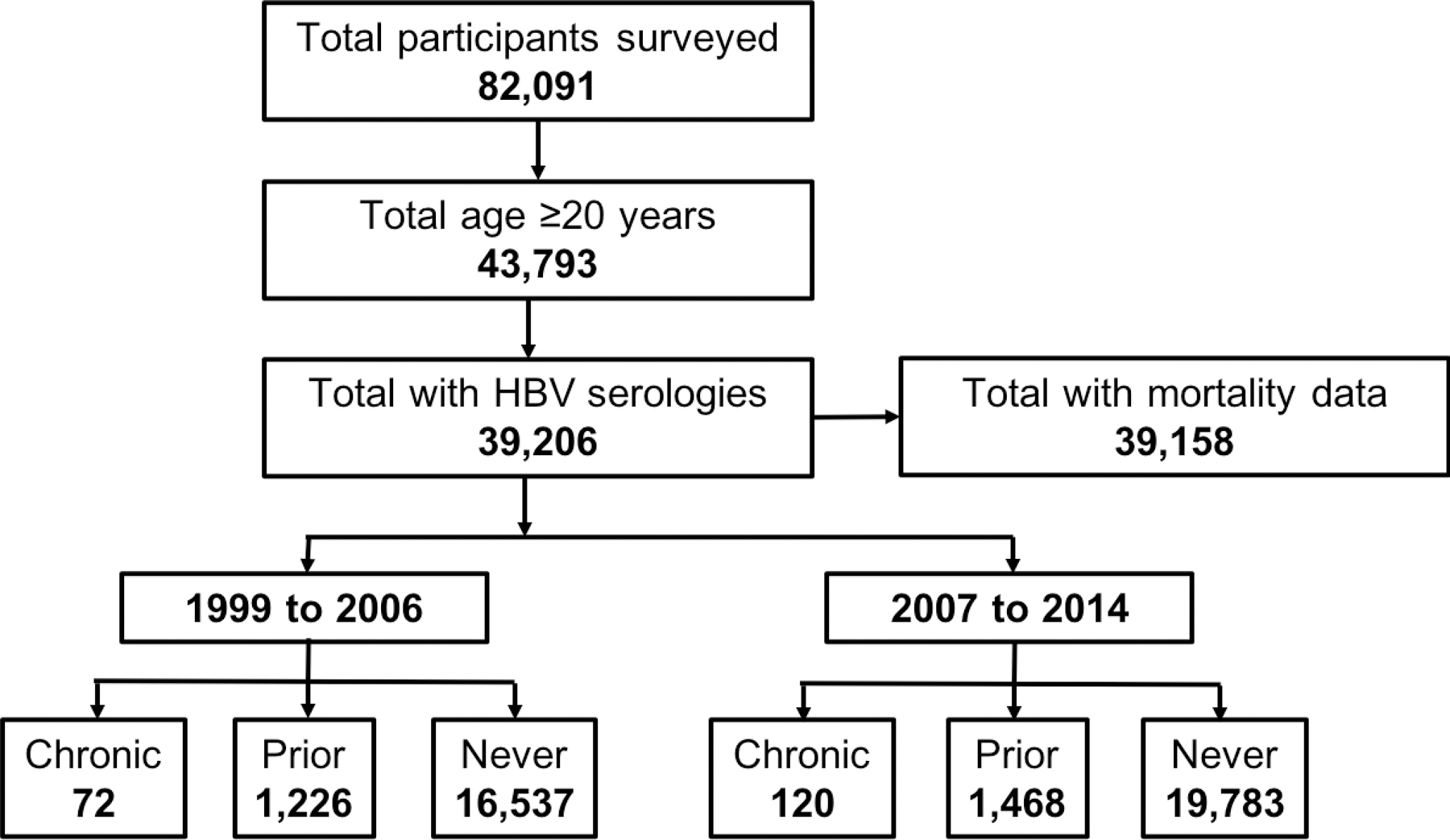
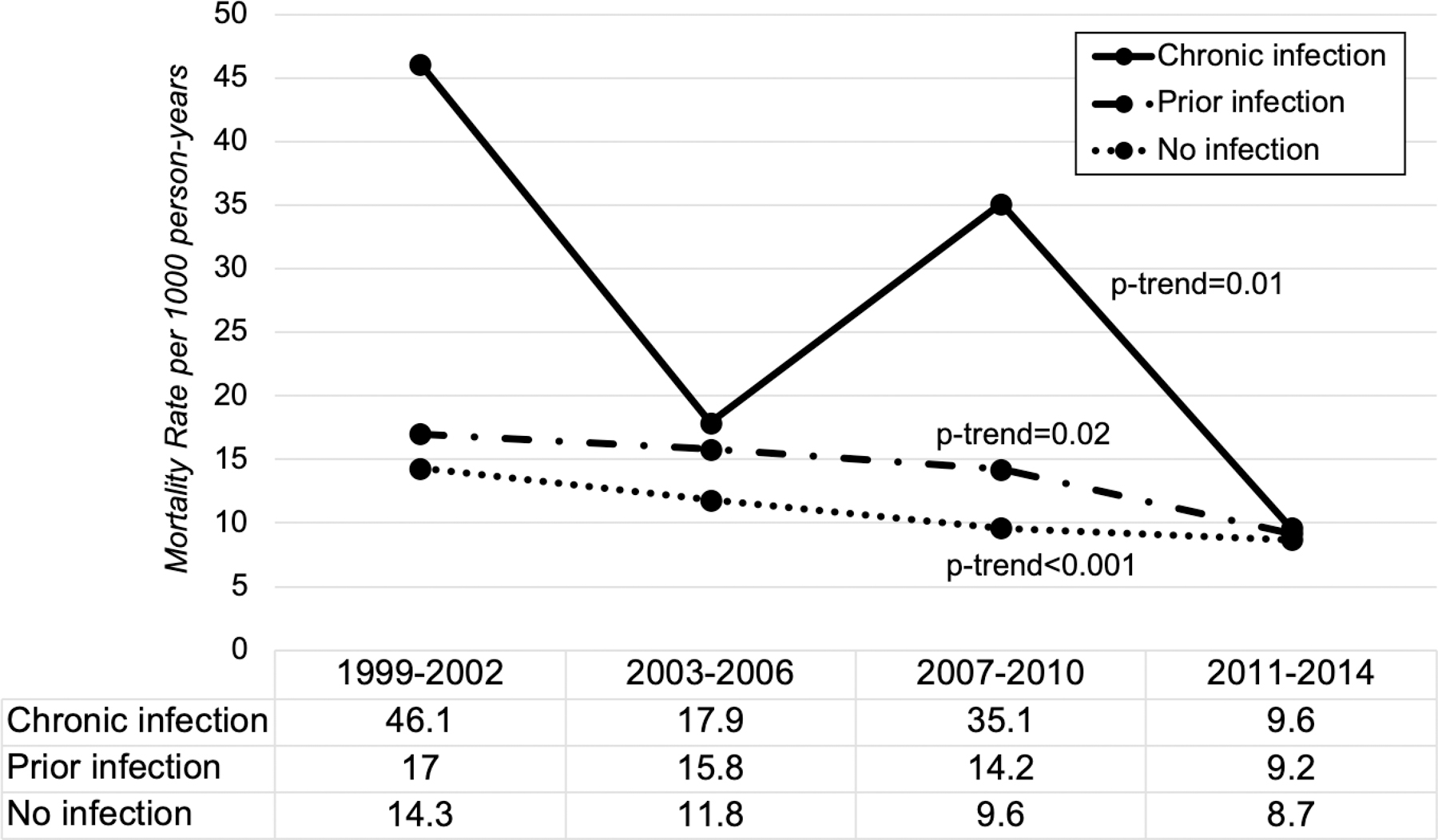
Results: Of 39 206 participants, 192 (0.5%) had chronic and 2694 (6.9%) had prior hepatitis B infection. The all-cause age/sex-standardised mortality rates for chronic, prior and uninfected were 21.4, 15.1 and 11.8 per 1000 person-years respectively. Liver-related mortality occurred at respective rates of 4.1, 0.3 and 0.1 per 1000 person-years. In multivariable analyses, those with chronic infection had 1.9-fold (95% CI 1.1-3.3) increased hazard of all-cause mortality and 13.3-fold (95% CI 3.9-45.5) increased hazard of liver-related mortality compared to uninfected. Predictors of all-cause mortality among chronic infection included heavy alcohol use (HR 18.3, 95% CI 3.3-100.6) and higher alanine aminotransferase (HR 1.02, 95% CI 1.00-1.03).
Conclusions: Mortality among adults living with chronic hepatitis B infection still exceeds that of uninfected despite availability of improved therapeutics. Identification of chronic infection, initiation of treatment among eligible and modulation of co-factors for disease progression are needed to improve survival.
© 2020 John Wiley & Sons Ltd.
Conflict of interest statement
Statement of Interests
Authors’ declaration of personal interests
Dr. Terrault reports institutional grant support from Gilead Sciences. The other authors disclose no conflicts.
Figures
References
-
- Stanaway JD, Flaxman AD, Naghavi M, Fitzmaurice C, Vos T, Abubakar I, Abu-Raddad LJ, Assadi R, Bhala N, Cowie B, Forouzanfour MH, Groeger J, Hanafiah KM, Jacobsen KH, James SL, MacLachlan J, Malekzadeh R, Martin NK, Mokdad AA, Mokdad AH, Murray CJL, Plass D, Rana S, Rein DB, Richardus JH, Sanabria J, Saylan M, Shahraz S, So S, Vlassov VV, Weiderpass E, Wiersma ST, Younis M, Yu C, El Sayed Zaki M and Cooke GS. The global burden of viral hepatitis from 1990 to 2013: findings from the Global Burden of Disease Study 2013. Lancet 2016;388:1081–1088. - PMC - PubMed
-
- Perz JF, Armstrong GL, Farrington LA, Hutin YJ and Bell BP. The contributions of hepatitis B virus and hepatitis C virus infections to cirrhosis and primary liver cancer worldwide. J Hepatol 2006;45:529–38. - PubMed
-
- Roberts H, Kruszon-Moran D, Ly KN, Hughes E, Iqbal K, Jiles RB and Holmberg SD. Prevalence of chronic hepatitis B virus (HBV) infection in U.S. households: National Health and Nutrition Examination Survey (NHANES), 1988–2012. Hepatology. 2016;63:388–97. - PubMed
-
- Kowdley KV, Wang CC, Welch S, Roberts H and Brosgart CL. Prevalence of chronic hepatitis B among foreign-born persons living in the United States by country of origin. Hepatology. 2012;56:422–33. - PubMed
-
- Wong GL, Tse YK, Chan HL, Yip TC, Tsoi KK and Wong VW. Oral nucleos(t)ide analogues reduce recurrence and death in chronic hepatitis B-related hepatocellular carcinoma. Aliment Pharmacol Ther 2016;43:802–13. - PubMed
Publication types
MeSH terms
Substances
Grants and funding
LinkOut - more resources
Full Text Sources