


No Place Like Home: Cross-National Data Analysis of the Efficacy of Social Distancing During the COVID-19 Pandemic
- PMID: 32434145
- PMCID: PMC7257477
- DOI: 10.2196/19862
No Place Like Home: Cross-National Data Analysis of the Efficacy of Social Distancing During the COVID-19 Pandemic
Abstract
Background: In the absence of a cure in the time of a pandemic, social distancing measures seem to be the most effective intervention to slow the spread of disease. Various simulation-based studies have been conducted to investigate the effectiveness of these measures. While those studies unanimously confirm the mitigating effect of social distancing on disease spread, the reported effectiveness varies from 10% to more than 90% reduction in the number of infections. This level of uncertainty is mostly due to the complex dynamics of epidemics and their time-variant parameters. However, real transactional data can reduce uncertainty and provide a less noisy picture of the effectiveness of social distancing.
Objective: The aim of this paper was to integrate multiple transactional data sets (GPS mobility data from Google and Apple as well as disease statistics from the European Centre for Disease Prevention and Control) to study the role of social distancing policies in 26 countries and analyze the transmission rate of the coronavirus disease (COVID-19) pandemic over the course of 5 weeks.
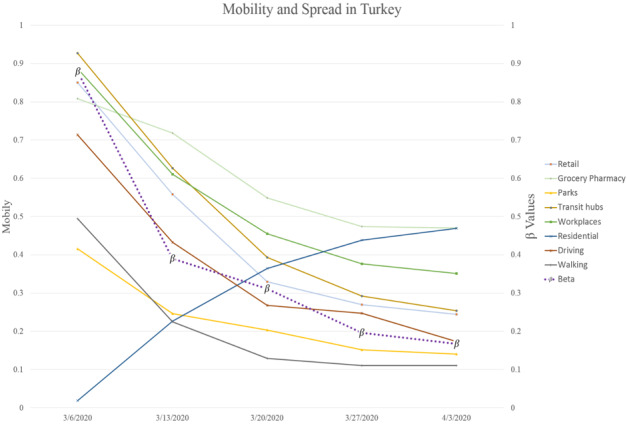
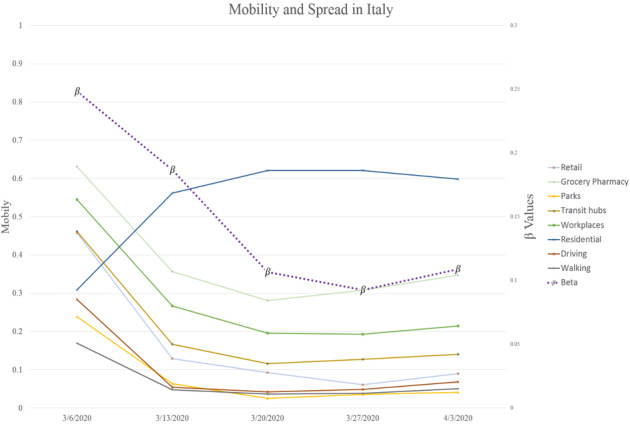
Methods: Relying on the susceptible-infected-recovered (SIR) model and official COVID-19 reports, we first calculated the weekly transmission rate (β) of COVID-19 in 26 countries for 5 consecutive weeks. Then, we integrated these data with the Google and Apple mobility data sets for the same time frame and used a machine learning approach to investigate the relationship between the mobility factors and β values.
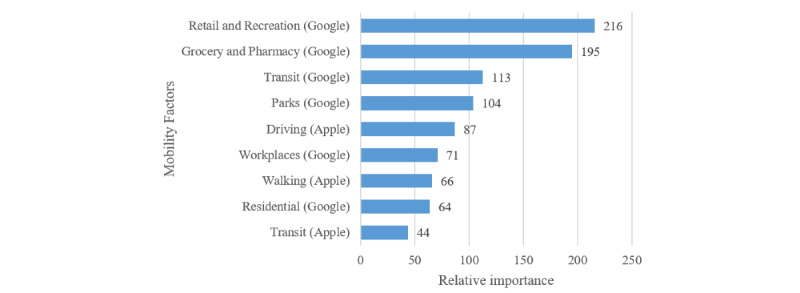
Results: Gradient boosted trees regression analysis showed that changes in mobility patterns resulting from social distancing policies explain approximately 47% of the variation in the disease transmission rates.
Conclusions: Consistent with simulation-based studies, real cross-national transactional data confirms the effectiveness of social distancing interventions in slowing the spread of COVID-19. In addition to providing less noisy and more generalizable support for the idea of social distancing, we provide specific insights for public health policy makers regarding locations that should be given higher priority for enforcing social distancing measures.
Keywords: COVID-19; machine learning; pandemic; public health; social distancing.
©Dursun Delen, Enes Eryarsoy, Behrooz Davazdahemami. Originally published in JMIR Public Health and Surveillance (http://publichealth.jmir.org), 28.05.2020.
Conflict of interest statement
Conflicts of Interest: None declared.
Figures
References
-
- Worldometer. [2020-05-22]. COVID-19 Coronavirus Pandemic https://www.worldometers.info/coronavirus/
-
- Guest JL, Del Rio C, Sanchez T. The Three Steps Needed to End the COVID-19 Pandemic: Bold Public Health Leadership, Rapid Innovations, and Courageous Political Will. JMIR Public Health Surveill. 2020 Apr 06;6(2):e19043. doi: 10.2196/19043. https://publichealth.jmir.org/2020/2/e19043/ - DOI - PMC - PubMed
-
- Reluga TC. Game theory of social distancing in response to an epidemic. PLoS Comput Biol. 2010 May 27;6(5):e1000793. doi: 10.1371/journal.pcbi.1000793. http://dx.plos.org/10.1371/journal.pcbi.1000793 - DOI - DOI - PMC - PubMed
-
- Kelso JK, Milne GJ, Kelly H. Simulation suggests that rapid activation of social distancing can arrest epidemic development due to a novel strain of influenza. BMC Public Health. 2009 Apr 29;9:117. doi: 10.1186/1471-2458-9-117. https://bmcpublichealth.biomedcentral.com/articles/10.1186/1471-2458-9-117 - DOI - DOI - PMC - PubMed
MeSH terms
LinkOut - more resources
Full Text Sources
